


- Narita Airport
- Haneda Airport
- JR Trains
- Subway
- Private Rails
- City Bus
- Sightseeing Bus
- Taxi
- Highway Bus
- Suica Card
- PASMO Card
- Shinjuku Station
- Transport Passes
- Haneda Airport to Tokyo City
- Narita Airport to Tokyo
- Narita Airport to Haneda Airport
- Travel from Tokyo to Kyoto
- Travel from Tokyo to Osaka
- Travel from Tokyo to Nara
Keihin-Tohoku Line (JK)
The Keihin-Tohoku Line (JK) is a major north-south JR line in Tokyo that connects Saitama, Tokyo, and Kanagawa, with a total of 47 stations. It offers three key advantages for travelers: First, on the downtown section from Tabata to Shinagawa, it stops at many key areas, such as Tokyo Station, Kanda Station, and Akihabara Station, making it convenient for sightseeing and transfers. Second, it provides direct service from central Tokyo to Yokohama, allowing you to easily visit major attractions in Yokohama such as Minato Mirai 21 and Yokohama Red Brick Warehouse. It also reaches Ofuna Station, a key gateway to Kamakura. Third, for travelers wishing to explore Saitama Prefecture and visit Japan’s largest railway museum, the Keihin-Tohoku Line serves as a viable option.The Keihin-Tohoku Line is represented by sky blue, which is shown in its train exteriors, station signs, and route maps.
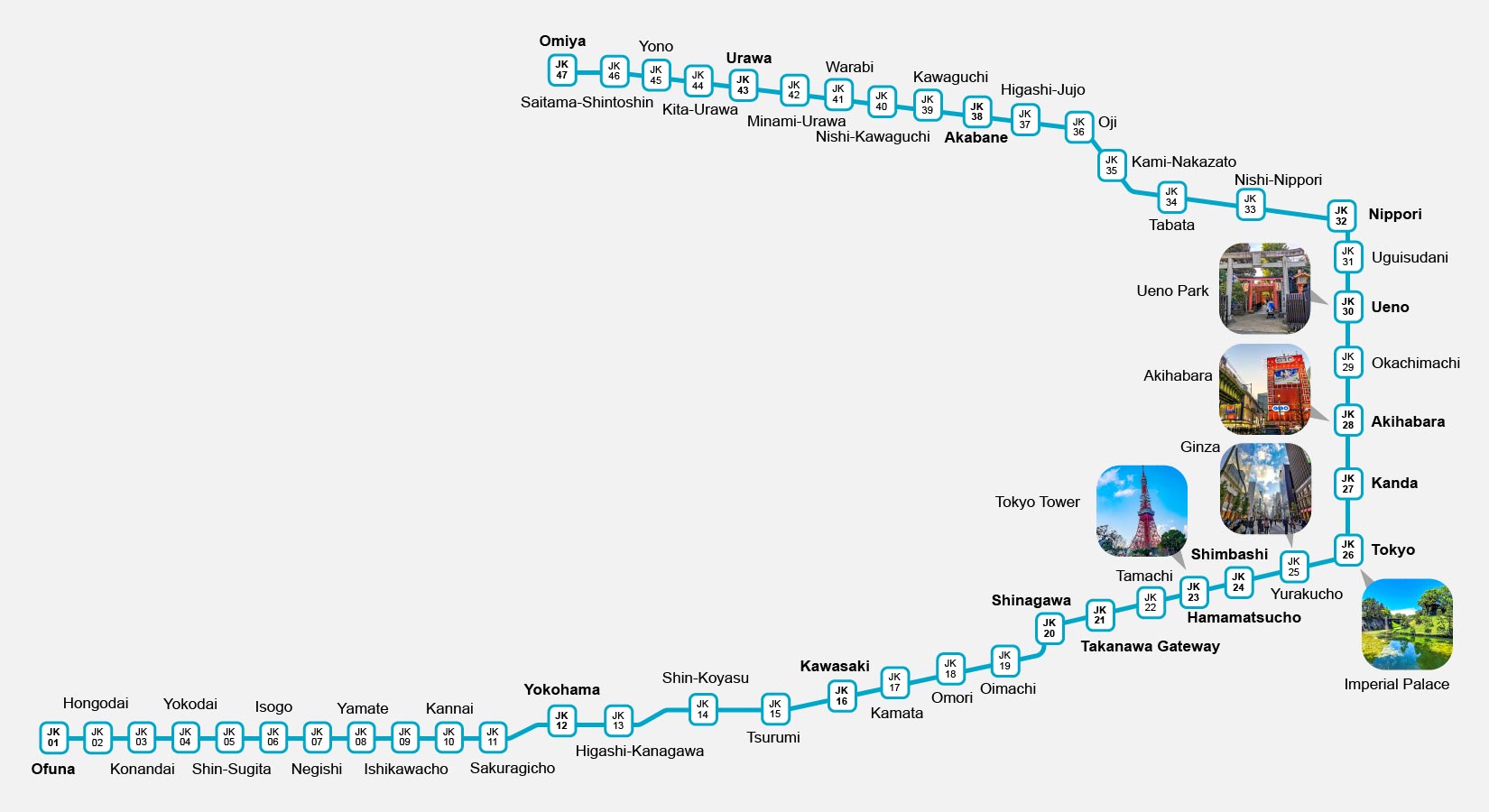
Main Stations of Keihin-Tohoku Line (Click to See the Entire Route Map)
|
Introduction to the Major Stations
JK12 Yokohama StationNearby attractions: Minato Mirai 21
You can transfer to:
(1) JR Lines: Tokaido Main Line, Yokosuka Line, Shonan-Shinjuku Line, Ueno-Tokyo Line
(2) Private Railways: Tokyu Toyoko Line, Keikyu Main Line, Sotetsu Main Line
JK20 Shinagawa Station
Nearby attractions: Sengakuji Temple, Maxell Aqua Park Shinagawa
You can transfer to:
(1) Shinkansen trains to various destinations
(2) JR Lines: Yamanote Line, Tokaido Line, Yokosuka Line
(3) Private Railways: Keikyu Main Line
(4) Other: Tokyo Monorail
JK23 Hamamatsucho Station
Nearby attractions: Tokyo Tower, World Trade Center Building
You can transfer to:
(1) JR Lines: Yamanote Line
(2) Subway: Toei Asakusa Line, Toei Oedo Line
(3) Others: Tokyo Monorail

JK24 Shimbashi Station
You can transfer to:
(1) JR Lines: Yamanote Line, Tokaido Line, Yokosuka Line
(2) Subway: Ginza Line, Toei Asakusa Line
(3) Private Railways: Yurikamome Line
JK25 Yurakucho Station
Nearby attractions: Ginza, Hibiya Park
You can transfer to:
(1) JR Lines: Yamanote Line
(2) Subway: Yurakucho Line, Hibiya Line, Chiyoda Line, Toei Mita Line
JK26 Tokyo Station – An Important Transport Hub
Nearby attractions: First Avenue Tokyo Station, Imperial Palace, Marunouchi, Nihonbashi
You can transfer to:
(1) Shinkansen trains to various destinations
(2) JR Lines: Yamanote Line, Chuo Line (Rapid), Keiyo Line, Ueno-Tokyo Line, Tokaido Line, Yokosuka Line, Sobu Rapid Line
(3) Subway: Marunouchi Line
JK27 Kanda Station
You can transfer to:
(1) JR Lines: Yamanote Line, Chuo Line (Rapid)
(2) Subway: Ginza Line
JK28 Akihabara Station
Nearby attractions: Mecca for Anime and Video Games, Electronics Shopping Paradise
You can transfer to:
(1) JR Lines: Yamanote Line, Chuo-Sobu Line
(2) Subway: Hibiya Line
(3) Private Railways: Tsukuba Express
JK29 Okachimachi Station
You can transfer to:
(1) JR Lines: Yamanote Line
(2) Subway: Hibiya Line, Ginza Line, Toei Oedo Line
JK30 Ueno Station
Nearby attractions: Ameyoko, Ueno Park, Ueno Zoo, Tokyo National Museum
You can transfer to:
(1) Shinkansen trains to various destinations
(2) JR Lines: Yamanote Line, Utsunomiya Line, Takasaki Line, Joban Line
(3) Subway: Ginza Line, Hibiya Line
(4) Private Railways: Keisei Main Line
JK32 Nippori Station
Nearby attractions: Yanaka Ginza
You can transfer to:
(1) JR Lines: Yamanote Line, Joban Line
(2) Private Railways: Keisei Main Line
(3) Other: Nippori–Toneri Line
JK36 Oji Station
Nearby attractions: Asukayama Park, Oji Shrine
You can transfer to:
Subway: Namboku Line
JK38 Akabane Station
Nearby attractions: Akabane Hachiman Shrine
You can transfer to:
(1) JR Lines: Shonan-Shinjuku Line, Utsunomiya Line, Takasaki Line, Saikyo Line
(2) Subway: Namboku Line
JK47 Omiya Station
Nearby attractions: Railway Museum, Omiya Bonsai Art Museum
You can transfer to:
(1) Shinkansen trains to various destinations
(2) JR Lines: Utsunomiya Line, Takasaki Line, Saikyo Line, Shonan-Shinjuku Line, Kawagoe Line, Ueno-Tokyo Line
(3) Private Railways: Tobu City Park Line, New Shuttle
Operating Hours & Train Frequencies
The trains on the Keihin-Tohoku Line operate from approximately 4:30 to 24:00. Generally, during morning and evening rush hours, trains run every 2 to 5 minutes; during other regular daytime hours, trains run every 5 to 10 minutes; and in the early morning and late at night, trains run every 10 to 15 minutes.Train Types
There are two types of trains operating on the Keihin-Tohoku Line, but at totally different times:
 Local Trains
Stops: Stops at every station
Rapid TrainsOperating Hours: Approximately 10:30–15:30
Stops:
(1) Weekdays: All stations except Nishi-Nippori, Nippori, Uguisudani, Otsucho, Yuyakucho, and Shimbashi.
(2) Weekends and holidays: All stations except Nishi-Nippori, Nippori, Uguisudani, Yuyakucho, and Shimbashi.
Fare
Fares for the trains on the Keihin-Tohoku Line are based on the distance traveled, with a starting fare of JPY160 (USD1). For your reference, the fare for the entire route from Ofuna to Omiya is JPY1,410 (USD8.7). The pricing rules are the same for both local and rapid trains.Tips
1. The Keihin-Tohoku Line is one of Tokyo’s most crowded railway lines, especially the section between Ueno and Akihabara during rush hours from 07:30 to 09:00 and 17:30 to 19:00. If possible, you are recommended to avoid riding the Keihin-Tohoku Line during these hours.2. Please note that there are some section trains on this line. Generally, the final stop of each train will be displayed on the electronic signs at the platform, announced over the PA system, and shown on the electronic signs on the train cars. Be sure to check carefully before boarding.