


- Narita Airport
- Haneda Airport
- JR Trains
- Subway
- Private Rails
- City Bus
- Sightseeing Bus
- Taxi
- Highway Bus
- Suica Card
- PASMO Card
- Shinjuku Station
- Transport Passes
- Haneda Airport to Tokyo City
- Narita Airport to Tokyo
- Narita Airport to Haneda Airport
- Travel from Tokyo to Kyoto
- Travel from Tokyo to Osaka
- Travel from Tokyo to Nara
Chuo Line (Rapid)
The Chuo Line (Rapid), with the line symbol JC, is an important JR line that connects downtown Tokyo with the western surrounding areas. To be specific, the outbound trains depart from bustling Tokyo Station toward tranquil and natural Takao Station, with some special services continuing on to Otsuki Station, an important stopover on the way to Mount Fuji; the inbound trains depart from Takao Station toward Tokyo Station. The trains on the line stop only at the major stations, especially in the city center, like Tokyo Station, Kanda Station, Ochanomizu Station, Yotsuya Station, Shinjuku Station, and Nakano Station, and there are only 24 stations along its about 53-kilometer (33-mile) route. As a result, they run fast and are ideal choices for travelers in a hurry, transferring to the Shinkansen, or heading to Mount Takao.
The line’s representative color is orange: on the one hand, the trains have iconic orange stripes; on the other hand, the line is clearly marked in orange on official route maps, station signs, and platform signage.
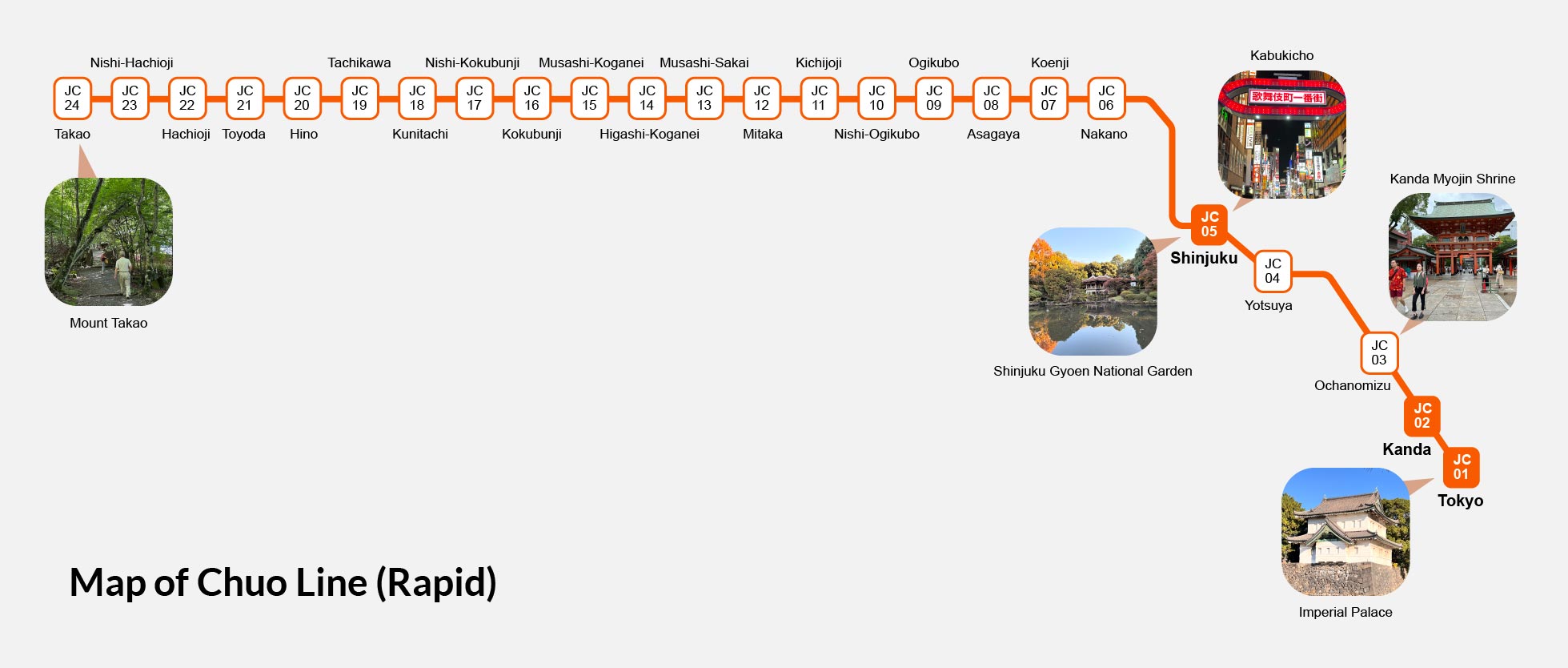
Main Stations of Chuo Line Rapid (Click to See the Entire Route Map)
|
Introduction to the Major Stations
JC01 Tokyo Station – An Important Transport Hub
Nearby attractions: First Avenue Tokyo Station, Imperial Palace, Marunouchi, Nihonbashi
You can transfer to:
(1) Shinkansen trains to various destinations
(2) JR Lines: Yamanote Line, Keihin-Tohoku Line, Keiyo Line, Ueno-Tokyo Line, Tokaido Line, Yokosuka Line, Sobu Rapid Line
(3) Subway: Marunouchi Line
JC02 Kanda Station
Nearby attractions: Yushima Seido
You can transfer to:
(1) JR Lines: Yamanote Line, Keihin-Tohoku Line
(2) Subway: Ginza Line

JC03 Ochanomizu Station
Nearby attractions: Kanda Myojin Shrine, Holy Resurrection Cathedral, Yushima Seido, Hijiri-bashi Bridge
You can transfer to:
(1) JR Lines: Chuo-Sobu Line
(2) Subway: Marunouchi Line
JC04 Yotsuya Station
Nearby attractions: Suga Shrine, State Guest House Akasaka Palace
You can transfer to:
(1) JR Lines: Chuo-Sobu Line
(2) Subway: Marunouchi Line, Namboku Line
JC05 Shinjuku Station – An Important Transport Hub
Nearby attractions: Kabukicho, Shinjuku Gyoen National Garden, Tokyo Metropolitan Government Building Observation Deck
You can transfer to:
(1) JR Lines: Yamanote Line, Saikyo Line, Shonan-Shinjuku Line, Narita Express
(2) Subway: Marunouchi Line, Toei Shinjuku Line, Toei Oedo Line
(3) Private Railways: Odakyu Line, Keio Line
JC06 Nakano Station
Nearby attractions: Nakano Broadway, Nakano Sun Mall
You can transfer to:
(1) JR Lines: Chuo-Sobu Line
(2) Subway: Tozai Line
JC07 Koenji Station
Nearby attractions: Koenji Junjo Shotengai, Nakadori Shopping Street, Kisho Shrine
You can transfer to:
JR Lines: Chuo-Sobu Line
JC11 Kichijoji Station
Nearby attractions: Inokashira Park, Harmonica Yokocho
You can transfer to:
(1) JR Lines: Chuo-Sobu Line
(2) Private Railways: Keio Inokashira Line
JC12 Mitaka Station
Nearby attractions: Ghibli Museum
You can transfer to:
JR Lines: Chuo-Sobu Line
JC16 Kokubunji Station
Nearby attractions: Tonogayato Garden
You can transfer to:
(1) JR Line: Musashino Line
(2) Private Railways: Seibu Kokubunji Line, Seibu Tamako Line
JC19 Tachikawa Station
Nearby attractions: Showa Memorial Park
You can transfer to:
JR Lines: Ome Line, Nambu Line
JC22 Hachioji Station
Nearby attractions: Hachioji Yume Art Museum, Mount Takao
You can transfer to:
(1) JR Lines: Yokohama Line, Hachiko Line
(2) Private Railways: Keio Line
JC24 Takao Station
Nearby attractions: Mount Takao, Takao Baigo, Keio Takaosan Onsen / Gokuraku-yu
You can transfer to:
Private Railways: Keio Takao Line
Operating Hours & Train Frequencies
From Tokyo Station: 04:38-24:06
From Takao Station: 04:27-24:13
Trains run very frequently, with one every 2–4 minutes during peak hours and approximately every 4–6 minutes during off-peak hours.
Train Types and Fares
The types of trains operating on the Chuo Line (Rapid) include:
(1) Rapid: On weekdays, these trains stop at all 24 stations listed above; on Saturdays, Sundays, and other holidays, they do not stop at Koenji, Asagaya, and Nishi-Ogikubo.
(2) Commuter Rapid: They only run during the morning and evening rush hours on weekdays, and they don’t stop at Koenji, Asagaya, Nishi-Ogikubo, Musashi-Sakai, Higashi-Koganei, Musashi-Koganei, Nishi-Kokubunji, and Kunitachi.
(3) Chuo Special Rapid: Stops include only Tokyo, Kanda, Ochanomizu, Yotsuya, Shinjuku, Nakano, Mitaka, Kokubunji, Tachikawa, Hino, Toyota, Hachioji, Nishi-Hachioji, and Takao. They stop at many fewer stations than the rapid trains and thus travel at a much faster speed.
(4) Ome Special Rapid: They stop only at Tokyo, Kanda, Ochanomizu, Yotsuya, Shinjuku, Nakano, Mitaka, Kokubunji, and Tachikawa in the Chuo Line. After Tachikawa, it switches to the Ome Line.
(5) Commuter Special Rapid: Also operated only during the rush morning and evening hours of weekdays, the trains have just 9 stations: Tokyo, Kanda, Ochanomizu, Yotsuya, Shinjuku, Kokubunji, Tachikawa, Hachioji, and Takao.
Although the trains listed above vary in speed and stops, their fare structure is the same - it is calculated based on distance. Generally, the starting fare is JPY160 (USD1). For reference, the fare from Tokyo Station to the popular Shinjuku Station is JPY260 (USD1.6), and the fare from Tokyo Station to Takao Station is around JPY1,040 (USD6.4).
How to Take Trains of Different Types on the Chuo Line (Rapid)?
Trains in Japan run strictly according to the schedules, so all you need to do is check the departure time for the type of train you plan to take in advance and board the train according to the time. However, it’s still a good idea to carefully double-check related information before boarding by reading the electronic display on the train.
Green Car
Some trains on the Chuo Line (Rapid) have several green cars providing more comfortable services. These double-decker cars are equipped with more spacious seats, free Wi-Fi, and power outlets at every seat. Naturally, these cars are more expensive: in addition to the basic fare mentioned above, passengers will pay surcharges for the green cars: JPY1,010 (USD6.3) for distances up to 50 kilometers (31 miles), and JPY1,260 (USD7.8) for distances between 50 and 100 kilometers (31-62 miles). This means that even if you have an IC card such as SUICA or PASMO or have already purchased a ticket to enter the station, you still need to buy a separate green car ticket from an automated ticket machine if you want to ride in these cars. Besides, seats in the green cars are not assigned.
The green cars are marked with a green four-leaf clover symbol on the exterior, making it easy for passengers to locate them. If you intended to ride in a standard-class car but accidentally boarded a green car, you’ll need to pay the difference or move to a standard-class car.
Tips
1. The JC Line is one of the fastest routes connecting Shinjuku and Tokyo, the city’s two major hubs. By the JC Line, the entire journey between the two stations takes less than 15 minutes, whereas about 32 minutes by the Yamanote Line.
2. At some stations, such as Tachikawa Station, limited express trains, which are very fast but expensive, also stop at the same platform as the trains of the Chuo Line (Rapid). These limited express trains only share a short section of track with the Chuo Line trains, and their overall routes are not exactly the same. Be sure not to get on these trains by mistake to avoid paying more or even failing to end up at the destination you intended. The easiest way to tell them apart is that limited express trains do not have orange decorative stripes.
3. Please note that some trains on this line are shuttle services, so be sure to check the electronic display of the train before boarding to avoid getting on the wrong train. For example, the “Rapid Tachikawa” is a train that stops at all stations along the route and terminates at Tachikawa but not at Takao.
4. The Chuo Line Rapid trains can get very crowded during rush hour - from 7:00 to 9:00 and from 18:00 to 20:00.