


- Narita Airport
- Haneda Airport
- JR Trains
- Subway
- Private Rails
- City Bus
- Sightseeing Bus
- Taxi
- Highway Bus
- Suica Card
- PASMO Card
- Shinjuku Station
- Transport Passes
- Haneda Airport to Tokyo City
- Narita Airport to Tokyo
- Narita Airport to Haneda Airport
- Travel from Tokyo to Kyoto
- Travel from Tokyo to Osaka
- Travel from Tokyo to Nara
Tokyo Transportation
Tokyo has an extremely well-developed transportation system, making it very convenient for you to get to and get around the city.Specifically, there are two airports: Haneda Airport and Narita Airport, allowing travelers to enter and exit the city quickly and conveniently. There are also the Shinkansen and highway buses, which can help passengers travel between Tokyo and other cities in Japan. When traveling around Tokyo, these forms of transportation can fulfill nearly all your needs: JR ordinary trains, which connect major hubs within and near the city; subways, which primarily run in the downtown areas and cover some of the major hubs also served by the JR ordinary trains and exact neighborhoods, commercial districts, and attractions not served by the JR ordinary trains; private railways, which mainly take passengers to some certain prefectures near Tokyo like Hakone; buses, which can reach niche spots of the city; and taxis, the flexible but expensive choice. Generally speaking, a single SUICA or PASMO card can help you easily and efficiently pay for most forms of public transportation.

How to Get to Tokyo?
For most visitors, the primary way to get to Tokyo is to fly into one of its two major airports: Narita International Airport or Haneda Airport, also known as Tokyo International Airport.Narita International Airport is Tokyo’s main international hub, boasting an extensive global flight network: it connects to over 18 cities within Japan and 100 cities worldwide. Moreover, Narita serves as the primary destination of Tokyo for long-haul flights from Europe, the Americas, and Australia. However, this airport is about 60 kilometers (37.3 miles) from the city center and takes at least an hour to reach by public transportation. Many tourists joke that NRT, the airport code for Narita International Airport, stands for “Not Really Tokyo”.
Haneda Airport, on the other hand, connects to approximately 37 airports within Japan and 48 cities worldwide. It primarily serves domestic routes and short-haul international routes within Asia, with relatively fewer flights from Europe and the Americas. Haneda is very close to downtown Tokyo, just 15–20 kilometers (9.3–12.4 miles) away, and can be reached in as little as 20 minutes by public transportation.
If you are traveling to Tokyo from other parts of Japan, such as Osaka or Nagoya, the Shinkansen is a very convenient option, while the highway bus is a budget-friendly choice. Of course, you can also opt for the ferry, which offers a more unique experience.
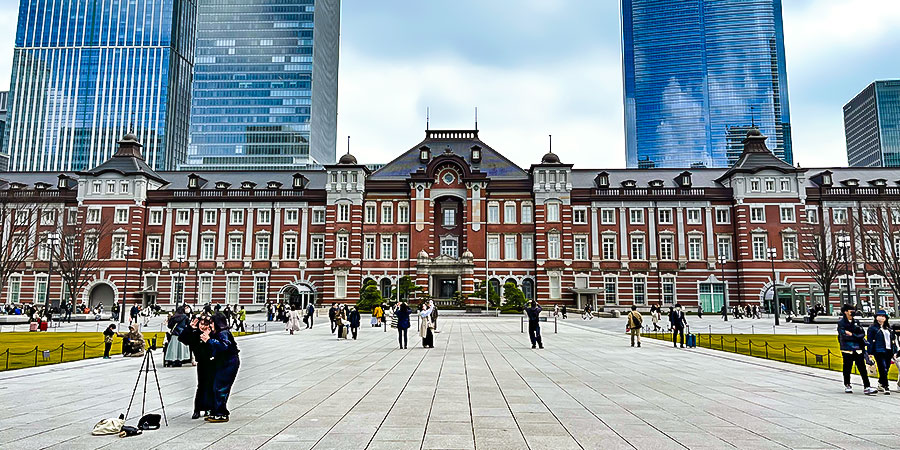
Tokyo Station
|
Read More:
How to Travel around Tokyo?
As mentioned above, Tokyo has extensive public transportation networks that are convenient for visitors to travel around, including the most commonly used three forms of JR ordinary trains, subways, and private railways, as well as less frequently used but equally convenient and well-developed two forms of buses and taxis.JR Ordinary Trains, Subways, and Private Railways – Meeting Most of Your Travel Needs
JR ordinary trains, subways, and private railways are operated by different companies, but in practice, they work together to form a comprehensive rail network covering downtown Tokyo and its surrounding areas, allowing visitors to easily reach various attractions in central Tokyo, such as the Imperial Palace and Akihabara, as well as destinations outside but near Tokyo, like Hakone and Nikko.The networks of JR ordinary trains serve as the backbone of the city’s public transportation system:
(1) The networks cover most major hubs of Tokyo. To be specific, among the more than 30 lines, the most important and frequently used one is the yellow-and-green Yamanote Line, which circles the city center, connecting comprehensive districts such as Shinjuku, Shibuya, Tokyo, Ueno, Ikebukuro, and Akihabara - areas that combine transportation hubs and shopping and entertainment centers.
(2) Some lines cross through the city and even stretch from downtown Tokyo to surrounding prefectures. For instance, there are the Chuo Line (Rapid) and Chuo-Sobu Line, which run east to west across the entire city of Tokyo; the Keihin-Tohoku Line, which runs through Tokyo and the surrounding areas of Yokohama and Kamakura; the Saikyo Line, which connects Tokyo directly to Kawagoe and Japan’s largest railway museum located in Tokyo’s nearby Saitama Prefecture; and the Keiyo Line, which provides direct access to the Tokyo Disney Resort in Chiba Prefecture…
For downtown visits, JR ordinary trains and subways will be your main transportation options. Inside and around the Yamanote loop Line , in other words, around the central part of Tokyo, there are a total of 13 subway lines operated by two companies: Tokyo Metro and Toei Subway. While JR ordinary trains allow passengers to quickly travel from one central area or hub in downtown Tokyo to another, the subway is an essential means of transportation for exploring specific finer locations within or near that area or hub. For example, if you want to visit Senso-ji Temple or Omotesando, which are deep in the city, the subway is a must.
If you’d like to further explore the surrounding areas of Tokyo, JR ordinary trains and private railways will work together. On the one hand, as mentioned above, JR ordinary trains operate on some routes to surrounding areas such as Yokohama and Kamakura. On the other hand, Tokyo’s private railways specialize in serving destinations in Tokyo’s surrounding regions, such as Hakone, Nikko, and Kawagoe. Furthermore, many of these private railways depart from major hub stations like Shinjuku, Shibuya, and Ikebukuro, making them extremely convenient.
 Tip: The only thing to keep in mind is that JR lines, Tokyo Metro lines, Toei Subway lines, and each private railway line are operated by different companies, so you’ll need to exit the station and re-enter when transferring.
Read More:
JR Ordinary Trains: Yamanote Line (JY), Chuo Line (Rapid), Chuo-Sobu Line, Keihin-Tohoku Line (JK), Saikyo Line, Keiyo Line
Lines of Tokyo Subway, Guide for Taking the Tokyo Subway
Buses - A Less Commonly Used Mode of Transportation
During downtown sightseeing, buses, with lower speed, are used primarily as a supplement to JR ordinary trains and subways, or for specific purposes. There are four main types of buses you might use.(1) Tokyo City Buses: They are also called Toei buses. With routes that cover the entire city, they are the most commonly used bus type in Tokyo. Sometimes, by city buses, you can travel between the subway station and your final destination more conveniently and quickly.
(2) Sightseeing Buses: Designed specifically for tourists, these buses are typically open-top and come in two types: hop-on/hop-off and fixed-route. They offer a convenient, efficient, and relaxed way to visit multiple attractions such as Tokyo Tower, Ginza, Odaiba, Asakusa, and Tokyo Skytree.
(3) Free Shuttle Buses: These buses allow you to travel freely within commercial areas, such as the central business districts between Tokyo Station, Marunouchi, Yurakucho, and Otemachi.
(4) Community Buses: They can reach various finer locations in some specific administrative districts, such as Shinjuku Ward, Minato Ward, Chuo Ward, and Koganei City.
Read More:
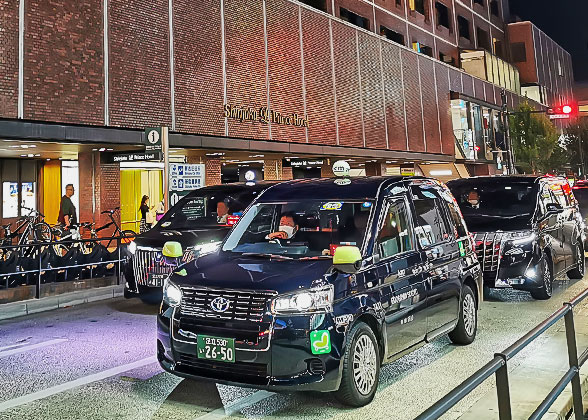
Taxi in Tokyo
|
Taxis – A Convenient but Expensive Option
Taxis in Tokyo are clean and offer excellent service, but you should be aware that they are much more expensive than other transportation tools:The fare is JPY500 (USD3) for the first 1.096 km (0.6 miles), with an additional JPY100 (USD0.6) for every 255 meters (837 feet) thereafter. Additionally, you will be charged extra for time lost due to traffic congestion or other delays. If you take a taxi between 22:00 and 05:00, a 20% surcharge will apply. For example, a taxi ride from Narita Airport to downtown Tokyo costs about JPY20,000 (USD125) to JPY35,000 (USD218).
How to Pay for Public Transportation in Tokyo?
Of course, you can use cash to purchase tickets for the Shinkansen, JR local trains, subways, private railways, buses, and taxis. However, to make things easier for you or help you save money, the following payment methods are introduced:IC Cards - The Most Efficient and Convenient Payment Method
IC cards are currently the most convenient way to pay for public transportation, with SUICA and PASMO being the top choices for getting around Tokyo. With these cards, you can quickly and easily tap to ride JR ordinary trains, subways, private railways, buses, and some taxis. In addition, you can even use them at convenience stores, vending machines, and lockers. They are also easy to obtain: you can purchase them at ticket machines or ticket counters at Tokyo’s airports, JR stations, and subway stations. Alternatively, iPhone users can add an e-card of SUICA or PASMO directly to their Apple Wallet and top up using Apple Pay, eliminating the need to purchase a physical card.
|
|
|
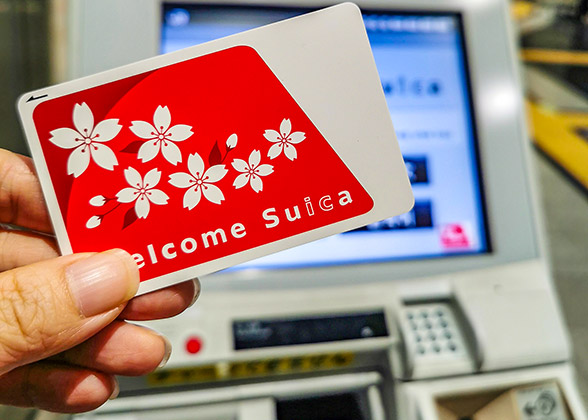
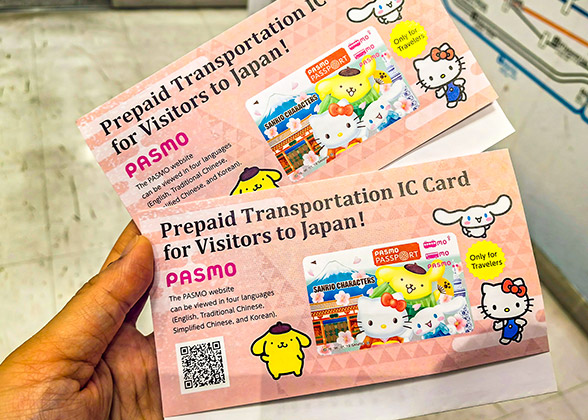
There is also a reminder for you: If Tokyo isn’t your first stop in Japan and you’ve already visited the Kansai region and purchased an ICOCA card, you can use that card in Tokyo directly instead of buying a SUICA or PASMO card. Simply put, these three cards have the same used areas, and the only difference is that SUICA and PASMO are sold in the Kanto region, while ICOCA is sold in the Kansai region.
Read More: SUICA Card and PASMO Card
Passes – Budget-Friendly but with Complex Rules
Generally speaking, a pass is a money-saving card for transportation. You pay a fixed amount upfront and can then use one or more specified modes of transportation within a specified period. Once you exceed a certain number of rides, you can make your money back. Subways, JR trains, etc., all offer their own passes.
Keep in mind that passes usually have restrictions on the modes of transportation, the areas, and the validity periods. If your itinerary calls for the use of multiple modes of transportation or crossing multiple zones, you may need to carefully calculate and plan your route to get your money’s worth. Furthermore, you might end up deliberately avoiding more time-efficient or convenient options just to use the modes included in your pass, ultimately wasting time and energy. In summary, travel passes aren’t suitable for all visitors but are only best suited for those with highly concentrated itineraries and who rely heavily on specific modes of transportation.
Read More: Tokyo Transport Pass