

Mount Fuji – the Holy Mountain in Japan
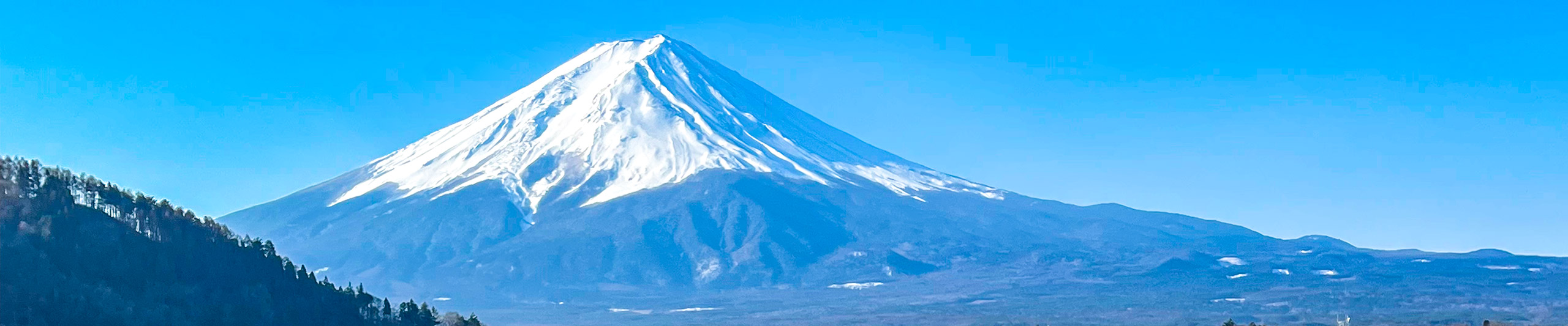
Mount Fuji, one of Japan’s most iconic landmarks, is widely welcomed by visitors due to its nearly perfect conical shape with the iconic snow-capped peak, and its significant role in Japanese culture. At 3,776 meters (12,388 feet) above sea level, this active volcano is Japan’s highest peak. Located 80 kilometers (50 miles) east of Tokyo, it straddles Shizuoka and Yamanashi Prefectures.You can either admire Mount Fuji from a distance for its full when the weather is clear or take on the challenge of climbing it during the official climbing season.
What Is Mount Fuji and Why Is It Famous
Mount Fuji Photos ( 20
 ) )
|
Mount Fuji’s unique natural beauty and profound cultural significance are what make it so popular with tourists and well worth a visit:
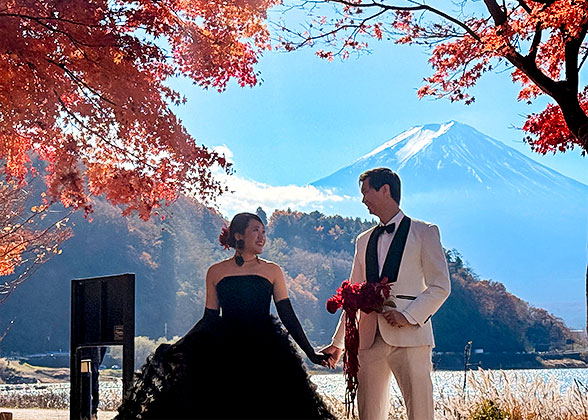
On the one hand, Mount Fuji is a perfectly symmetrical conical active volcano whose summit is covered in snow most of the year - a feature that is quite rare worldwide. Mount Fuji harmonizes beautifully with its surroundings, such as cherry blossoms, autumn foliage, and lakes. On the other hand, it is regarded as a holy site where deities dwell in Japanese culture, with sengen shrines built both at its summit and at its base for worship. Besides, it was inscribed on the UNESCO World Heritage List in 2013.
Enjoying Mount Fuji from a Distance
Viewing Mount Fuji from a distance is actually more popular than climbing it, because only from a distance can you appreciate its full silhouette. Moreover, visiting Mount Fuji from a distance requires no physical exertion and is suitable for visitors of all ages.

Where Can I See Mount Fuji
There are many places to view Mount Fuji, but the distance and viewing angles vary.
1. The Fuji Five Lakes, Arakurayama Sengen Park, Oshino Hakkai Springs, and Fuji-Q Highland of Yamanashi Prefecture, located at the northern foot of Mount Fuji, provide a close view of the mountain in full.
2. From various locations, including the Izu Peninsula, Nihondaira and Miho Matsubara of Shizuoka City, Fujinomiya City, Fuji City, and Gotemba City, in Shizuoka Prefecture situated at the southern foot of Mount Fuji, you can also see Mount Fuji from a relatively close distance.
3. A little further away, you can view Mount Fuji at locations such as Lake Ashi in Hakone, Enoshima in Kamakura, and Minato Mirai 21 in Yokohama, all in Kanagawa Prefecture.
4. At high-rise buildings in Tokyo, such as the Tokyo Metropolitan Government Building, Roppongi Hills Mori Tower, Tokyo Tower, and Tokyo Skytree, you may catch a glimpse of a small part of Mount Fuji on clear days.
5. Mount Fuji will come into view for several minutes along the Tokaido Shinkansen between Mishima and Shizuoka Stations. When traveling toward Tokyo, Mount Fuji will appear on your left, and when departing from Tokyo, it will appear on your right.
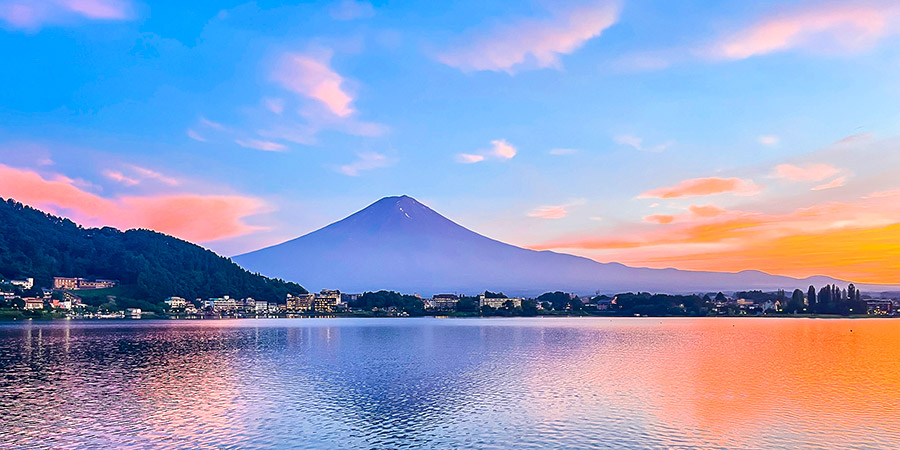
Distant View of Mt. Fuji
|
Top Locations to See Mount Fuji
Of the destinations mentioned above, the Fuji Five Lakes area and the Hakone area are the most popular. In Specific:
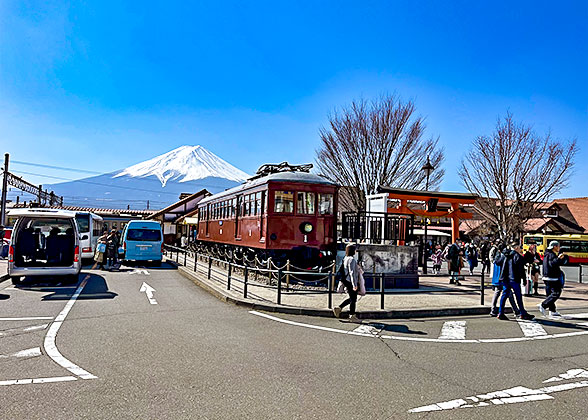
1. Lake Kawaguchi: One of the Fuji Five Lakes, it is the most widely visited one because it provides convenient access, a relatively close and unobstructed view of Mount Fuji, and the opportunity to see the mountain reflected in water. Taking the Mt. Fuji Panorama Ropeway to the observation deck at Tenjoyama Park and getting the Lake Kawaguchi Sightseeing Boat to view Mt. Fuji are welcome.
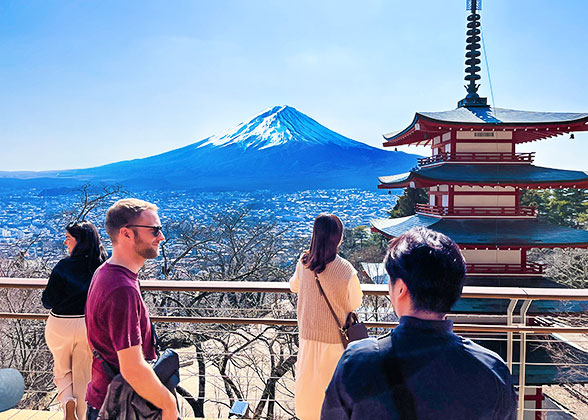
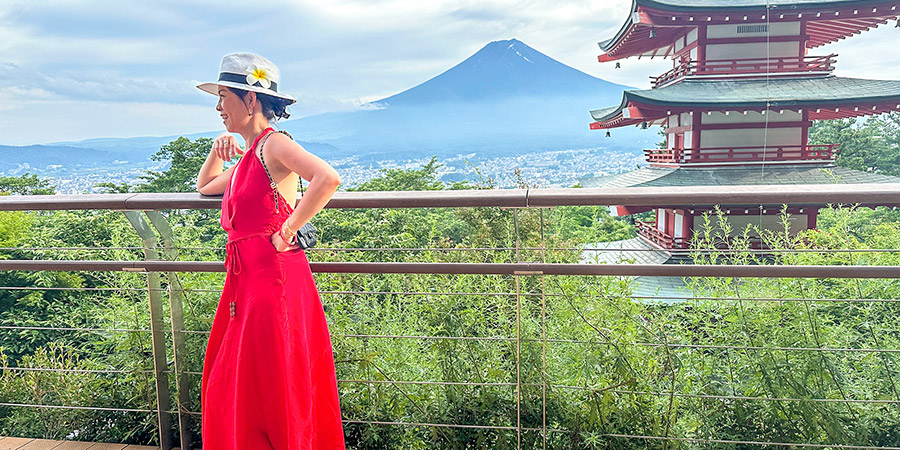
2. Arakurayama Sengen Park: Near Lake Kawaguchi, its observation deck is located on a high point halfway up a mountain and faces directly toward Mount Fuji, offering an excellent viewing point. Additionally, you can capture Mt. Fuji and the red Chureito Pagoda in a single frame, and sometimes even along with cherry blossoms or autumn foliage.
|
|
|
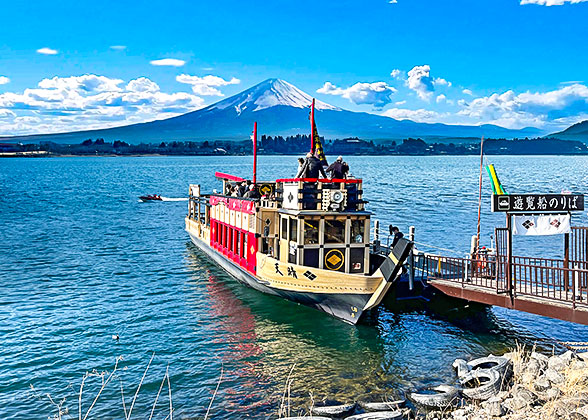
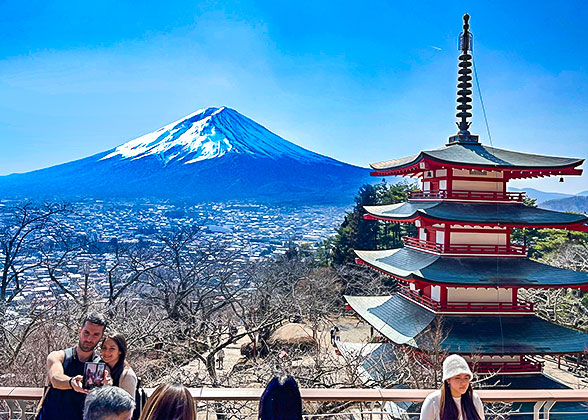
4. Oshino Hakkai Springs: Comprising eight crystal-clear ponds formed by meltwater from Mount Fuji, this location also features scenery of a traditional Japanese village. Located between Lake Kawaguchi and Lake Yamanaka, it can also provide you with a close view of Mt. Fuji. The pond waters can clearly reflect Mount Fuji on some sunny days.
5. Lake Ashi in Hakone: On clear days, you can take the Hakone Sightseeing Cruise shaped like a pirate ship or the Hakone Ropeway to enjoy distant views of Mount Fuji. Although it is farther from Mount Fuji than the previous attractions, it offers a wider range of travel experiences beyond viewing the mountain.
Read More:

Best Time to See Mount Fuji
Winter, from December through February, is the best time of year to see Mt. Fuji from a distance. On the one hand, the air is dry and crisp during this season, offering excellent visibility. On the other hand, the summit of Mount Fuji is covered in a thick blanket of snow during this period. If you don’t like cold weather, you might also consider visiting in the spring from March to May or autumn from September to November, though the chances of seeing Mount Fuji are a little bit lower and the snow-capped area is smaller than in winter. It’s worth noting that in early April, you can also see cherry blossoms, and in early November, you can enjoy autumn foliage with the mountain.
In a day, early morning, especially before 8:00, is the best time to view Mt. Fuji, regardless of the season. As the sun rises, moisture evaporates from the ground, causing clouds and mist to form more easily, which often obscures the mountain.
Read More:
Tips to See Mount Fuji
1. Whether you can see Mount Fuji depends heavily on the weather, so be sure to keep a close eye on weather and visibility forecasts throughout your trip so you can adjust your plans as needed.
2. Why is it not recommended to view Mount Fuji from a distance during the summer months of June through August? For one thing, the weather is unstable with much rain, leading to low visibility. For another, Mount Fuji has no snowcap in the summer and appears entirely dark gray.
Climbing Mount Fuji
If you love outdoor activities and are in good physical shape, climbing Mount Fuji will be an unforgettable experience. During the climb, you’ll pass through forests, across barren volcanic rock, and up to the treeless red-gravel summit. After reaching the top, you will be rewarded with a beautiful sea of clouds.
Mount Fuji during Climbing Season
|
Climbing Season
When can you climb Mount Fuji? Mt. Fuji is open for climbing only during specific periods, generally from early July to early September each year. An entry fee of JPY4,000 (USD24.5) is required.Climbing Routes
There are four routes for climbing Mount Fuji, all of which start from the 5th Station, located midway up the mountain at an elevation between 2,300 and 2,400 meters (7,546 and 7,874 feet).1. Yoshida Trail: With well-developed facilities and a relatively gentle trail, this route is the most suitable for beginners among the four and is also the most popular. The ascent and descent take about 6–7 hours and 3.5–5 hours, respectively.
2. Fujinomiya Trail: Although the distance is shorter, the gradient is steeper, so it is more suitable for those in good physical condition. The ascent takes about 5–7 hours, and the descent about 3–4 hours.
3. Subashiri Trail: It is less crowded and offers the most beautiful natural scenery, with forest vegetation and waterfalls along the way, but it is more challenging than the previous two. The ascent and descent need about 5–7 hours and 2–4 hours, respectively.
4. Gotemba Trail: It is long with some complex terrain and has few supply points, thus the most difficult one and suitable only for experienced climbers. The ascent takes about 8–9 hours, and the descent takes about 4 hours.
 Read More: Guide for Climbing Mount Fuji
How to Get to Mount Fuji Area from Tokyo
Get to Lake Kawaguchi from Tokyo
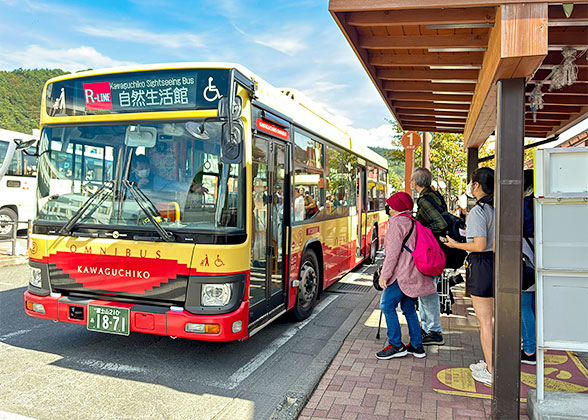
Highway Bus: Direct buses run from locations such as Shinjuku Express Bus Terminal and Tokyo Station to Kawaguchiko Station, with a travel time of about 2 hours. They run frequently, especially those setting off from Shinjuku, with 2-4 departures per hour from 7:00 to 21:00. Note that advance reservations are still required although there are frequent departures.JR Chuo Line and Fujikyu Railway Line: This option requires one transfer but is more flexible, since advance reservations are generally not required. Specifically, you’ll first take the Chuo Line from Tokyo to Otsuki Station, then transfer to the Fujikyu Railway Line to Lake Kawaguchi. The entire journey takes about 2 hours.
Fuji Excursion Train: This is the only limited express train that runs directly from central Tokyo to Lake Kawaguchi, in about less than 2 hours. However, there are 5 departures per day, only in the morning, so you’ll need to book well in advance.
Tip: Lake Kawaguchi has a relatively well-developed public transportation system, making it easy to reach other attractions around Mount Fuji. For example, you can take a bus from Lake Kawaguchi to Lake Yamanaka and Oshino Hakkai Springs, and choose between the Fujikyuko Line or a bus to Arakurayama Sengen Park.
|
|
|
Get to Hakone from Tokyo
Traveling from Tokyo to Hakone is extremely convenient, with a variety of transportation options to choose from, including express buses and trains of varying types. Overall, these options offer frequent service and can accommodate travel needs from different departure locations in Tokyo. Specifically, you can refer to: How to Get to Hakone from TokyoGet to Mt. Fuji 5th Station from Tokyo
The most direct way to get from Tokyo to the 5th Station of Mount Fuji is by highway bus, which sets off at Shinjuku Expressway Bus Terminal and takes about 2.5 hours. However, note that:(1) From May to June, there are only about two daily departures, all in the morning. During the hiking season from July through early September, the number of daytime departures increases to about four, all in the morning, and a late-night departure around 23:30 is added. From early September, when the hiking season ends, until April of the next year, this direct bus service is suspended.
(2) Tickets need to be booked about a month in advance, especially during the climbing season.
Or, you can also get to Lake Kawaguchi first by the methods mentioned above and then transfer to a bus heading up the mountain. The buses from Lake Kawaguchi to Mt. Fuji 5th Station operate from about 6:40 to 17:40 with 12 departures per day during the climbing season, run less frequently from May to July, and are also out of service from early September to next April.
How Much Time Is Needed for Mount Fuji Viewing and Climbing
For viewing Mount Fuji from a distance: You are highly recommended to set aside two days and one night. This will allow for a more leisurely trip and give you a higher chance of seeing Mount Fuji. A one-day trip is possible, but only if you travel from Tokyo to relatively accessible destinations like Lake Kawaguchi or Hakone and get up quite early. Besides, for a one-day trip, your schedule will be really tight - after all, the round trip alone takes about 4–6 hours.
For climbing Mount Fuji: You’ll typically need two days and one night, since the entire round trip takes at least 8–9 hours. On the first day, hike to a mountain hut halfway up the mountain and then have a rest. During the wee hours of the second day, set out again to reach the summit for a beautiful sunrise.
Mt. Fuji Photos & Mt. Fuji Videos