

Lake Kawaguchi
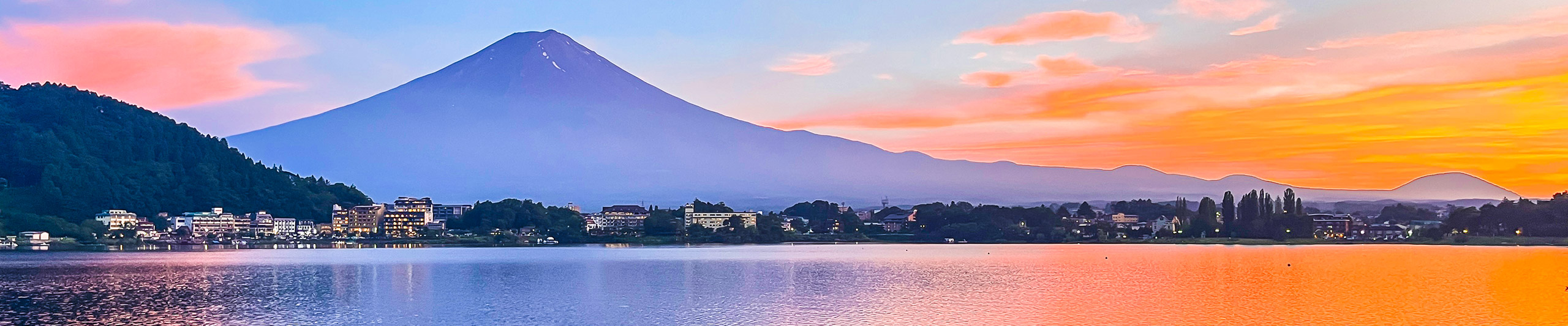
Located on the northern side of Mount Fuji, Lake Kawaguchi is one of the Fuji Five Lakes and the most popular among them and even among all the attractions near Mount Fuji. First, it offers a superb view of Mount Fuji. Second, Lake Kawaguchi has quite many attractions, allowing you to enjoy a variety of enriching experiences. Furthermore, it has the best transportation access among the Fuji Five Lakes, making it convenient to reach from Tokyo and to travel to the other lakes of the Fuji Five Lakes and other attractions near Mount Fuji.
Read More: Mt. Fuji
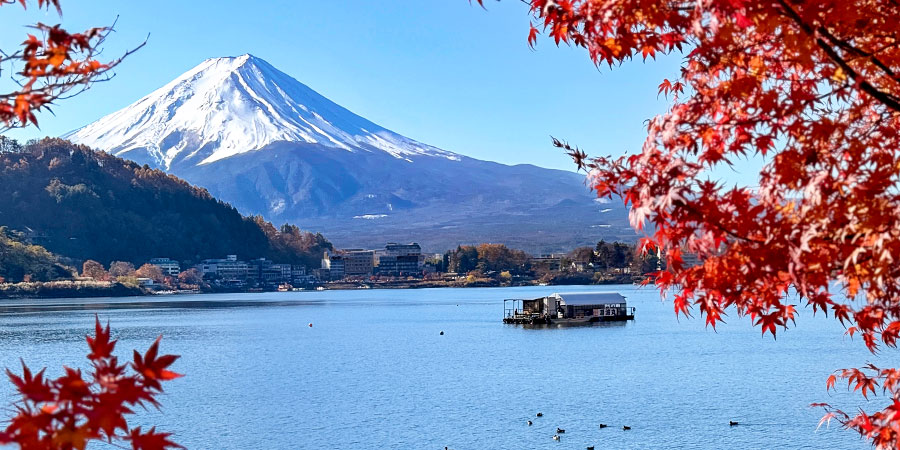
Mt. Fuji with Lake Kawaguchi in Autumn
|
Most Complete View of Mt. Fuji Can Be Seen from Lake Kawaguchi
Lake Kawaguchi is one of the best spots to view Mount Fuji.
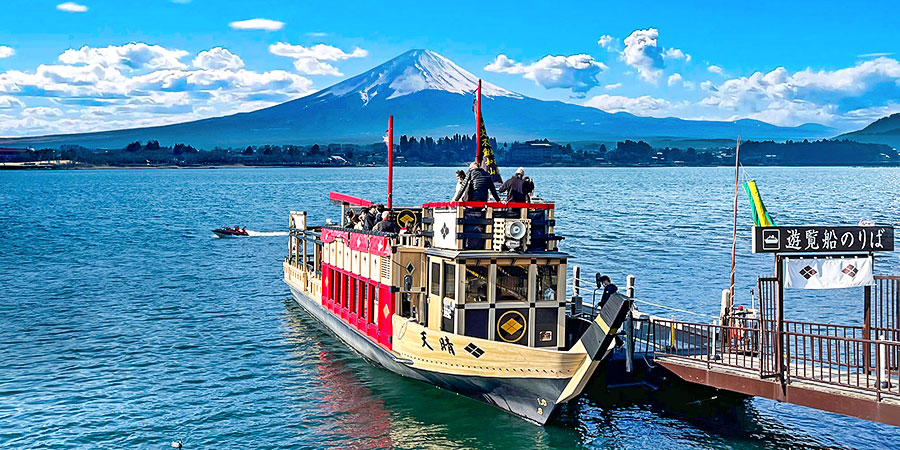
Lake Kawaguchi is approximately 13 kilometers (8 miles) away from Mount Fuji as the crow flies - neither too close nor too far; the lake’s surface has a gentle elevation difference with the base of Mount Fuji; and, Lake Kawaguchi faces the northern slope of Mount Fuji directly and stretches horizontally from east to west, making the entire northern shore of the lake running perpendicular to the mountain… All these factors allow you to see the complete conical silhouette of Mount Fuji from its base to its summit. In fact, it offers the most complete view of Mount Fuji among the Five Lakes.
Lake Kawaguchi Photos ( 26
 ) )
|
Furthermore, Lake Kawaguchi is one of the best spots to admire the “inverted Mount Fuji”: its surface is wide and calm on clear days, and you can see the entire mountain perfectly reflected in the blue and mirror-like waters from many points along its northern shore.
Main Attractions of Lake Kawaguchi
Lake Kawaguchi is not just a place to admire Mount Fuji. Parts of the spots offer great views of the Mount, while many others can provide you with a cultural journey.
|
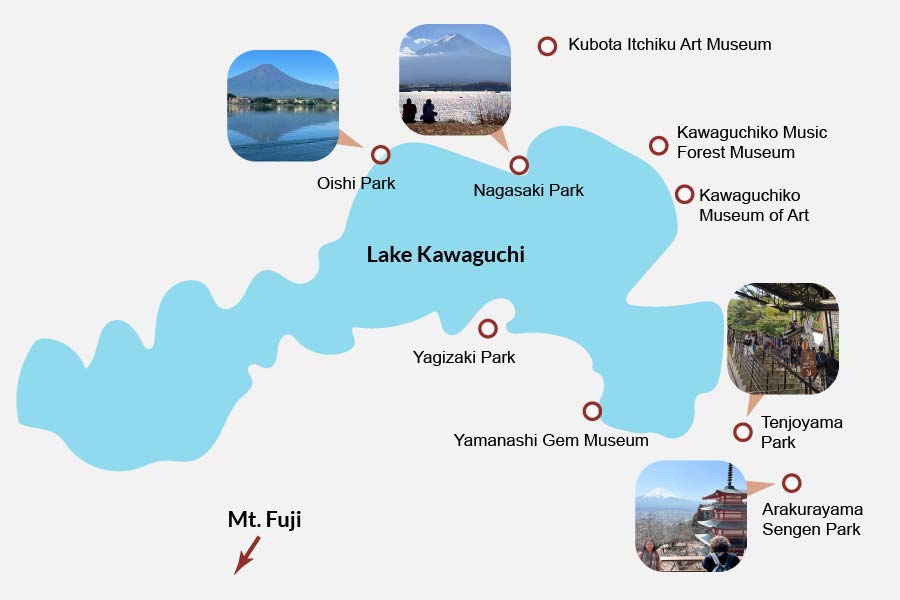
Top 5 Spots to Enjoy Mount Fuji around Lake Kawaguchi
1. Arakurayama Sengen Park with Chureito Pagoda
This is definitely one of the must-see attractions for many visitors to Mount Fuji. From the observation deck, you can see the spectacular Mount Fuji and the quintessentially Japanese-style architecture of the Chureito Pagoda share a frame. The park is beautiful year-round, but it’s most popular with visitors around April each year, when approximately 650 cherry trees are in full bloom. At that time, you’ll witness the iconic scene where snow-capped Mount Fuji, a sea of pink cherry blossoms, and the red pagoda create a harmonious contrast.
Additionally, the Arakura Fuji Sengen Shrine is located in the park. You can capture the view of Mount Fuji framed by its red torii gate.
Opening Hours: 24 hours a day, year-round
Admission: Free
Read More: Arakurayama Sengen Park
2. Oishi Park
Oishi Park is a quite famous attraction of Lake Kawaguchi because it perfectly blends the majestic Mount Fuji, colorful fields of flowers that change with the seasons, and the serene scenery of the lake:
(1) Oishi Park faces Mount Fuji directly and has a wide-open view that is completely unobstructed by any hills or buildings.
(2) It is the best spot for photographing the reflection of Mount Fuji on the surface of Lake Kawaguchi among the various attractions.
(3) The park features a lakeside promenade, lined with over 90 varieties of flowers that bloom in succession throughout the seasons, adding ever-changing scenery to the view of Mount Fuji in the distance.
 From April to June, cherry blossoms, tulips, rapeseed flowers, and butterfly flowers bloom here.
From late June to mid-July, Oishi Park is blanketed by vast fields of purple lavender.
From October to November, fiery red kochia can be seen together with Mount Fuji.
Tips
(1) Oishi Park is open 24 hours a day and 365 days a year. Its admission is free.
(2) Oishi Park is home to the Kawaguchiko Nature Living Center, which offers a wide selection of Mount Fuji-themed souvenirs, accessories, and food. From March through September, it is open from 9:00 to 17:45; from October through February, the closing time is moved up to 17:15.

3. Tenjoyama Park
Tenjoyama Park, or Tenjozan Park, is located at the summit of Mount Tenjoyama, one of the highest points in Kawaguchiko. The highlights of this attraction include 360-degree panoramic observation decks offering perfect views of Mount Fuji and the natural scenery of Lake Kawaguchi, the Mount Fuji Swing at an elevation of 1,075 meters (3,527 feet), the Bell of Tenjo, and the Rabbit Shrine.
|
|
|
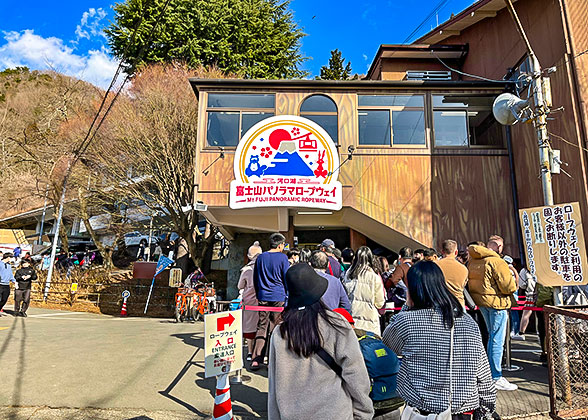
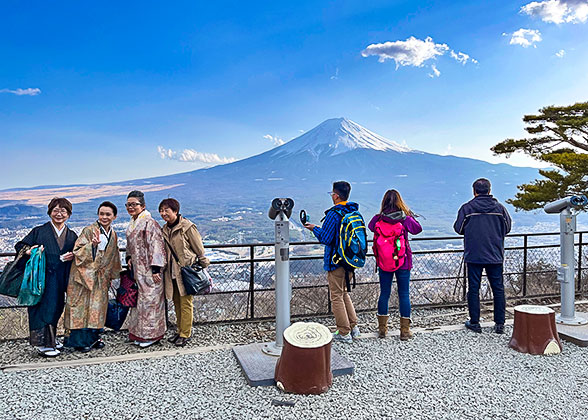
You can, of course, choose to hike up and down the mountain, and a one-way trip takes about 30 to 40 minutes. However, the Mt. Fuji Panorama Ropeway is highly recommended and very popular among tourists, and it takes you directly from the lakeshore to the park at the summit in about 3 minutes.
Mt. Fuji Panorama Ropeway
| Periods | Opening Hours |
|
July 20-August 31 |
8:30-18:00, last descent at 18:20 |
|
Other Times |
8:30-17:00, last descent at 17:20 |
Fare: JPY600 (USD3.7) for a one-way adult ticket, JPY1,000 (USD6.2) for a round-trip adult ticket
4. Nagasaki Park
Nagasaki Park also offers a wide-open landscape of Mount Fuji. Compared with Oishi Park and Tenjoyama Park, it is less crowded and quieter. What makes Nagasaki Park special is that the shore is lined with silver grass, which turns a golden yellow in autumn, creating a beautiful scene when framed alongside Mount Fuji.
Opening Hours: 24 hours a day, year-round
Admission: Free
5. Yagizaki Park
Yagizaki Park is a quiet and niche spot on the shores of Lake Kawaguchi. It features expansive lawns where you can lie down and take photos with Mount Fuji in the background. It’s a great place to visit in summer, when the grass is lush and green, as well as in autumn, when it turns golden.
Hours: 24 hours a day, year-round
Admission: Free
Other Attractions
1. Kawaguchiko Music Forest Museum
This is a fairy-tale-like park centered around the theme of music boxes. It is dotted with European-style buildings, with Mt. Fuji as the background. In addition, the museum displays many precious self-playing musical instruments and hosts exciting performances from time to time.
2. Kawaguchiko Museum of Art
It primarily houses a collection of paintings, prints, and photographs depicting Mount Fuji. Outside the museum is a large lawn, and looking out across it reveals the azure waters of Lake Kawaguchi.
3. Kubota Itchiku Art Museum
The indoor gallery primarily showcases textiles and kimono works by the dye artist Kubota Itchiku. The exterior won’t disappoint you either - it features the pyramid-shaped main building, the Spanish-style new wing, and an exquisite Japanese garden. It has wonderful autumn scenery.
4. Yamanashi Gem Museum
The museum houses a collection of over 3,000 gemstones and crafts representing approximately 500 varieties from around the world. If you are interested, you can visit the gift shop to purchase your favorite natural gemstones.
Seasonal Events by Lake Kawaguchi
Fuji Kawaguchiko Cherry Blossom Festival: The festival is typically held in mid-April along the north shore of Lake Kawaguchi. Its highlight is the cherry blossom tunnel along the north shore of Lake Kawaguchi, with Mount Fuji as the backdrop.
Kojosai - Lake Kawaguchi Festival: In early August, the Fuji Five Lakes take turns hosting spectacular fireworks displays.
Fuji Kawaguchiko Autumn Leaves Festival: From early November through late November, the Momiji Kairou, that is, Maple Corridor, along the north shore of Lake Kawaguchi is full of fiery red leaves, creating a unique landscape against the backdrop of Mount Fuji. Evening illuminations and food stalls are also featured.
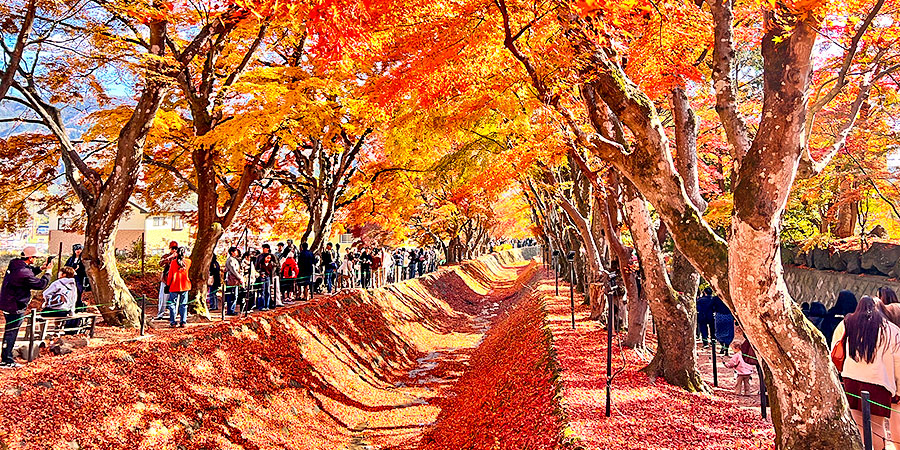
Autumn leaves at Lake Kawaguchi
|
Lake Kawaguchi Winter Fireworks Festival: Held around 20:00 every
Saturday and Sunday in January and February at Oike Park, the festival
will show you spectacular fireworks lighting up the surface of Lake
Kawaguchi against the backdrop of snow-capped Mount Fuji, creating a
truly magnificent sight.
When to Visit Lake Kawaguchi
Lake Kawaguchi has its own unique charm in every season and is worth visiting year-round. However, focusing solely on the view of Mount Fuji, you might want to know:December through February offers the highest probability of seeing a snow-capped Mount Fuji clearly. Then, April and November are also good times to visit. In addition to the relatively high chances of seeing Mount Fuji, these two months also boast special scenery: in April, you can see pink cherry blossoms together with Mount Fuji; in November, the snow-capped Mount Fuji is set against a backdrop of beautiful autumn foliage. Note that during the summer months of June through August, although Lake Kawaguchi features colorful flowers and fireworks festivals, the visibility for Mount Fuji is the lowest of the year, and the mountain is not covered in snow during this time.
See More: Best Time to Visit Lake Kawaguchi, Lake Kawaguchi Weather
How to Get to Lake Kawaguchi?
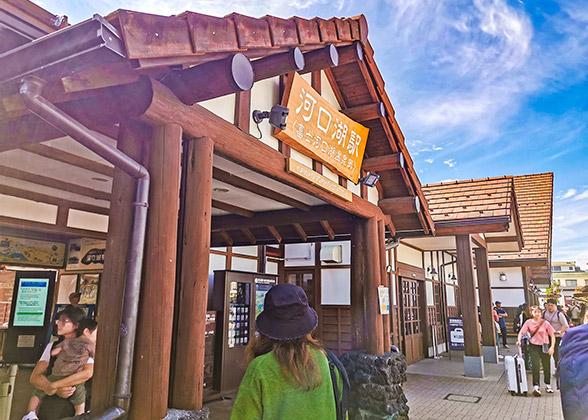
Generally speaking, most tourists travel to Lake Kawaguchi from central Tokyo, which is also the most convenient location to get there: it takes about 2 hours to reach Lake Kawaguchi from spots such as Shinjuku. Specifically, you can take:
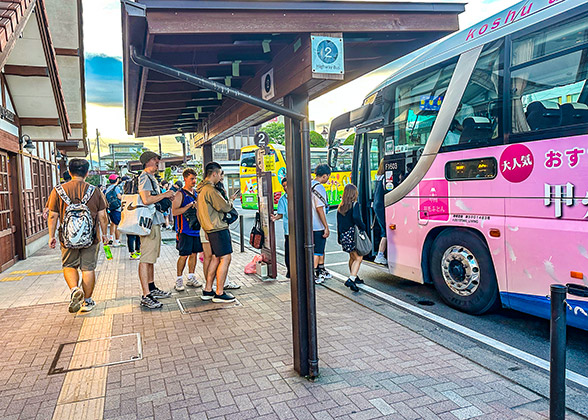
1. Highway Bus: At Shinjuku Expressway Bus Terminal, Tokyo Station Yaesu South Exit Bus Terminal, and Shibuya Station, there are highway buses that can take you directly to Lake Kawaguchi. The entire journey takes about 1.5–2 hours, assuming there is no traffic jam. Fares are inexpensive, at around JPY2,000 (USD12.4). As for the frequency of departures:
The buses departing from Shinjuku Express Bus Terminal operate from approximately 7:00 to 21:00, with 2-4 departures per hour.
Express buses departing from Tokyo Station Yaesu South Exit Bus Terminal run from approximately 6:00 to 18:00, with 1-2 departures per hour.
The buses departing from Shibuya Station run from approximately 6:00 to 17:00, with about 10 departures per day.
2. JR Chuo Line and Fujikyu Railway Line: This route requires a transfer, but there are many departures. Specifically, the JR Chuo Line can take you from Shinjuku Station to Otsuki Station, where you can transfer to the Fujikyu Railway Line to reach Kawaguchiko. The total travel takes a time of about 2 hours and costs around JPY3,000 (USD18.6).
3. Fuji Excursion Train: This is a limited express train that runs directly from Shinjuku Station to Lake Kawaguchi. There are 3-5 departures daily, and the journey takes about 2 hours. Fares are relatively expensive, at about JPY4,000 (USD24.8).
|
|
|
How to Travel around Lake Kawaguchi?
1. Taking the Lake Kawaguchi Sightseeing Boat
The Lake Kawaguchi Sightseeing Boat “Appare” is uniquely styled after a traditional Japanese warship. Standing at the 360-degree observation deck on the second floor on sunny days, you can clearly enjoy the multi-angle views of Mount Fuji, Lake Kawaguchi, and the lakeside scenery. If you’re lucky, you might even catch the view of Mt. Fuji reflected in the water. Cruises depart approximately every 30 minutes and take you on a full circuit of the lake in about 20 minutes.
2. Taking the Kawaguchiko Sightseeing Bus
The Kawaguchiko Sightseeing Bus will provide much convenience for your trip around Kawaguchiko. With the help of the bus, you can get to most of Lake Kawaguchi’s attractions, including Oishi Park, the entrance to Mt. Fuji Panorama Ropeway, Yagisaki Park, Kawaguchiko Museum of Art, Kawaguchiko Music Forest Museum, Kubota Itchiku Art Museum, Maple Corridor, and Yamanashi Gem Museum. If you have related plans, you can even take it to nearby areas such as Lake Sai, Lake Shoji, and Lake Motosu.
3. Cycling
If time permits, cycling around is also a great way to explore Lake Kawaguchi. You can have a distant view of Mount Fuji for almost the entire journey of your ride. Compared with taking the sightseeing bus, cycling offers more freedom - you can stop anytime to take photos and enjoy the scenery. The circuit around Lake Kawaguchi is about 19 kilometers (11.8 miles), and a full lap takes roughly 3-4 hours.
There are many bike rental shops near Lake Kawaguchi Station, Oishi Park, etc. If you’re worried about getting tired from cycling, you can also opt for an electric-assist bicycle.
How Long Should I Stay at Lake Kawaguchi?
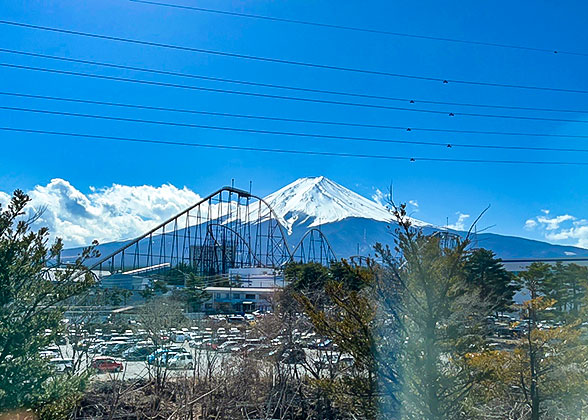
Mt. Fuji with Fuji-Q Highland
|
As mentioned above, transportation from Tokyo to Lake Kawaguchi is very convenient, so many tourists choose to make a same-day round trip from Tokyo. In fact, one day is more than enough to visit most of the popular attractions.
If you have more time, you can also consider spending two days and a night here to enjoy a more relaxed trip. Compared with a day trip, in addition to admiring more attractions, you will also be able to see Mount Fuji and Lake Kawaguchi at sunrise and sunset, and enjoy a hot spring bath at the foot of Mount Fuji. For your reference, some travelers who opt for a two-day and one-night trip will visit other nearby attractions around Mount Fuji after finishing their tour of Lake Kawaguchi, such as Fuji-Q Highland, Oshino Hakkai, Lake Yamanaka, Mt. Fuji 5th Station, and Lake Motosu.
Read More:
Top 6 Places to Enjoy the Best View of Mt. Fuji