

Lake Ashi
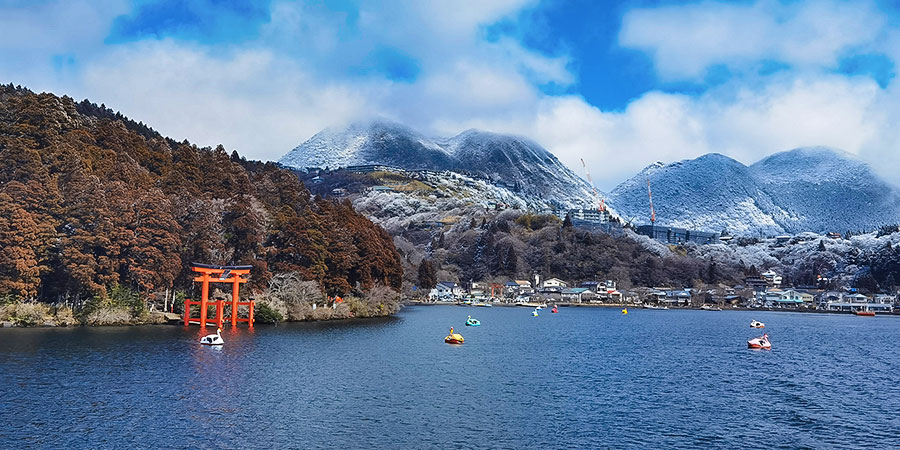
Lake Ashi is a crater lake formed approximately 3,000 years ago and is one of the premier tourist attractions in the Hakone region. It is located to the southwest of Mount Fuji, about 22 kilometers (13.7 miles) away as the crow flies. On clear days, visitors can not only admire the deep blue waters and the ever-changing scenery throughout the seasons but also enjoy magnificent views of Mount Fuji from many vantage points, which is why it attracts so many tourists.
Beautiful Lake Ashi
|
It’s also worth noting that, compared with places like Lake Kawaguchi and Lake Yamanaka, Lake Ashi is slightly farther from Mount Fuji, making the view of the mountain not that complete. However, there are plenty of other experiences to enjoy beyond visiting Mount Fuji - for example, setting aside seeing the mountain, taking a ride on the uniquely designed Hakone Sightseeing Cruise is an interesting experience in itself. In other words, even on days when the weather is poor and Mount Fuji is not visible, you won’t find yourself bored at Lake Ashi.
Read More:
What to Do at Lake Ashi?
In addition to taking a stroll along the lake and leisurely admiring the harmonious view of Lake Ashi and Mount Fuji in the distance, you can also enjoy the following rich and attractive experiences.

1. Take the Hakone Sightseeing Cruise
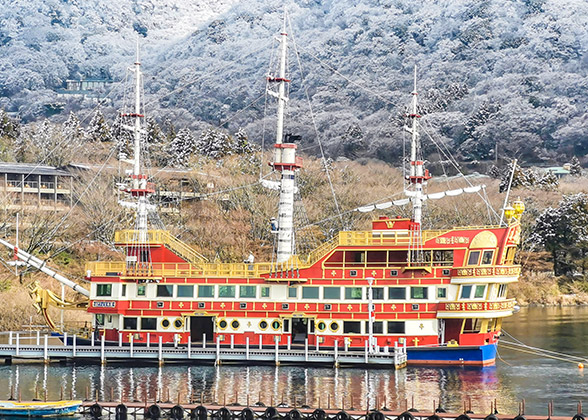
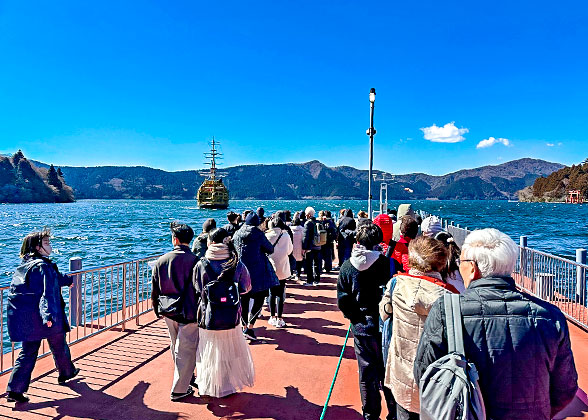
This is the most iconic and popular activity on Lake Ashi. The Hakone Sightseeing Cruise, also called Hakone Pirate Ship, is modeled after 17th-century European warships and comes in three distinct designs, each featuring vibrant colors and a unique appearance. As it cruises across the lake, you can enjoy a unique perspective of Mount Fuji, Lake Ashi, and the torii gate in the water. If the weather is clear enough and the lake is calm, you may even have the chance to see the magnificent sight of Mount Fuji reflected on the water. The boat has three decks, and the third deck offers the best vantage point for viewing and photographing Mount Fuji.
 Operating Hours and Frequency
March 20 - November 30: It operates from 9:30 to 17:00, with departures approximately every 30 – 40 minutes.
Notes: During the summer peak season from July 26 to August 25, additional temporary departures will be added, reducing the interval to 15 – 30 minutes. During this period, there are 13 – 15 trips per day.
December 1 - March 19: It operates from 9:30 to 16:00, with departures every 40 – 50 minutes.
Time Consumed and FareMoto-Hakone to Togendai: 30 minutes, JPY1,700 (USD10.8) for tourist class and JPY800 (USD5.1) surcharge for first class
Togendai to Hakone-Machi: 30 minutes, JPY1,700 (USD10.8) for tourist class and JPY800 (USD5.1) surcharge for first class
Hakone-Machi to Moto-Hakone: 10 minutes, JPY600 (USD3.8) for tourist class and JPY240 (USD1.5) surcharge for first class
Notes
Round-trip tickets from Togendai to Moto-Hakone or Hakone-Machi are available for JPY3,000 (USD19.1).
First-class benefits include: priority boarding, more spacious space, and an exclusive observation deck.
|
|
|
2. Look out at Mt. Fuji and Overlook Owakudani and Lake Ashi by Hakone Ropeway
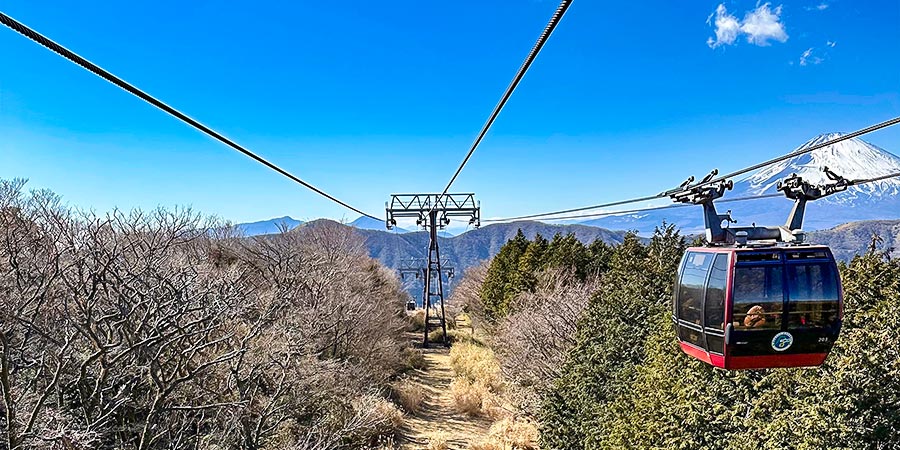
The Hakone Ropeway is a moving observation deck that allows you to simultaneously gaze upon the majestic Mount Fuji, look down on the shimmering Lake Ashi, and take in the breathtaking views of Owakudani. Its total length is approximately 4 kilometers (2.5 miles), and the ride takes about 25–30 minutes.
Unlike the view from the ground level, from the cable car, Mount Fuji is no longer merely a backdrop but forms a three-dimensional panorama alongside the surroundings. Along the entire line, the best stretch for viewing Mount Fuji is the section between Owakudani Station and Togendai Station, where the mountain appears clearly and creates a breathtaking scene with the other mountain ranges and Lake Ashi.
Hakone Ropeway
|
Operating Hours and FrequencyFebruary -November: 9:00 - 17:00, one gondola every minute
December - January: 9:00 - 16:15, one gondola every minute
FareJPY2,000 (USD12.7) for a one-way trip, and JPY3,000 (USD19) for a round trip.
3. Visit Hakone Shrine and the Torii Gate in the Water
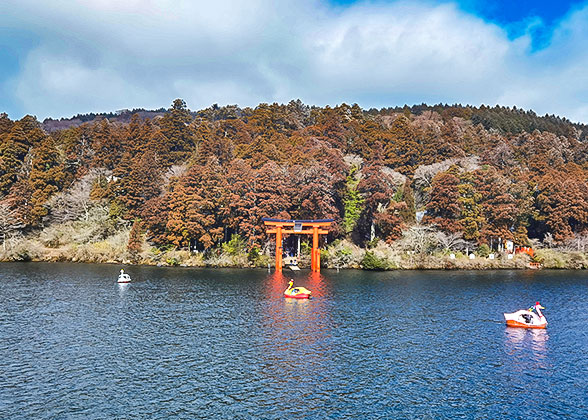
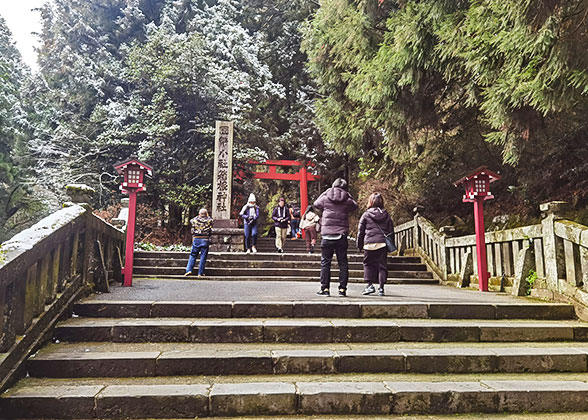
Hakone Shrine is an ancient shrine with a history spanning over 1,200 years. Its most famous landmark is the red torii gate standing in the shallow water, which sets spectacularly against the azure lake, the mountains and forests, and Mount Fuji. Starting from the torii gate, an approach is lined with massive cedar trees over 800 years old. After passing this approach, you will come upon the vermilion-colored Main Hall, Worship Hall, and Treasure Hall.
Opening Hours
The shrine itself is open 24 hours a day. You are free to explore the shrine’s approach and the torii gate at any time. However, please note: The Treasure Hall opens from 9:00 to 16:00.
Read More: Hakone Shrine
|
|
|
4. Visit Narukawa Art Museum
The Narukawa Art Museum is a truly special destination on a trip to Lake Ashi: First, the museum is situated on high ground and features a massive floor-to-ceiling window about 50 meters (164 feet) long, making it an excellent vantage point for viewing Lake Ashi, the torii gate in the water, and Mount Fuji in the distance. Sometimes, you can even see the Hakone Sightseeing Cruise in the same frame. Second, the museum houses a large collection of classic Japanese paintings and traditional crafts.
Opening Hours: 09:00 - 17:00
Fare: JPY1,500 (USD9.5)
5. Stroll through Onshi Hakone Park and the Hakone Checkpoint
Onshi Hakone Park, located on the shore of Lake Ashi, was once the summer retreat of the Japanese imperial family. It features vast lawns, gardens, and woodlands, making it ideal for exploring on foot. In addition, there are many spots offering sweeping views of Mount Fuji and Lake Ashi, such as the Lakeside Observation Building and the Benten-no-Hana Tenbodai Viewing Platform.
The Hakone Checkpoint, an important checkpoint in the past, will show you something related to transportation in Hakone during ancient times.
|
|
Onshi Hakone Park |
Hakone Checkpoint |
|
Opening Hours |
Green spaces, walking trails, and viewing platform: 24 hours a day Lakeside Observation Building: 9:00 - 16:30, closed from December 29 to January 3 |
March – November: 9:00 – 17:00 December – February: 9:00 – 16:30 |
|
Fare |
Free |
JPY500 (USD3.2) |
Tips
1. When visiting Lake Ashi, the Hakone Freepass is highly recommended to buy, which can help you save a lot and make your trip more convenient. On the one hand, it allows you to use Hakone’s public transportation as many times as you like during its validity period, including the Hakone Sightseeing Cruise and Hakone Ropeway mentioned above. On the other hand, it also offers discounted admission to certain attractions, such as the Narukawa Art Museum and the Hakone Checkpoint.
2. Hakone Sightseeing Cruise, Hakone Ropeway, and the torii gate in the water are all popular with tourists at Lake Ashi and throughout Hakone, so you are likely to encounter long lines no matter when you visit. Therefore, it’s advisable not to pack your itinerary too tightly and to allow plenty of extra time. Additionally, if possible, be sure to avoid Japanese public holidays, especially Golden Week in early May and the Obon Festival in mid-August.
Read More: Hakone Passes
The Scenery of Lake Ashi in Four Seasons
Spring from March to May 
With rising temperatures, fresh greenery sprouts along the lake and in the mountains, creating a scene brimming with vitality. From early to mid-April, the cherry blossoms in Lake Ashi are in full bloom, creating a picturesque contrast with the deep blue lake waters and magnificent Mount Fuji in the distance.
At this time, the summit of Mount Fuji is still covered with extensive snow, and the chance of seeing the mountain is generally high thanks to the relatively high visibility.
Summer from June to August
All surroundings of Lake Ashi are blanketed in lush and vibrant greenery in summer. Additionally, from July through August, visitors can enjoy fireworks festivals.
The snow on Mount Fuji has melted. Besides, as this is the rainy season, overcast and foggy days are frequent, resulting in very low visibility of Mount Fuji. Whether traveling by Hakone Sightseeing Cruise or Hakone Ropeway, there is a high probability that you will only see a little bit of Mount Fuji or none at all.
Autumn from September to November
This is the highly recommended time to visit Lake Ashi. From late October through mid-November, the trees along the lakeshore gradually change color, offering breathtaking views and excellent photo opportunities together with the lake and Mount Fuji.
In autumn, snow begins to accumulate on Mount Fuji, and the snow-covered area gradually expands. The air is crisp and clear, leading to high visibility.
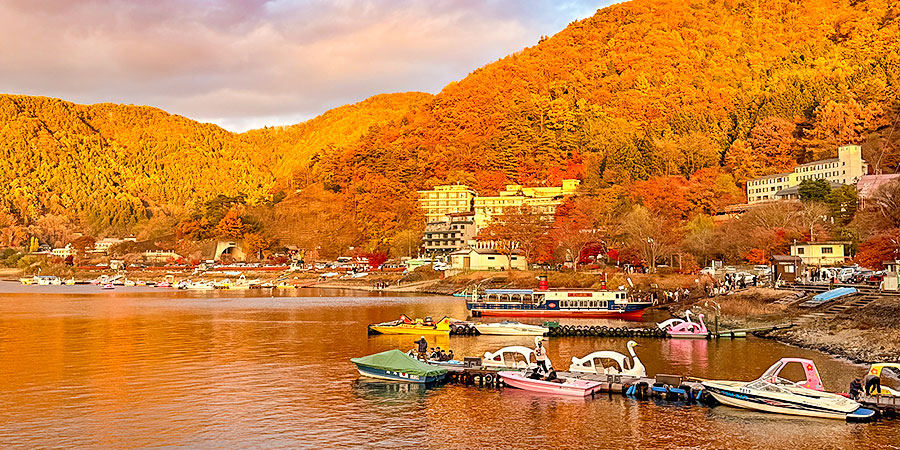
Lake Ashi in Autumn
|
Winter from December to February
Although the trees are bare and yellow during this season, the snow-covered area on Mount Fuji’s summit is at its largest. Furthermore, visibility during this time is the highest of the year. All of these mean that it is the best time throughout the year to see Mt. Fuji.
If you happen to visit on a snowy day, the scenery you witness will be even more serene and captivating.
How to Get to Lake Ashi?
It’s very convenient to get to Lake Ashi from Tokyo:
1. You can take the Romancecar from Shinjuku to Hakone-Yumoto Station, then transfer to the Hakone Tozan Bus bound for Moto-Hakone Port or Hakone-Machi Port. The entire trip takes about 2 hours. The Romancecar runs frequently, but advance reservation is recommended.
2. Alternatively, you can first travel to Odawara Station, the gateway to Hakone, and then head to the area around Lake Ashi.
For the first leg of the journey, you can take an ordinary train on the Odawara Line from Shinjuku Station; take an ordinary train on the JR Tokaido Main Line or JR Shonan-Shinjuku Line from Shinjuku, Tokyo, Shinagawa, or Shibuya Stations; or take the JR Tokaido Shinkansen from Tokyo or Shinagawa Stations. The first two options take about 1 hour and 40 minutes to reach Odawara Station, while the Shinkansen takes about only 40 minutes.
Once you arrive at Odawara Station, transfer to the Hakone Tozan Bus, which will take you to Moto-Hakone Port, Hakone-Machi Port, or Togendai Port near Lake Ashi in about 40 minutes.
3. Taking the Odakyu Hakone Highway Bus from Shinjuku Expressway Bus Terminal, you will arrive directly at Togendai Station on the shores of Lake Ashi, in about 2.5 hours. There are about 7 departures throughout the day, from around 6:30 to 16:30.
Read More: How to Get to Hakone from Tokyo / Kyoto / Mount Fuji…