

- Kansai International Airport
- Itami Airport
- Osaka Metro
- City Bus
- Express Bus
- Sightseeing Bus
- Water Bus
- Osaka Taxi
- Osaka Station
- Namba Station
- Umeda Station
- Shin-Osaka Station
- Metro & Bus Pass
- Kansai Railway Pass
- Kansai One Pass
- JR-West Passes in Kansai
- JR West Passes – Kansai Plus Neighboring Areas
- Kansai Airport to Osaka
- Kansai Airport to Kyoto
- Osaka to Kyoto
- Kansai Airport to Nearby Cities
Sakaisuji Line
The Sakaisuji Line is Osaka Metro Line 6, with brown as its signature color, route symbol “K”, and station codes beginning with this letter. Contrasting with the all-round utility of the Midosuji Line and the east‑west reach of the Chuo Line, it plays a rather different role - bridging Osaka and Kyoto. Despite its modest length of just 8.5 kilometers (about 5 miles) and a total of only ten stations, it cuts straight through the heart of Osaka, linking a richly varied mix of local highlights: the country’s longest covered shopping arcade, the anime and electronics hub of Nippombashi, and the retro neon district of Shinsekai.
Beyond its value for inner-city exploration, it also provides one of the most convenient routes to Kyoto, with seamless through-services onto the Hankyu Railway. At Tenjimbashisuji 6-chome, the Sakaisuji Line connects directly with the Hankyu Senri Line and Kyoto Main Line. Passengers boarding trains marked “Kyoto-Kawaramachi”, can stay seated all the way to central Kyoto without changing trains. Through trains to Kyoto run at intervals of roughly 3 to 10 minutes, and these through services are mostly operated as Semi-Express trains, which skip stops and move faster than local services. Since these direct trains share platforms with other trains, always check the platform screens for the final destination before you board.
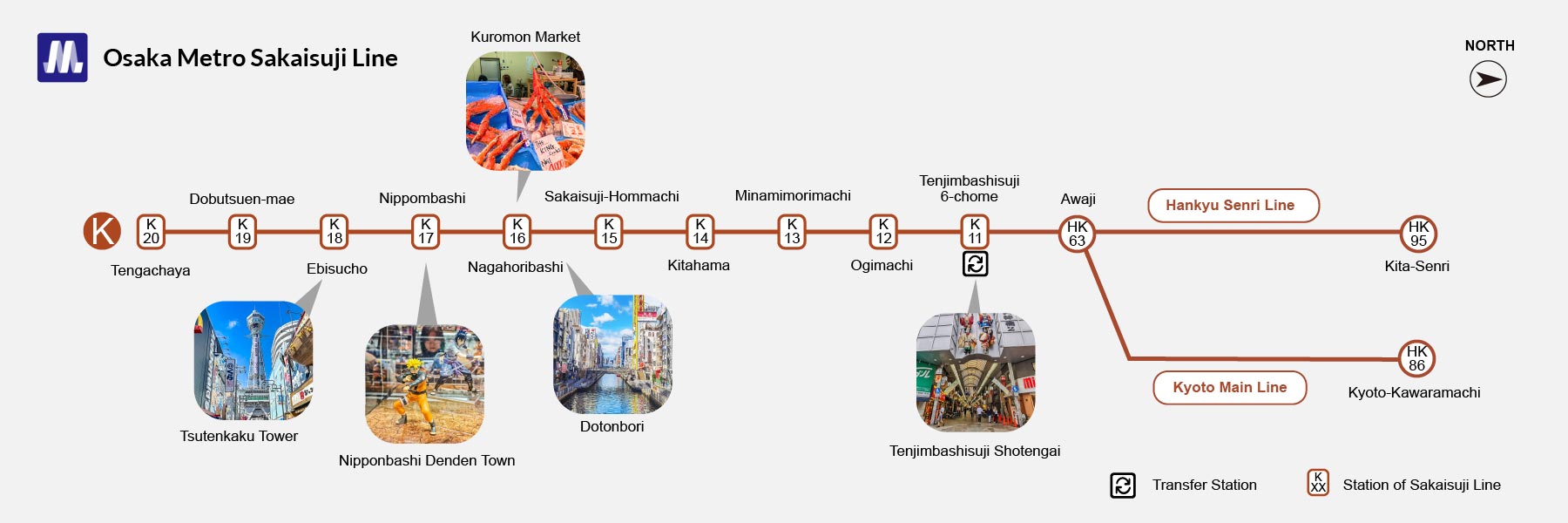
Sakaisuji Line (Click to Enlarge)
|
Operation Time & Frequencies
The Sakaisuji Line runs from approximately 5:00 to just after midnight. During peak periods, headways are around 3 to 5 minutes, while off‑peak intervals lengthen to about 6 to 10 minutes between trains.
First and Last Train Times at Major Stations
|
Station |
Southbound (Towards Tengachaya) |
|
|
First |
Last |
|
|
Tenjimbashisuji 6-chome |
5:12 | 24:08 |
|
Ogimachi |
5:14 | 24:09 |
|
Kitahama |
5:17 | 24:13 |
|
Nagahoribashi |
5:21 |
24:16 |
|
Nippombashi |
5:23 | 24:18 |
|
Ebisucho |
5:25 | 24:20 |
|
Dobutsuen-mae |
5:27 | 24:22 |
|
Station |
Northbound (Towards Kitan-senri, Takatsuki, and Kyoto) |
|
|
First |
Last |
|
|
Tenjimbashisuji 6-chome |
5:05 |
24:35 |
|
Ogimachi |
5:23 |
24:33 |
|
Kitahama |
5:19 | 24:29 |
|
Nagahoribashi |
5:16 |
24:26 |
|
Nippombashi |
5:14 |
24:24 |
|
Ebisucho |
5:12 | 24:22 |
|
Dobutsuen‑mae |
5:10 | 24:20 |
|
Tengachaya |
5:08 | 24:18 |
Note: The departure times shown above apply to weekdays only. Timetables on weekends and public holidays may be different, so it is always a good idea to verify the latest schedule before you travel.
Fares
Fares on the Sakaisuji Line follow the same fare structure of the Osaka Metro system, with charges calculated based on distance traveled. A typical ride between any two stations along the line costs between 180 and 280 yen (1 - 2 dollars). Children aged 6 to 11 are eligible for half-price fares, while those under 6 ride free when accompanied by an adult.
Note: When taking through trains that continue on to the Hankyu line, the fare for the portion beyond the Osaka Metro network is recalculated according to Hankyu’s own pricing system. For example, the total fare from Tenjimbashisuji-Rokuchome to Kyoto is around 700 yen (4 dollars).
Major Stations and Surrounding Attractions
1. K11 - Tenjimbashisuji 6-chome Station
Just outside the station lies the Tenjimbashisuji Shotengai, a famous shopping street. Nearby, the Osaka Museum of Housing and Living shows you what everyday life was like in Osaka centuries ago, while Osaka Tenmangu Shrine honors the deity of scholarship.
For onward travel, you can take the Tanimachi Line towards Higashi‑Umeda or Tennoji, or hop on the Hankyu Railway straight to Kyoto without changing trains.
2. K12 - Ogimachi Station
The station exit opens directly onto the Tenjimbashisuji Shotengai as well. Adjacent to the station is Kids Plaza Osaka, Japan’s largest children’s museum. Next to it is Ogimachi Park, which has spacious lawns and play equipment, and cherry blossoms can be enjoyed here in spring.
From here, you can walk a short distance to JR Temma Station and hop on the Osaka Loop Line, which gives you easy access to Osaka Castle Park, Tennoji, and even Universal Studios Japan via a direct connection.
3. K14 - Kitahama Station
The area around this station still has a noticeably retro feel, with many old buildings preserved along the streets. Within walking distance are Nakanoshima Park, Osaka City Central Public Hall, and the Museum of Oriental Ceramics, with their historic architecture and riverside views making for a nice stroll and some good photo spots.
From here, you can transfer to the Keihan Main Line for direct service to Kyoto.
4. K16 - Nagahoribashi Station
Nagahoribashi Station is one of the closest stops to the west side of Dotonbori. Shinsaibashi, Dotonbori, and Kuromon Market are all within easy walking distance. The station also has a direct connection to Crysta Nagahori, one of Japan’s largest underground shopping malls.
For onward travel, the Nagahori Tsurumi-ryokuchi Line runs from here towards Shinsaibashi and Tsurumi-ryokuchi.
5. K17 - Nippombashi Station
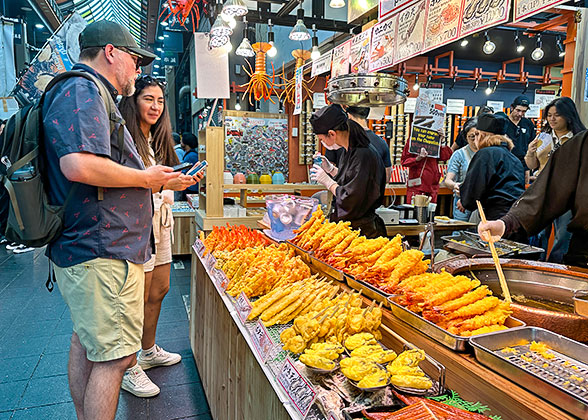
This station is Osaka’s hub for electronics and anime culture, and is counted among Japan’s three major electronics districts. To the north lies Kuromon Market, known as “Osaka’s Kitchen,” while the Denden Town electronics district stretches between Nippombashi and Ebisucho stations, packed with stores selling electronics, anime merchandise, and figurines.
For onward travel, the Sennichimae Line runs from here towards Namba and Minami-Tatsumi. If you’re planning a trip to Nara, you can walk over to Kintetsu Nippombashi Station via the connecting passage and take the Kintetsu Line directly.
6. K18 - Ebisucho Station
This is one of the most convenient stops for Shinsekai and Tsutenkaku Tower, both about a 3-minute walk away. Shinsekai is a lively retro district with neon-lit streets, and Tsutenkaku Tower stands as one of Osaka’s most recognizable landmarks.
Right next to the station is the stop for the Hankai Line, Osaka’s only streetcar. It runs south through Tennoji and Sumiyoshi, all the way to Hamadera Park, a scenic ride worth taking if you have time to explore beyond the city center.
7. K19 - Dobutsuen-mae Station
From here, Shinsekai, Tsutenkaku Tower, and Tennoji Zoo are all within walking distance. Shinsekai retains its old Showa-era charm, while Tennoji Zoo, the oldest in the city, is a great stop if you’re travelling with kids.
From here, you can board trains to Umeda, Shinsaibashi, and Namba through Midosuji Line.
8. K20 - Tengachaya Station
The real draw of this station is the connection: you can hop on the Nankai Electric Railway and get to Kansai Airport in about an hour, a very convenient option for getting between the airport and central Osaka, or head south to Wakayama. There are also a few minor sights nearby like Seitensan Park and the Hankai tram crossing if you have spare time.
9. HK86 - Kyoto-Kawaramachi Station of the Hankyu Kyoto Line
This is the terminus of the Hankyu Kyoto Main Line, reached directly from Osaka via the Sakaisuji through-service. Located at the Shijo-Kawaramachi intersection, it sits in the heart of Kyoto. From here, Gion and Yasaka Shrine are about a 5- to 8-minute walk, while the Kamogawa River is just step away. The station also serves as a transport hub, with onward connections to Kiyomizu-dera and Fushimi Inari Taisha via local buses or the Keihan Line.