

Zenko-Ji Temple
Zenko-Ji Temple stands in Nagano, Japan. Found in 644 AD, it has a history of nearly 1,400 years and ranks among the oldest temples in the country. It is not affiliated with any religious denomination and welcome every visitor equally, which has earned it the nickname “the temple of the common people”. There is an old Japanese saying that goes “Led by a cow, you’ll find your way to Zenko-ji”. It reflects how deeply the temple is rooted in popular culture, as a pilgrimage site everyone should visit in their lifetime.In 1998, the bell of Zenko-ji Temple rang out to open the Nagano Winter Olympics. The sound carried prayers for peace to the whole world and brought the temple even greater fame.
Zenko-Ji Temple Photos ( 29
 ) )
|
What Are the Best Things to See at Zenko-ji?
The layout of Zenko-ji’s grounds is easy to follow. At the very entrance stands the Niomon Gate, built entirely of keyaki wood and reaching about 14 meters (46 feet) in height. Inside the gate, two Kongorikishi statues stand on either side, their muscles bulging and eyes wide with fury, one with its mouth open and the other closed. Passing through the gate, you’ll enter the shopping approach, where stone-paved streets are lined with food and souvenir shops serving soba noodles, beef buns, and more. Further in stands another grand gate with “Zenko-ji” written across its lintel. Look closely and you may spot a hidden detail, as the characters are said to contain the shapes of five pigeons. At the end of the approach lies the Main Hall and the hidden Buddha, the highlights of any visit.
The Main Haill and the Hidden Buddha
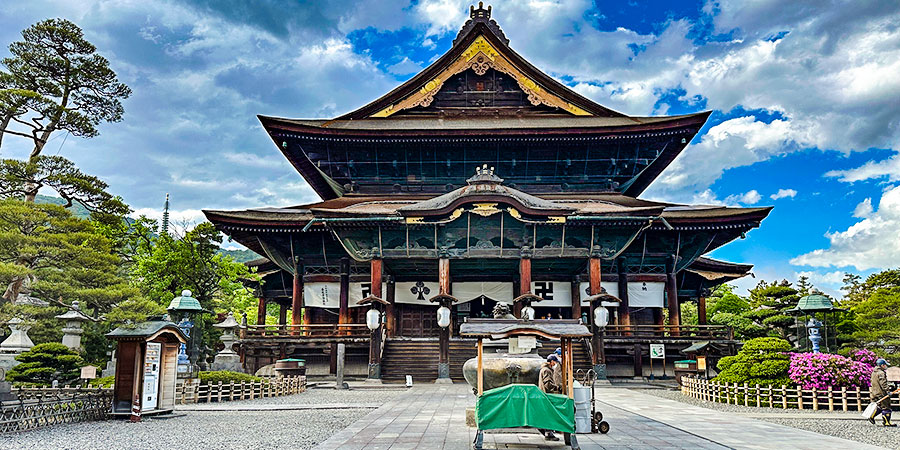
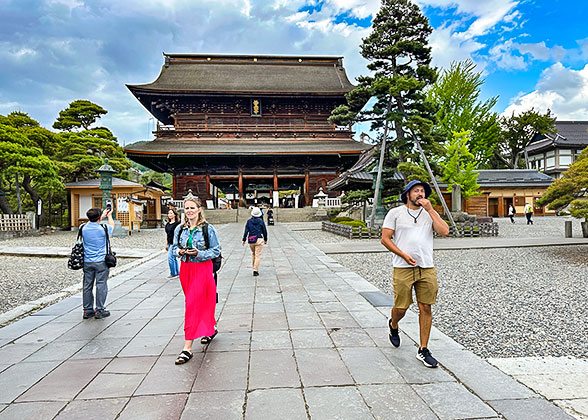
The Main Hall is the heart of Zenko-ji. Built in 1707, it has been designated a Japanese National Treasure. It measures 24 meters (79 feet) across the front and about 54 meters (177 feet) in depth. Unusually for a Japanese temple hall, its depth exceeds its width. It also ranks among the largest wooden building in the country. Seen from above, the roof forms a T shape, resembling the wooden mallet used to strike the bells in Japan. This style is known as “shumoku-zukuri”, named after the bell mallet itself.The Main Hall enshrines what is said to be the oldest Buddhist statue in Japan. It was brought to Japan from China in 552 AD, nearly a century before Zenko-ji was founded. Yet when it first arrived, it was falsely accused of carrying plague and thrown into a river, only to be recovered by chance and enshrined here much later. Its most remarkable feature is its status as an “absolute hidden Buddha”. It remains completely wrapped in cloth at all times, and no one is allowed to see it. It is put on public display only once every seven years, and even then, only a replica of the main statue is shown. The most recent exhibition was 2022, so if you’re coming specifically for the hidden Buddha, you’ll need to wait until 2029.
Activities Worth Trying
Underground Tunnel Walk
This is an experience unique to Zenko-ji. Beneath the Main Hall runs a corridor nearly 50 meters (164 feet) long, with no lighting at all, so dark that you cannot see your own hand in front of your face. After descending the stairs, total darkness closes in immediately, and you can only move forward slowly by feeling your way along the walls with both hands. About halfway through, you’ll reach a cold bronze lock. It is said to sit directly below the hidden Buddha statue above, and touching it means you will reach the paradise. When a faint light appears ahead, your walk is nearly over. After exiting, you’ll find a mirror on the wall, in which you can see a new version of yourself, with your soul purified.Temple Lodging
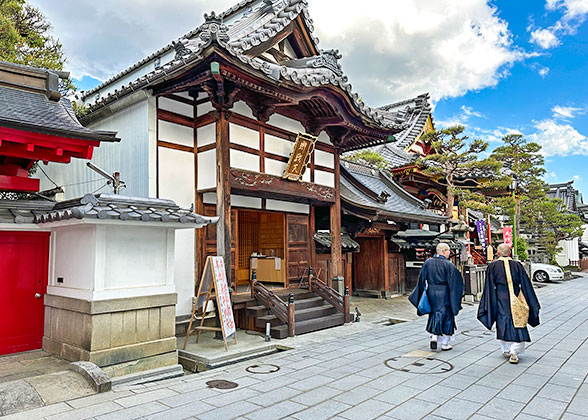
If you want to experience a quiet life away from the everyday world, you can stay overnight at the temple. Zenko-ji has several traditional shukubo, or temple lodgings, with rooms featuring Japanese tatami mats. Dinner is a fully vegetarian Buddhist meal. After waking up early, you can stroll through the temple grounds away from the crowds. If interested, you can also join in the morning service, where the head priest will personally place his hand on your head for blessing. Zenko-ji also sells lucky amulet, which you can buy for good fortune or bring back as souvenirs for family and friends.Keep in mind that there are only 39 shukubo rooms in total, so availability is very limited. This is especially true during cherry blossom season, autumn foliage season, and the New Year’s first visit, when rooms are nearly impossible to get. If you want to try it, be sure to book several months in advance.
|
|
Best Time to Visit
Spring: Every year from April to May, the cherry trees lining the approach to Zenko-ji bloom in full, turning the entire grounds into a sea of pink. When the wind blows, petals fall gently like a cherry blossom rain, creating a romantic scene against the old wooden buildings.Autumn: From October to November, the maple leaves inside the temple gradually turn red, pairing with the vermilion gate and Main Hall to create a striking visual scene. The weather is also dry and comfortable at this time, perfect for walking around.
Time to Avoid
New Year: January 1 to 3 is the busiest time of the year at Zenko-ji, when crowds of locals flock here for their first temple visit of the year. The grounds become extremely packed, so if you prefer a quieter experience, it’s best to avoid these days.Opening Hours and Admission
|
Area |
Opening Hours |
Admission |
|
Temple grounds (outdoor) |
All day |
Free |
|
Main Hall + Tunnel Walk |
April - October: approx. 4:30 - 16:30 December - March: approx. 6:00 - 16:00 |
600 yen(3.8USD) |
Notes:
1. Minors can receive discounts of 50% or more.
2. Several buildings within the grounds require separate tickets, ranging from 300 to 600 yen (1.9 - 3.8 USD) each. If you plan to visit everything, a combination ticket is recommended at 1,200 yen per person (7.5 USD).
How to Get There?
If you’re coming from Tokyo, the most common route is to take the Hokuriku Shinkansen from Tokyo Station directly to Nagano Station. The ride takes about 1 hour 30 minutes. Once you arrive, take a bus bound for Zenko-ji Temple from Nagano Station, and you’ll reach the entrance of the approach in about 15 minutes on foot.
Tips
1. You’ll need to remove your shoes when entering the Main Hall. It’s a good idea to bring a small shoe bag or leave your shoes on the rack at the entrance. In winter, going barefoot can feel a bit cold, so remember to wear thick socks.
2. Photography is not allowed inside the Main Hall or in the underground tunnel area. If you want to take photos, please do so in the outdoor areas.
3. Although the underground tunnel is very dark, please do not turn on your phone flashlight or any other lighting device, as it may disturb other visitors’ experience.
4. Before entering the underground tunnel, please tie your shoelaces tightly to avoid tripping and falling. The floor may also be uneven, so always watch your step and walk slowly.
5. Nagano may see snow in winter, and the stone paths inside the temple can be slippery. Please wear non-slip flat shoes or hiking shoes. High heels are not recommended.