

Matsumoto Castle
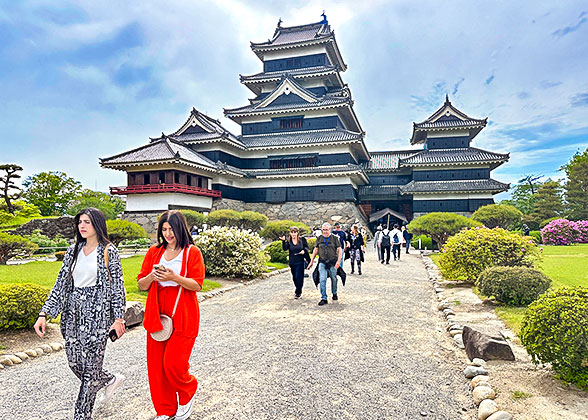
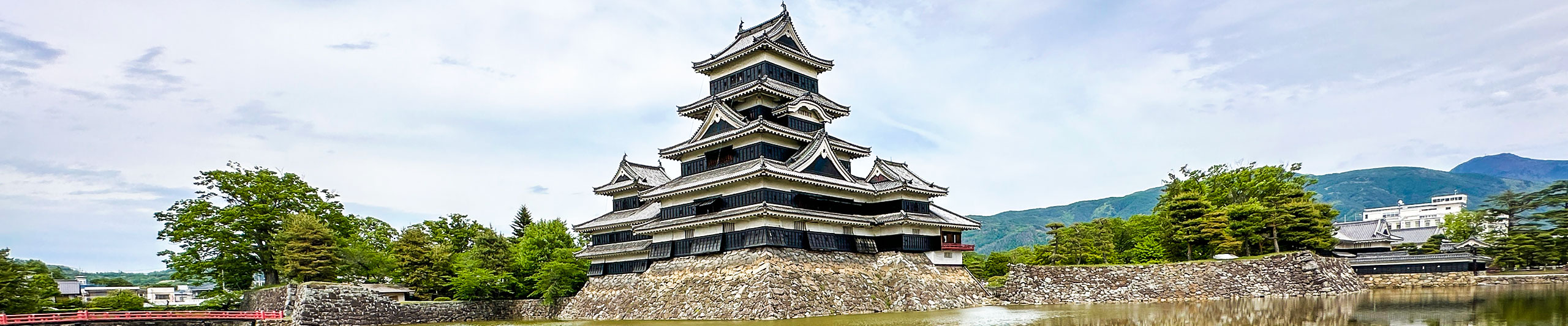
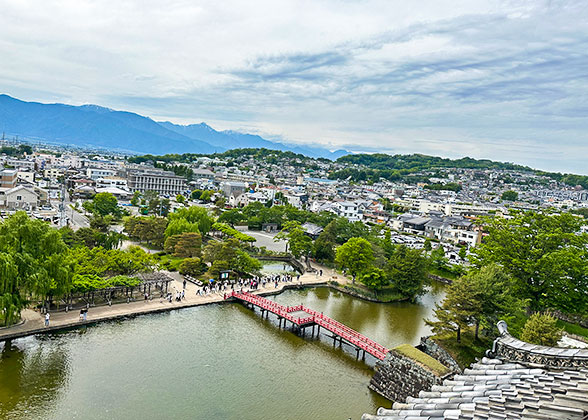
Matsumoto Castle stands in Matsumoto City, Nagano Prefecture. It is a Japanese National Treasure and home to the oldest surviving wooden castle keep in the country, with a history of 400 years. Its most striking feature is that the most part of the castle is painted black. It stands in complete contrast to Himeji Castle, famous for the brilliant white exterior. Wide moats surround the castles, with vermilion bridges spanning the water. Original stone carvings stand around the grounds, and the majestic Northern Alps rise behind it.
A Legacy of a Defected Warlord
The castle has always been wrapped in legend. It was first built by a warlord who defected from the enemy camp. In the late 16th century, during a struggle for power between two major Japanese factions, this warlord suddenly defected to the opposing side with his entire family. The reason remains unknown to this day. Because he knew all the military secrets of his former lord, his defection shocked the country. His new lord soon granted Matsumoto to him as a reward. Upon taking office, he began construction of Matsumoto Castle, but he passed away just three years later. His son completed the remaining work.Later, the castle went through many hardships. In the 19th, the government ordered the demolition of old castles across the country, and Matsumoto Castle was put up for auction, facing imminent destruction. The president of a local newspaper launched a preservation campaign. Using proceeds from a local exposition and public donations, he purchased the castle for 235 yen (1.5 USD), roughly four years’ salary of a civil servant at the time. This saved the castle from being dismantled and sold off. Decades later, when the castle was leaning so badly that it was nearly collapsing, local residents raised money once again to save it.
|
|
|
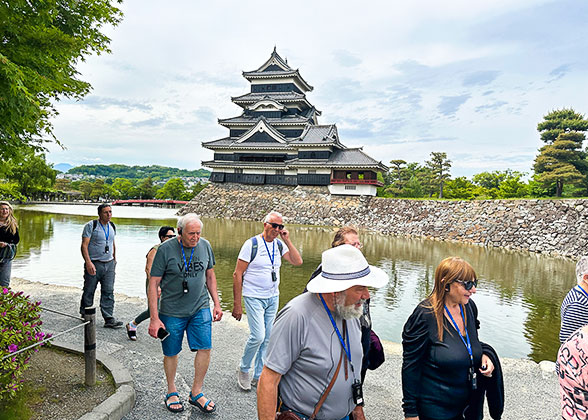
 )
)
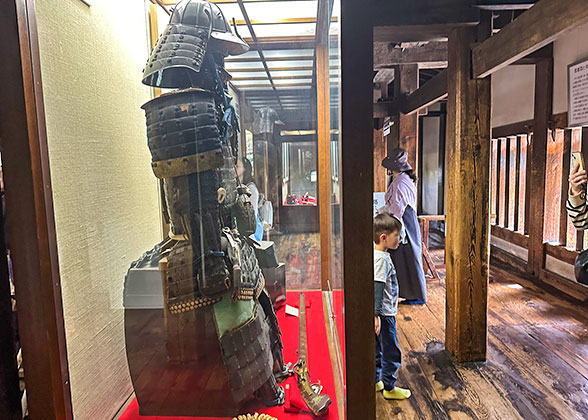
The Crow Castle: From Afar to Up Close
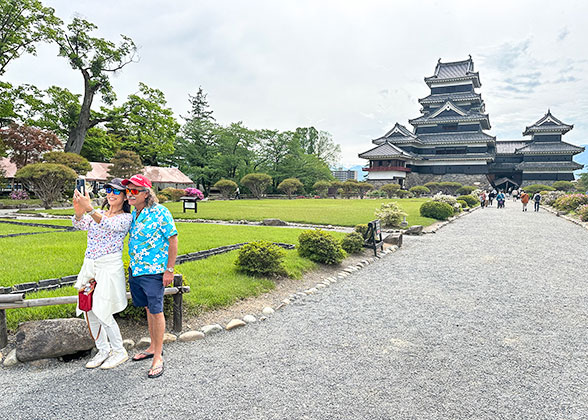
Distant View of Mastsumoto Castle
|
Walk up to the castle, and you’ll notice it is not a single standalone tower, but a cluster of buildings packed together. A small turret stands next to the main keep, connected by a covered corridor. Two smaller buildings are attached directly to the side. This layout is quite rare among Japanese castles, because it was not built all at once. The main keep and small turret were constructed first for military use. Later, when the country was at peace, two more buildings were added for entertainment and leisure.
Next, make your way to the side buildings, where the Tsukimi Yagura, or moon-viewing turret, awaits. The entire castle is made of dark, thick walls with small windows, but this pavilion alone is open on three sides and surrounded by a vermilion railing. It was a place built specifically for drinking and enjoying the moon, constructed by a former lord to welcome a visiting general. The general later canceled his visit for various reasons, but the pavilion remained. It has become the most incongruous yet eye-catching feature of the castle.
Finally, step inside the building and you may be surprised to find it has six floors, even though you counted only five from the outside. Between the second and third floors, there is a hidden windowless mezzanine that is completely invisible from outside. It served as a hiding place and ammunition depot for samurai during wartime. Once inside, you can climb stairs at a nearly 60-degree angle, view ancient weapons, and finally reach the top floor for a panoramic view.
More to See
Beyond the castle itself, the surrounding area is also well worth exploring. A wide moat encircles the castle, and when the water is calm, the black tower is reflected perfectly on its surface. This is the most classic view of Matsumoto Castle. A red bridge spans the moat, and against the black castle, the contrast on colors is striking.
|
|
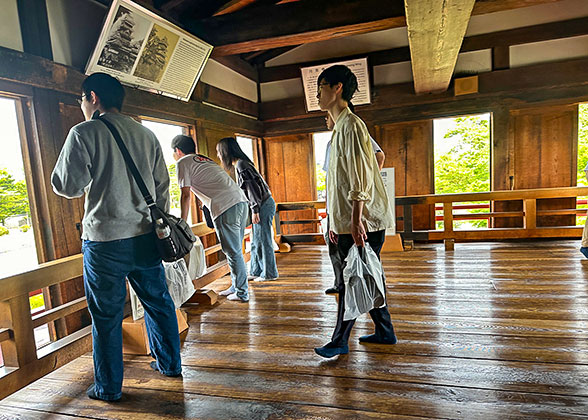
Best Time to Visit
April is the most beautiful time to visit Matsumoto Castle. Around 300 cherry trees bloom along both sides of the moat, and the black walls, pink blossoms, blue sky, and lingering snow on the distant Alps come together in one frame, looking just like a postcard.Late October to mid-November is the second best option, when the stately black-and-white castle stands against vivid autumn leaves, creating a stunning visual contrast.
During both cherry blossom and autumn foliage seasons, the area is lit up at night. The lights make the riverside scenery even more dazzling, and it is highly recommended to visit around sunset to experience the romantic atmosphere as the sky shifts between light and dark.
From mid-December to February, Matsumoto Castle enters another magical season. Every evening during this period, a projection show is held, with colorful light and shadows cast directly onto the black castle walls, like a moving canvas. The multicolored castle feels completely different from its solemn, dignified appearance during the day.
Opening Hours
| Period | Opening Hours | Last Entry |
| Regular Days | 8:30 - 17:00 | 16:30 |
| Golden Week | 8:00 - 18:00 | 17:30 |
Notes:
1. Golden week mainly refers to cherry blossom season from late April to early May.
2. Closed days: December 29 to December 31.
Admission
Adult admission is about 1,300 yen (8.5 USD), with discounts for children and students.
How to Get There?
If you’re already in Nagano, take the JR Shinano Line to Matsumoto Station; the ride takes about 1 hour. After exiting JR Matsumoto Station, walk along the main road for about 20 minutes to reach the site. If you prefer not to walk, you can take the Matsumoto Loop Bus Town Sneaker North Line and get off at Matsumoto Castle-City Hall, which takes about 10 minutes.
Tips
1.You’ll need to remove your shoes when entering the castle, so it’s better to wear socks. Plastic bags are provided at the entrance for carrying your shoes.
2. The stairs inside are steep, especially on the 4th and 5th floors, which can be quite difficult to climb. You may need to use both hands and feet, so be extra careful. Visitors with mobility issues or elderly travelers are advised not to try it.
3. For climbing the castle and viewing the exhibits, allow about 1 to 1.5 hours. If you also want to stroll through the garden and take photos by the moat, add another 30 minutes for a more relaxed pace.
4. In winter, temperatures in Matsumoto often drop below freezing and can even reach -10℃ (-50℉). Be sure to wear a windproof, warm jacket, snow boots, thick gloves, and a scarf. Additionally, the roads can easily be icy, so wear non-slip shoes.