

Lake Yamanaka
Lake Yamanaka, one of the most popular spots for viewing Mount Fuji from a distance, is located slightly east of the mountain’s northern foothills. It is the largest of the Fuji Five Lakes and the one closest to Mount Fuji. Compared with Lake Kawaguchi, the most popular of the Fuji Five Lakes, transportation here isn’t as convenient, and there aren’t as many attractions; however, it’s less crowded, and the overall atmosphere is much quieter.
Read More: Mt. Fuji, Lake Kawaguchi

Mt. Fuji View from Lake Yamanaka
|
Unique Views of Mt. Fuji from Lake Yamanaka
Among the many scenic spots where you can admire Mt. Fuji, the advantages and highlights of Lake Yamanaka are:1. Lake Yamanaka offers a close-up view of the mountain. Standing on the shores of Lake Yamanaka, you’ll feel as if you are in the “front row” for viewing Mount Fuji. As a result, Mt. Fuji appears more majestic and imposing. On a clear day, you can even see the winding hiking trails on its northern slope.
2. Thanks to its large and calm water surface, the lake is also one of the best spots to view the inverted Mt. Fuji reflected in the water.
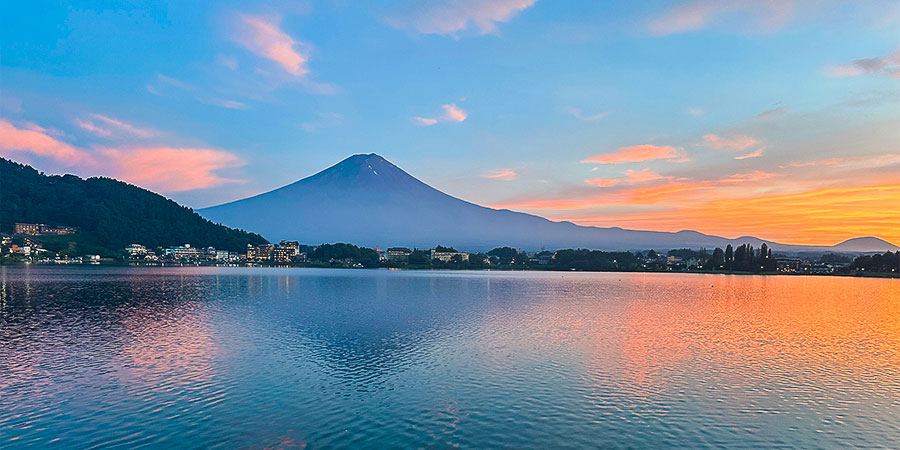
3. This is an excellent spot to witness the beautiful sight of the rays of the sunrise turn Mt. Fuji’s snow-capped peak pink.
4. Lake Yamanaka is one of the best places to view “Diamond Fuji”: In winter, at sunset, you may have the chance to see the rare sight of the sun perfectly behind the summit of Mount Fuji from certain locations around the lake, such as Nagaike Water Park. At that moment, the sun’s rays look just like a huge and sparkling diamond set atop the mountain peak.

Top Spots of Lake Yamanaka to See Mt. Fuji
|
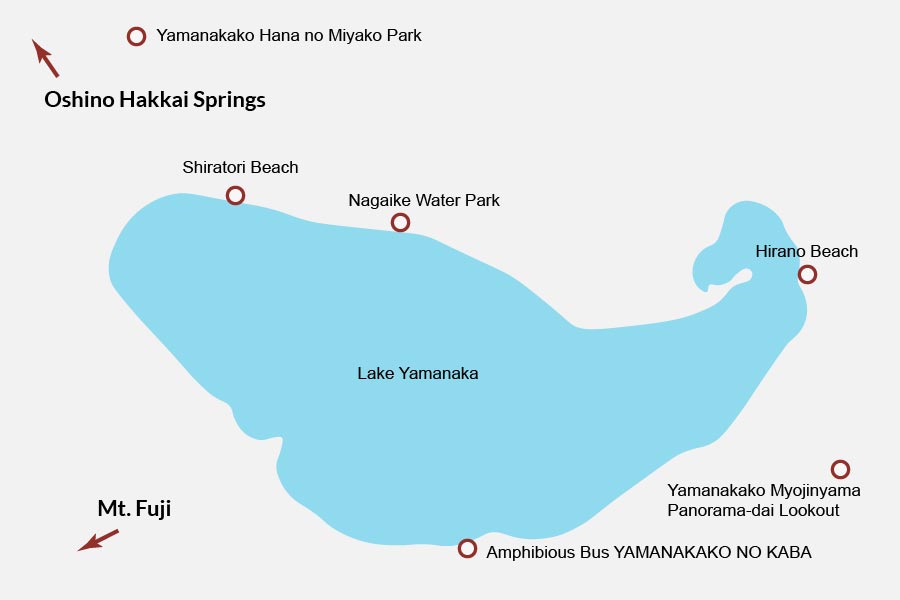
1. Nagaike Water Park
Nagaike Water Park offers the most unobstructed view of Mt. Fuji at Lake Yamanaka, with no trees or hills blocking the view. Besides, this spot is extremely famous for viewing and photographing inverted Mt. Fuji and “Diamond Fuji”.Opening Hours: 24 hours a day, year-round
Admission: Free
2. Hirano Beach
This is also quite a recommended spot on the shore of Lake Yamanaka for viewing Mt. Fuji. First, it’s a famous gathering place for swans on Lake Yamanaka, providing the captivating sight of flocks of elegant white swans gliding across the lake with Mt. Fuji in the distance as the background. Second, the stunning sunrise and sunset sights here are another highlight. During these periods, the sunlight bathes the snow-capped peak of Mount Fuji, turning it a beautiful golden or pink. Third, it is also an ideal spot to view the inverted Mt. Fuji.Opening Hours: 24 hours a day, year-round
Admission: Free
Mount Fuji at Sunset
|
3. Shiratori Beach
Shiratori Beach, also called Swan Beach, is another spot on Lake Yamanaka where you can see the spectacular Mount Fuji, the calm and beautiful lake, and pure white swans all at once. Compared with Hirano Beach, the view here isn’t as expansive, but there are more swans, and you can get up close to feed them. Please note that Swan Beach tends to be more crowded than Hirano Beach.Opening Hours: 24 hours a day, year-round
Admission: Free
4. Yamanakako Hana no Miyako Park
If you dream of admiring a spectacular sea of flowers at the foot of Mount Fuji or capturing romantic photos of the flowers against the backdrop of the mountain, this park is the place for you. It features vast flower fields, which are in full bloom with a variety of flowers almost year-round except in winter: tulips and cherry blossoms in spring, sunflowers in summer, and cosmos and zinnia in autumn.Opening Hours:
April 16–October 15: 8:30–17:30
October 16–April 15: 9:00–16:00
Closed: Tuesdays from December 1 to March 15 (except public holidays)
Admission: Most areas of the park are free to visit, but there is a paid section that includes the indoor greenhouse, artificial waterfall, and flower garden. During the peak season from April 16 to October 15, admission is JPY600 (USD3.7); during the shoulder season from October 16 to November 30 and from March 16 to April 15, admission is JPY360 (USD2.2); and during the slack season from December 1 to March 15, admission is free.
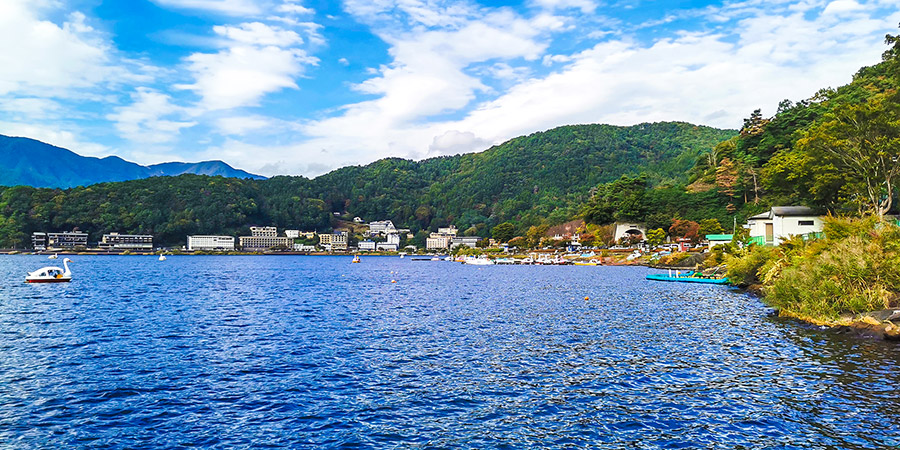
Scenery of Lake Yamanaka
|
5. Yamanakako Myojinyama Panorama-dai Lookout
Located at an elevation of 1,090 meters (3,576 feet), this 360-degree panoramic viewpoint offers a bird’s-eye view of Lake Yamanaka and a head-on view of Mount Fuji. In spring and summer, vast expanses of greenery can be seen together with Mount Fuji and Yamanaka Lake; in autumn, a sea of golden silver grass, the majestic mountain, and the serene lake come together to create a captivating scene; and in winter, it serves as one of the best spots to view “Diamond Fuji”.Opening Hours: 24 hours a day, year-round
Admission: Free
6. Oshino Hakkai Springs
Located at the foot of Mount Fuji, Oshino Hakkai is a group of spring pools formed by snowmelt from Mount Fuji over decades. There are eight pools surrounded by traditional Japanese architecture and lush greenery in total, all with crystal-clear water. On clear days, you have a chance to catch Mount Fuji’s reflection in the colorful waters.Opening Hours: 24 hours a day, year-round
Admission: Free
Read More: Oshino Hakkai Springs
How to Get to Lake Yamanaka
From Tokyo
The most convenient way to get from Tokyo to Lake Yamanaka is by express bus, which allows you to avoid transfers and takes you directly to Lake Yamanaka. Specifically, you can depart from the following two locations:
(1) Shinjuku Express Bus Terminal: Some express buses departing from here stop only at Yamanakako Asahigaoka, while others stop at both Yamanakako Asahigaoka and Yamanakako Hirano. Without traffic jams, the trip takes about 2 hours and 30 minutes, and the fare is approximately JPY2,600 (USD16). Buses run frequently, with about 20 departures per day.
(2) Tokyo Station Yaesu South Exit Bus Terminal / Tokyo Station Steel Building: Direct buses to Yamanakako Asahigaoka also depart from here daily. The trip generally takes 2 hours and 30 minutes or more, and the fare is approximately JPY2,700 (USD16.6). There are only 3 departures per day, at around 9:00, 14:00, and 18:00.
From Lake Kawaguchi
From Lake Kawaguchi, you can take a direct bus to Lake Yamanaka from 7:30 to 18:30: the fare is about JPY700 (USD4.3), and the trip takes about 30–45 minutes. However, you may need to wait about an hour at the No. 6 Bus Stop at Kawaguchiko Station for a bus.
How to Travel Around Lake Yamanaka
1. Cycling
Cycling is highly recommended as a way to explore Lake Yamanaka, and there are numerous bike rental locations and dedicated bike paths. As you ride, you will discover many spots with unique and expansive views of Mount Fuji in addition to the attractions mentioned above.A full lap around the lake is about 14 kilometers (8.7 miles) and takes approximately 2 to 3 hours. You are recommended to ride counterclockwise so that the beautiful view of Mount Fuji remains in front of you throughout the ride. Alternatively, you can cycle just the highlight route from Hirano Beach to Nagaike Water Park and then to Shiratori Beach.
2. Experiencing the Amphibious Bus YAMANAKAKO NO KABA
This is a signature activity at Lake Yamanaka and is very popular with tourists. Featuring a blue hippo logo on its body, this amphibious bus can run both on land and on the lake. The entire tour includes a roughly 15-minute drive through the forest on land and a 30-minute cruise on the lake. The absolute highlight of the tour is the moment the bus plunges directly from the land into the lake, splashing the water. Additionally, while cruising on the lake, you can admire Mount Fuji and Lake Yamanaka through the bus’s extra-large windows.Boarding Location: Asahigaoka
Fare: JPY3,000 (USD18.5) from July through August; JPY2,800 (USD17.3) at other times
Tips: During the peak season from May to September, there are 9 daily departures, operating from around 9:15 to 16:00. During the slack season, there are 7–8 daily departures, operating from 9:15 or 10:00 to 15:15 or 16:00. Early booking is recommended, especially during the peak season.
3. Taking the “Swan Lake” Sightseeing Boat
During the approximately 25- to 30-minute cruise of the sightseeing boat shaped like a swan, you can sit in the indoor main cabin on the lower deck or stand on the open-air deck on the upper deck to enjoy views of Mount Fuji and Lake Yamanaka.|
Boarding and Ticket Office |
Asahigaoka Pier |
|
Operating Hours |
December-February: 9:30-15:30 June-August and Golden Week: 9:00-17:30 Other Times: 9:30-16:30 |
|
Frequency |
Every 30 minutes |
|
Fare |
JPY1,200 (USD7.4) |
4. Taking the Fujikko-go Bus
Fujikko-go is an important and widely used bus to explore the Fuji Five Lakes area, including Lake Yamanaka. The main spots at and near Lake Yamanake that you can get on and off include: Asahigaoka Station, Hirano Beach, Nagaike Water Park, Yamanakako Hana no Miyako Park, Oshino Hakkai Springs, Fuji-Q Highland, and Kawaguchiko. However, the buses run infrequently, with only one departing every hour.Seasonal Views of Lake Yamanaka
Lake Yamanaka offers captivating scenery year-round. However, since the vast majority of visitors come to see Mount Fuji, the recommended levels for the four seasons are:Winter from December to February – Most Recommended: The winter scenery at Lake Yamanaka has three distinct advantages. First, Mount Fuji is crowned with a perfect snow cap. Second, the weather is stable, offering the highest probability of seeing Mount Fuji all year. Third, in winter, visitors have the chance to witness the spectacular “Diamond Fuji”.
Autumn from September to November – Second Recommended: In autumn, Mount Fuji also shows a white snow-capped peak, although it isn’t as extensive as in winter. In addition, the leaves gradually turn red. As for the weather, it is cool and relatively sunny with good visibility. Of these three months, November is the most highly recommended, as the snow cap covers a larger area and there are more red leaves.
|
|
|
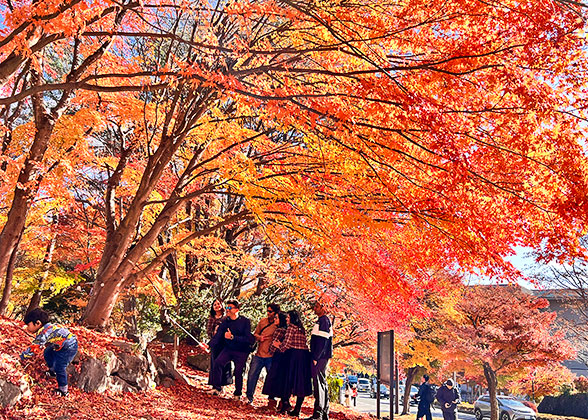
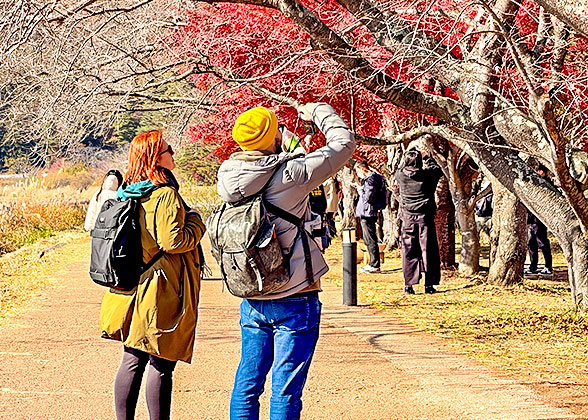
Spring from March to May – Third Recommended: At this time of year, Mount Fuji is still covered by snow, and the visibility is OK. It’s worth noting that from late March to mid-April, beautiful cherry blossoms bloom at Lake Yamanaka, and from late April to early May, tulips are in bloom. The combination of the sea of flowers and Mount Fuji attracts many visitors.
Summer from June to August — Not Recommended: During this time, there’s a high probability that Mount Fuji is obscured by clouds. Furthermore, Mount Fuji doesn’t look the way most people imagine it during this season - its snow-capped peak melts in the summer. The main highlight of summer is the fireworks festival with Mount Fuji as the backdrop.
How Long Should I Stay at Lake Yamanaka?
If possible, you are recommended to stay overnight here. The most famous sights here are the sunrise view of Mount Fuji from Hirano Beach and the “Diamond Fuji” view at sunset in winter at Nagaike Water Park, both of which you will only have a chance to see when staying overnight.If you are not particularly interested in those two sights, or if your time is limited, a one-day trip is perfectly feasible.
Read More: Top 6 Places to Enjoy the Best View of Mt. Fuji