

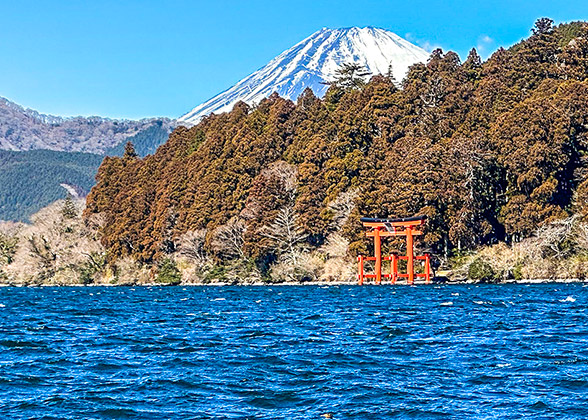
- Lake Ashi
- Owakudani Valley
- Hakone Shrine
- Open Air Museum
Hakone Owakudani Valley
Owakudani Valley, formed about 3,000 years ago during a violent volcanic eruption, is a famous scenic spot of Hakone. It boasts desolate volcanic landscape and the white steam rising constantly from the ground, both of which earn itself another name: Valley of Hell. Tasting black eggs, unique to this attraction and said to extend people’s life, is a welcomed experience in Owakudani Valley. Besides, it is worth mentioning that Mount Fuji can be seen from this location on sunny days.
Owakudani Valley
|
How to Visit Owakudani Valley
1. Taking Hakone Ropeway and Overlooking Owakudani Valley
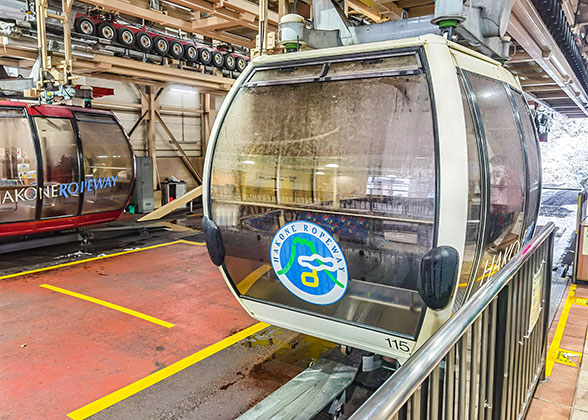
Taking Hakone Ropeway is actually a highly recommended and widely chosen way to visit Owakudani Valley. During the slow ascent of the gondola, you can consistently see white steam gushing out from the bare ridges. What’s more, since your perspective keeps changing with the movement of the gondola, you will feel like you are just above and flying over this desolate “hell”.When looking up and into the distance on clear days, Mount Fuji will come into your view.
|
|
Tips:
(1) Operating time of Hakone Ropeway:
February-November: 9:00-17:00; December-January: 9:00:16:15.
(2) Both the sections of Hakone Ropeway from Sounzan Station to Owakudani Station and from Togendai Station to Owakudani Station allow you to see Owakudani Valley and Mt. Fuji in the distance.
(3) You may need to wait in long lines to take the popular Hakone Ropeway, even on weekdays. So, you are recommended to allow plenty of time.
(4) Hakone Freepass can cover the fee of Hakone Ropeway.

2. Admiring Owakudani Valley at the Observation Deck
Once you step out of the Owakudani Station of Hakone Ropeway, you will see the Observation Deck. Standing at the deck, the bleak and vegetation-free volcanic landscape and the billowing white steam are clearly in front of you, while the equally spectacular Mount Fuji is in the distance. As a reminder, some parts of the Observation Deck feature glass floors, standing at where you will feel the volcano is right beneath your feet. The strong smell of sulfur wafting towards you also remind you of this.
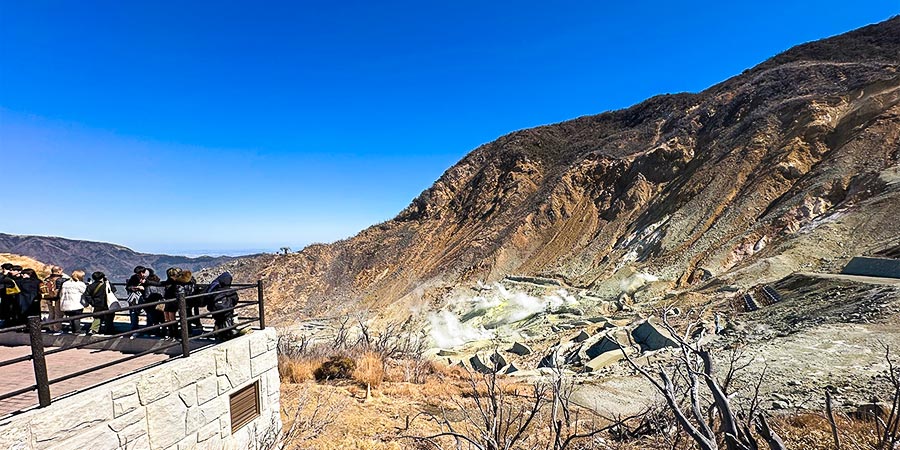
The Observation Deck opens from 9:00 to 17:00 for free.
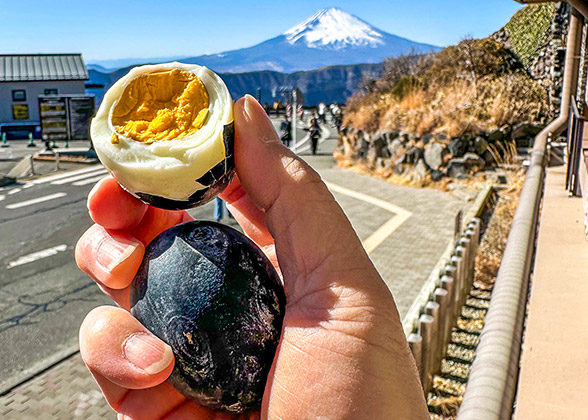
3. Tasting Black Eggs & Taking Photos with the Sculpture of Black Egg and Mt. Fuji
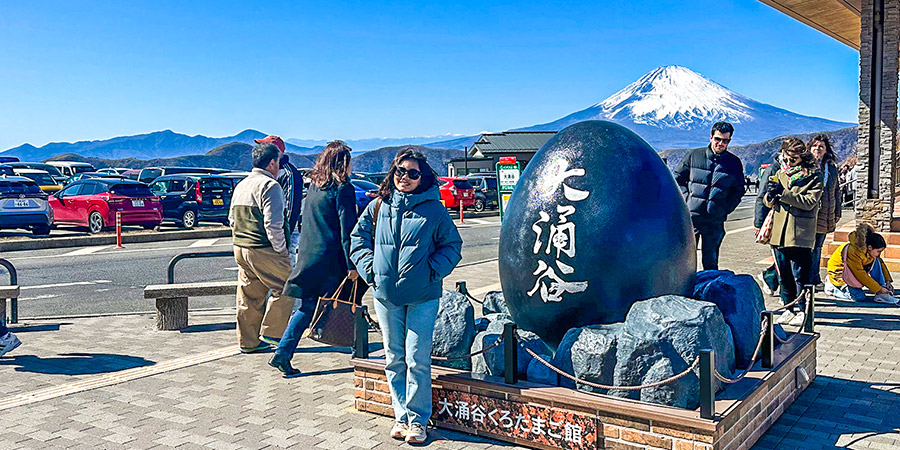
Black eggs, the most famous specialty of Owakudani Valley, refer to those with shells turning black after being boiled in the valley’s hot spring pools that contain sulphur and iron. Legend has that one’s life will be extended by 7 years if he or she eat a black egg. So, why not to taste one? Generally speaking, with JPY500 (USD3.1), 4 black eggs can be bought at the souvenir shop.Besides, near the souvenir shop, you can see a relatively large sculpture of black egg. Take a photo with the representative sculpture, and Mount Fuji is just behind you.
4. Joining Owakudani Nature Study Path and Stepping into Owakudani Valley
Want to observe the unique scenery of this volcanic area up close? You are recommended to reserve and join Owakudani Nature Study Path. It provides you with an opportunity to enter the volcanic area with the leading of staffs, admire the special scenery and feel the geothermal heat while listening to the explanations, and see the process of boiling black eggs. Moreover, you can also climb up to its observation deck to see Mount Hakone and Mount Fuji. The path is about 700 meters (2,297 feet) long and takes about 40 minutes to visit.Tips: The visiting activity is hold four times a day at 10:00, 11:30, 13:00, and 14:30, respectively, and a maximum of 30 visitors can be accommodated for one time. To join the activity, a reservation online is needed, which can be made as early as two months in advance. Then, after arriving at the scene, you can decide again whether to join or not. For those want to continue the activity, JPY800 (USD5) is required for the ticket. Please note that those with asthma, respiratory problems, and heart disease, those with difficulty walking, pregnant women, and children under 6 are not eligible to participate the activity.
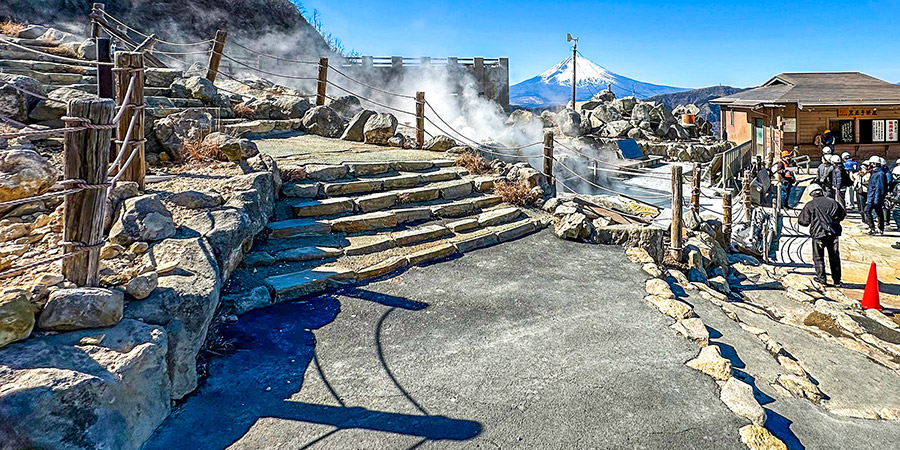
Nature Study Path
|
5. Visiting Hakone Geo Museum
The museum introduces Hakone’s geology, landscape, and history clearly, with the information of Hakone’s volcanic activity as a main part. In addition to a large number of exquisite picture and video materials, there are also many physical exhibits, models, etc., which can help visitors gain a more intuitive understanding.The operating time for Hakone Geo Museum is 9:00-16:00, and the admission is JPY100 (USD0.6).
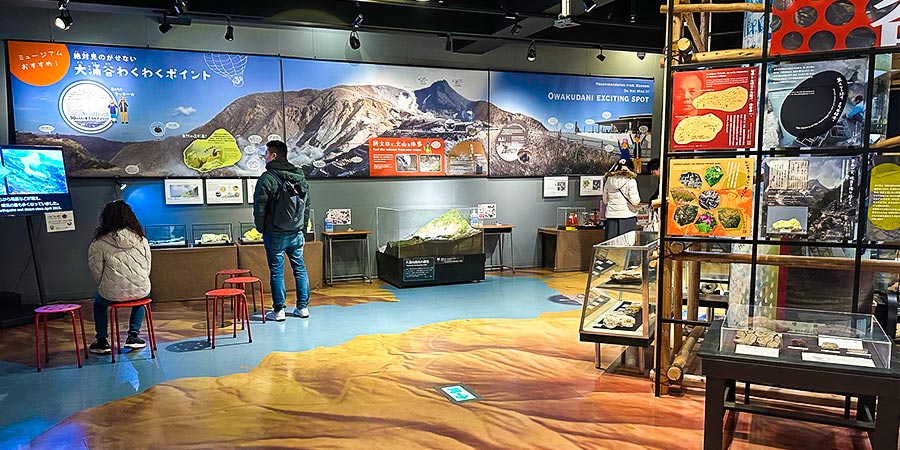
Hakone Geo Museum
|
How to Get to Owakudani Valley
From Hakone-Yumoto Station, you can:(1) Take the Hakone Tozan Train to Gora Station. Transfer to Hakone Tozan Cable Car at Gora Station to Sounzan Station, where you can take a ride of Hakone Ropeway to Owakudani Valley. The whole journey will take about 1 hour.
(2) Or, take the Hakone Tozan Bus to Moto-Hakone or Hakone-Machi, where you can experience the famous Hakone Sightseeing Cruise and get to Togendai Station. Togendai Station also allows you to take Hakone Ropeway to Owakudani Valley. The whole journey will take about 1 hour and 20 minutes.
Read Also: How to Get to Hakone from Tokyo / Kyoto / Mount Fuji...
Other Tips
1. You are advised to prepare a mask, because there will be obvious sulfur smell in the air.2. Okuda Valley is located on mountain top, meaning that there will be strong winds from time to time. Therefore, you are recommended to take a thin jacket even in summer, and wear a warm hat in winter.