

Kyoto Buses
Buses are the most popular and widely accessible way to get around Kyoto, with stops right outside nearly all major attractions. They run frequently throughout the day with short wait times, and their affordable fares strike an excellent balance of convenience and value.Kyoto’s bus network falls into two broad categories: regular fixed route services, commonly known as local buses among international visitors, and dedicated sightseeing buses. This guide focuses on local buses, the most practical option for your everyday sightseeing trips.

How Do Bus Fares Work?
Most local buses in central Kyoto operate on a flat fare - you pay the same price no matter how many stops you ride, with no need to fuss over distance calculations. A single ride costs 230 yen (1.4 US dollars) for adults, and half price for children aged 6 - 11. Nearly all the popular spots you’re likely to visit, including Kinkaku-ji, Kiyomizu-dera, Gion, Nijo Castle, and Shijo Kawaramachi, fall within this flat-fare coverage.If you plan to ride 4 or more times in a day, the Subway & Bus One-Day Pass is well worth getting. At 1,100 yen (7 US dollars) for adults, it offers unlimited travel on most bus routes and the full Kyoto Subway network, with only a handful of special routes excluded. Passes are available at subway stations and major convenience stores across the city.
There are only two exceptions to the flat-fare rule: routes to outlying attractions such as Sanzen-in Temple, Kurama-dera and Kifune Shrine charge by distance, with fares topping out at around 700 yen (4.3 US dollars); and the EX sightseeing express branch, which runs only on weekends and public holidays, costs 500 yen (3 US dollars) per adult one-way.
How Do I Pay My Fare?
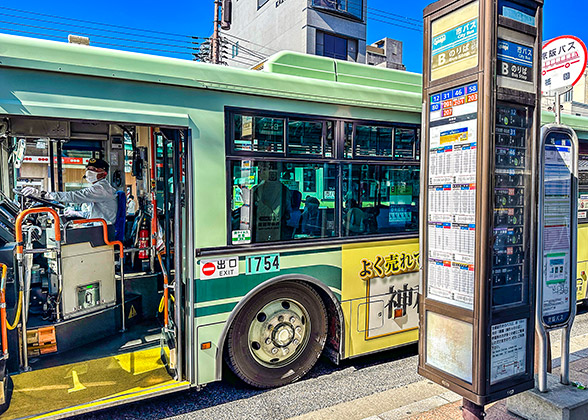
Bus Front Door to Exit
|
IC Cards
IC cards including ICOCA, Suica and PASMO, all of which are valid for public transport across Japan, are accepted, and child cards apply the half-rate fare. This is the most recommended payment method.On flat-fare city routes, simply tap your card on the reader by the front door as you alight, and the fare is deducted. For distance-based routes, tap your card on the rear-door reader when boarding to record your starting stop, then tap again when you exit. The system calculates the distance-based fare automatically, so you do not need to work out the price yourself.
Cash
Cash is advised only as a backup. The on-board fare machine accepts 1,000-yen bills (6 US dollars) and all coin denominations. When you insert a 1,000-yen bill, it automatically deducts your fare and dispenses change in coins. Bills of 2,000 yen (12 US dollars) and above are not accepted, and no change is provided for larger denominations - please have small bills or coins ready in advance.On flat-fare city routes, just pay your fare into the machine when alighting. For distance-based routes, you will collect a numbered boarding ticket when boarding through the rear door. Match your ticket number to the fare shown on the front display, then insert both the ticket and your cash fare into the slot when you get off.
Passes
On flat-fare city routes: On your first ride of the day, insert the pass into the front-door card reader before alighting to activate it, and the date of use will be printed on the pass. For all subsequent trips, simply show the dated pass when exiting.On distance-based routes: Insert the pass into the rear-door card reader when boarding to log your starting stop; no boarding ticket is required. When you alight, insert the pass again at the front door to settle your fare. Any fare difference beyond the flat-fare zone must be paid on the spot.
Which Bus Routes Can I Take?
Below are the most frequently used routes from Kyoto Station to major attractions, with all attractions reachable within a 10-minute walk from their corresponding bus stops, for your reference:
|
Attraction |
Route |
Travel Duration |
Alighting Stop |
|
Kiyomizu-dera Temple |
206 | 20 mins |
Kiyomizu-michi |
|
Sanjusangendo Temple |
206 | 15 mins |
Hakubutsukan Sanjusangendo-mae |
|
Kinkaku-ji Temple |
205 | 35 mins |
Kinkakuji-michi |
| Kitano Tenmangu Shrine | 50 | 35 mins |
Kitano Tenmangu-mae |
|
Ginkaku-ji Temple |
7 | 30 mins |
Ginkakuji-michi |
| Arashiyam | 28 | 50 mins |
Arashiyama Tenryuji-mae |
|
Fushimi Inari Taisha Shrine |
South 5 | 20 mins |
Inari Taisha-mae |
|
Sanzen-in Temple |
Kyoto Bus 17 | 70 mins | Ohara |
|
|
|
Tips
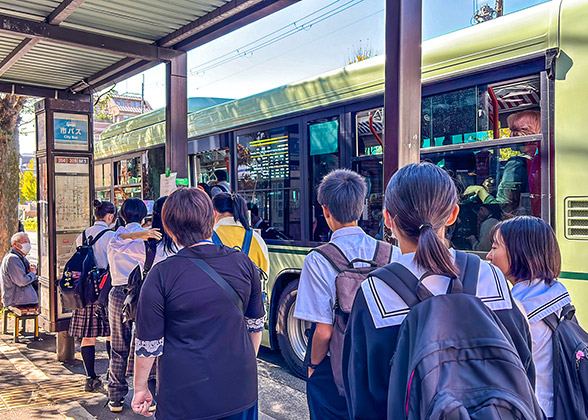
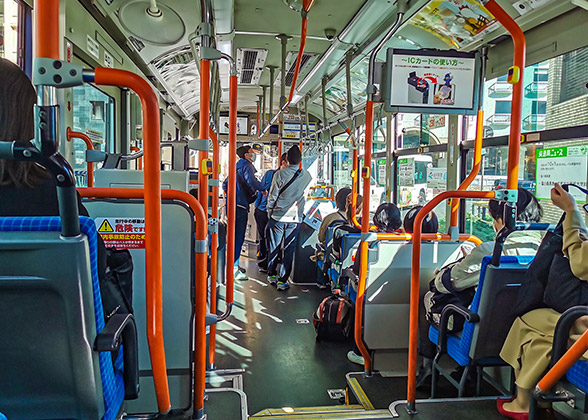
1.On nearly all Kyoto local buses, you board through the rear door and alight through the front. Press the stop button inside the bus before your stop to alert the driver; no repeat press is needed if another passenger has already done so. If you’re unsure which door to use, just follow local passengers; you’ll almost never go wrong.
2. A single bus stop name may correspond to multiple independent platforms operated by different companies, and these platforms can be over 100 meters (328 feet) apart. Always check the platform number and destination carefully when using navigation, so you don’t end up at the wrong stop and delay your itinerary.
3. Most buses you’ll take for sightseeing have a light mint-green body with dark green trim. Only a handful of suburban routes, such as Route 17 to Sanzen-in Temple, feature an off-white livery with thick burgundy stripes. Some route numbers serve more than one route alignment, so before boarding, take a quick look at both the bus’s color and the destination display above the front windshield. This simple double check greatly reduces the chance of boarding the wrong bus.
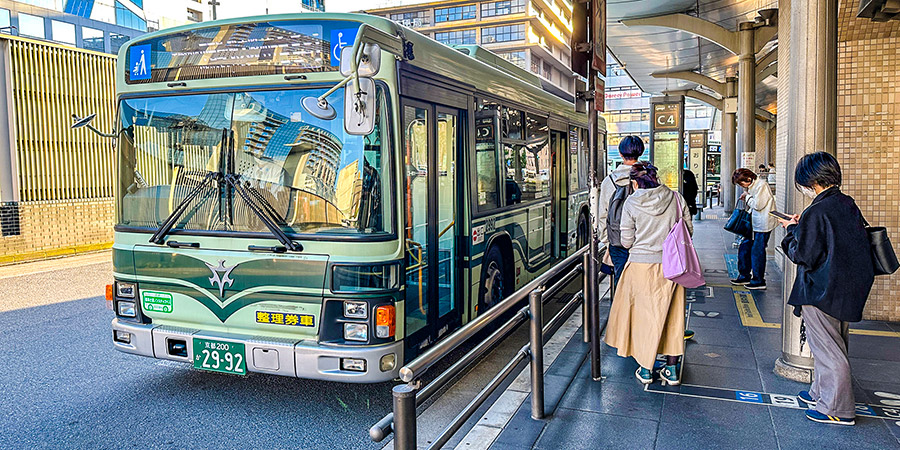
Kyoto Bus with Common Livery
|
4. On weekends and public holidays, additional Sightseeing Limited Express Bus services, namely Routes EX100 and EX101, operate toward Kiyomizu-dera, Gion and Ginkaku-ji. With fewer stops and faster travel speeds, they offer a much more efficient way to get around.
5. Most city bus routes run at high frequency, so you can usually board shortly after arriving at the stop. Outlying routes to destinations like Ohara and Takao, however, have far longer intervals, with up to 20 - 30 minutes between departures. Check the timetable posted at the stop or your navigation app for exact departure times before setting off, to avoid long, unplanned waits.
6. Last buses on outlying routes finish service much earlier than city-center routes. Plan your return journey in advance when visiting these areas, as missing the last bus will result in a very expensive taxi fare back to downtown Kyoto.
7. During peak travel seasons such as cherry blossom and autumn foliage, buses along popular sightseeing routes are prone to traffic congestion and delays. At some stops, you may even be unable to board if the bus is already at full capacity. We recommend traveling outside peak hours where possible, and building an extra 10 - 15 minutes of buffer time into your itinerary.