Day 1: Algiers Airport Pick-up & City Sightseeing; Fly to Djanet
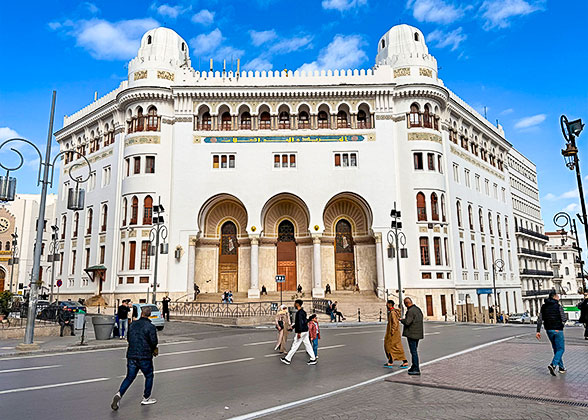
Welcome to Algeria! Upon your arrival in Algiers, your private guide and driver will pick you up at the airport and accompany you on a city tour. Let’s first head to Martyrs’ Square. Algeria made significant sacrifices in its war for independence in the 1950s and 1960s. Approximately one million people lost their lives in the fierce conflict, and thus the country is titled as the “Land of a Million Martyrs.” Revolutionary spirit has become part of the local culture. As one of the first places occupied by French army in Algiers, the square is now a peaceful haven, with seagulls flying above. If it’s on a market day, you can luckily find a lot of stalls selling traditional handicrafts. Next, let’s take a stroll along the Esplanade, admiring the azure Mediterranean Sea and the white colonial buildings. Afterward, you can take photos in front of the iconic neo-Moorish Grande Poste, or send postcards to family or friends to share your happy moments with them. After the tour, your guide and driver will accompany you to Algiers Airport for a 2.5-hour night flight to Djanet, the gateway to the Sahara Desert. After arrival, your local guide and driver will escort you to a local campsite for overnight. ► For Your Information: 1. If you arrive in Algiers after 2:00 p.m., you may not have enough time to visit all the above spots today. The itinerary will be adjusted based on your flight time. 2. We’ll spend 7 nights in campsites which may not be as well-equipped as hotels, so please prepare your travel supplies in advance. Local campsite in Djanet has shower or bathroom facilities, but desert campsites may have limited water supply. 3. The Algerian visa application process is complicated and may take about two months, and the validity period will strictly match your itinerary. You may need to fill out forms similar to a visa application when arriving in various cities. Please contact us ahead of time to confirm your itinerary details in order to apply for a visa smoothly. Accommodation: Local Campsite in Djanet Algiers Grande Poste Algeria Local Market
|
Day 2: Djanet to Tililine: Explore Steep Canyon and Guelta of Tililine
Over the next six days, we’ll venture deep into the Sahara, camping in canyons and dunes, and getting up close to nature. Our well-prepared vehicle is equipped with essential supplies including tents, sleeping mats, sleeping bags, gas stoves, and food. With your professional local guide, you can enjoy your upcoming journey without any worries!
This morning, you’ll enjoy a private transfer to Tililine Canyon, located in Tassili n’Ajjer National Park. As a UNESCO World Heritage Site, Tassili is praised as the “the world’s greatest museum of prehistoric art” for its stunning rock formations and over 15,000 petroglyphs. Ready for a visual feast? Admire the deep brown, wind-eroded rock formations, resembling giant chocolates, in the golden sands of the Sahara. Standing amidst them, you could be awestruck by the power of nature’s creation. Walking through the steep canyons, you may find the world so quiet that you can only hear your footsteps on the sand. When you hear the delightful sound of flowing water, we’re approaching the Guelta of Tililine. A guelta is a naturally formed pool in the rocky desert landscape. What many people don’t know is that, although the Sahara may seem lifeless, it actually possesses abundant underground water resources! And there may be willows and acacia trees growing in low-lying areas.
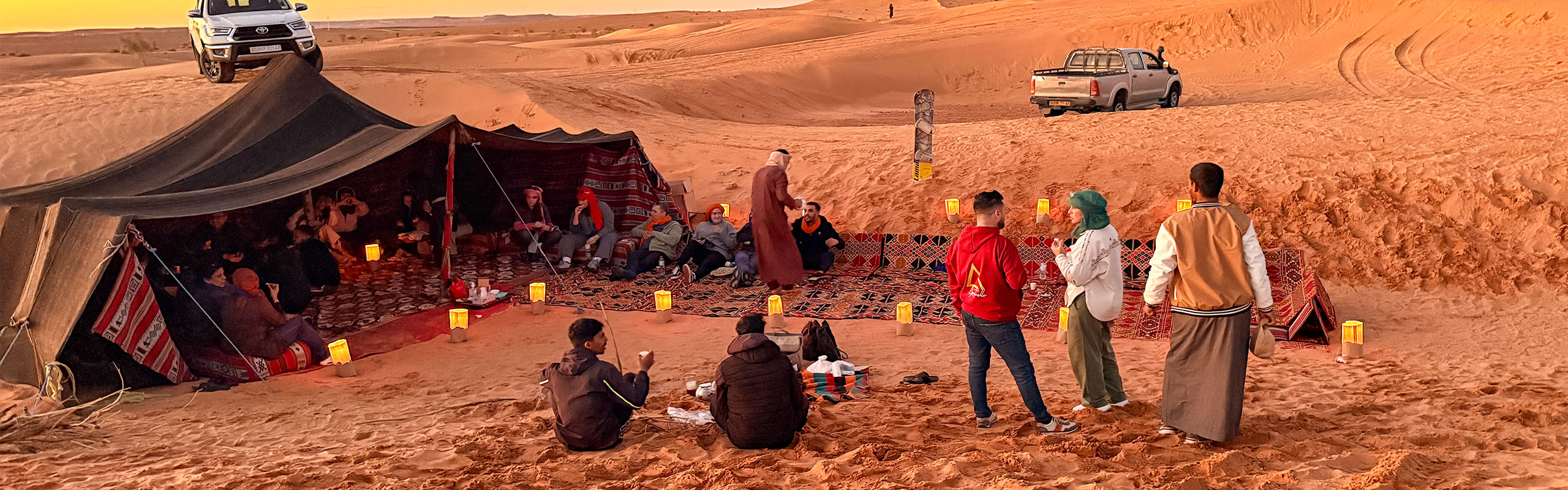
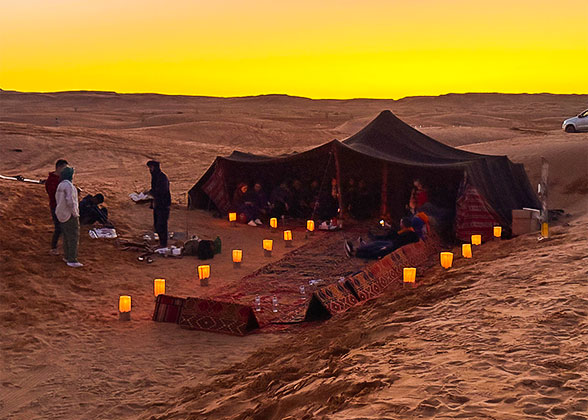
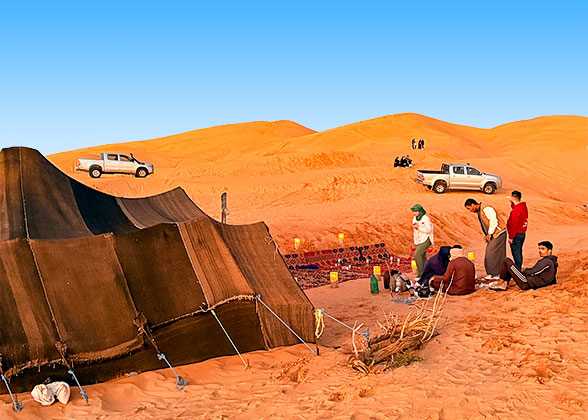
In the evening, we’ll camp in the desert and have a meal around a warm campfire. Under the twinkling stars in the Sahara night sky, you can experience the primal joy of escaping from civilized society.
► Warm Tips
1. Due to the large temperature difference between day and night in the desert, the nighttime temperatures may drop to zero, so please bring your warm clothing such as down jackets and thermal underwear. Additionally, there are no fixed power sources in the desert, so we suggest you bring a high-capacity portable power bank if needed.
2. The fine sand particles can easily get into your camera and mobile phone. Please avoid using them when it’s windy, and put them in a dust-proof bag or protective cover when not in use.
Meals: Breakfast, Lunch, Dinner
Accommodation: Desert Campsite, Tassili
|
Day 3: Tililine - Tikoubaouine - Touia Guelta - Hell Valley - Loualalaten
Today, with your guide and driver, you’ll head to the Tikoubaouine region. With rock arches and obelisks tens of meters high, here you’ll encounter one of the Sahara’s most magnificent landscapes. Surrounded by these enormous, otherworldly rocks, it’s hard not to marvel at the grandeur of nature. Harsh natural environment has made the land barren, and even the hardest rocks crumble under millions of years of scorching sun and relentless wind. However, for centuries, this desert has been home to the nomadic Tuareg people. Tuareg men often wrap themselves in long, indigo robes, thus nicknamed the “Blue Men of the Sahara.” Interestingly, Tikoubaouine is also the name of an Algerian band. They combine their ethnic elements with Western music, and create a unique style of “Desert Blues,” called Assouf in Tuareg, which means nostalgia. Then, let’s continue to the Guelta of Touia, where there is an archway spanning about 11 meters (36 ft.) as well as a lush green pool. Slow your pace, and you might encounter wildlife such as fennec foxes and Barbary sheep drinking here. Afterward, we’ll go deeper to the Wadi of Hell (Hell Valley), where you can admire the steep rock formations and listen to your guide tell the ancient stories of Tuareg. In the evening, we’ll camp overnight in Loualalaten. Meals: Breakfast, Lunch, Dinner Accommodation: Desert Campsite, Tassili
|
Day 4: Loualalaten to Essendilene: Canyon Exploration with Gueltas & Cliffs
After breakfast at the campsite, your guide and driver will accompany you to set off for Essendilene Canyon, a secret garden in the heart of the Sahara. It is a tranquil haven with bushes and wild grasses, adorned with blooming flowers. Beside the dry waterfalls, the murmuring clear streams will guide us deep into a cool pool. Soon you could find palm trees growing freely near the water. They provide shade for desert dwellers and visitors with the towering cliffs. Some of the trees are over a thousand years old! After witnessing so many desolate scenes, you can be deeply captivated by the beauty and vitality of Essendilene. Immerse yourself in its cool and tranquil atmosphere.
Tonight, we’ll camp near a guelta, where you can closely observe the rugged indentations left by wind and rain on the rocks. As night falls, stargazing with binoculars under the beautiful Milky Way will be an unforgettable experience.
Meals: Breakfast, Lunch, Dinner
Accommodation: Desert Campsite, Tassili
|
Day 5: Essendilene Canyon Hidden Gems
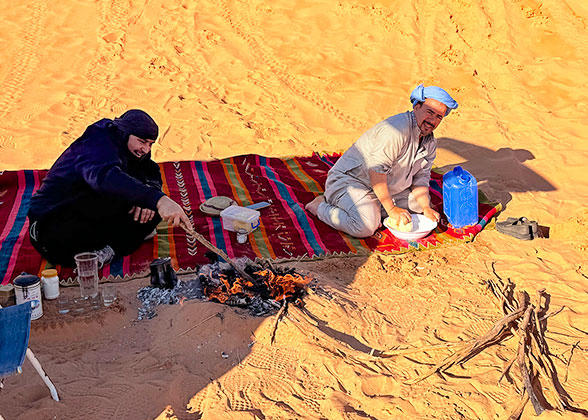
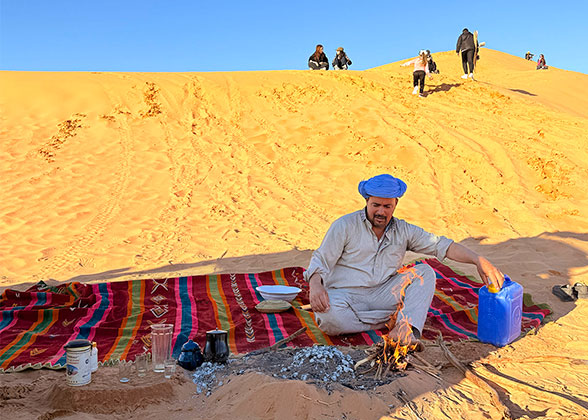
Algeria Traditional Market Today, with your guide and driver, you’ll go deep into Essendilene Canyon, discovering its deeper pools, narrower gorges, and more dramatic rock formations that are rarely visited. Seeing dense oleanders and reeds growing by the water in the rocky desert area can be truly refreshing and pleasant. Even better, such scenes are common in Essendilene, and in fact, this is exactly what the Sahara looked like thousands of years ago. For both humans and animals, where there is water, there is life. Before 8000 BC, abundant water brought vast grasslands and rushing rivers to the Sahara. Large animals like crocodiles, elephants, and giraffes lived here. Ancient nomadic people grazed their livestock on the pastures, and depicted their lives on the rocks with pigments made from red sand and blood. However, continuous climate change reduced the Sahara’s water resources, and forests and grasslands became barren. By around 4000 BC, most of the Sahara had been occupied by sand, and people had to migrate in search of places with stable water sources. That’s how today’s oases were constructed. This evening, we’ll camp near a guelta. For dinner, you’ll have chance to sample an authentic Tuareg traditional food: Taguella bread. This kind of flat bread is typically baked in the embers and hot sand of a bonfire, and then cut into small pieces and eaten with stewed meat and vegetables. Generations of Tuareg people have relied on this high-calorie food to survive the harsh conditions of the desert. Meals: Breakfast, Lunch, Dinner Accommodation: Desert Campsite, Tassili
|
Day 6: Essendilene - Erg Admer Sand Dunes & Prehistoric Remains - Tiouitatirine
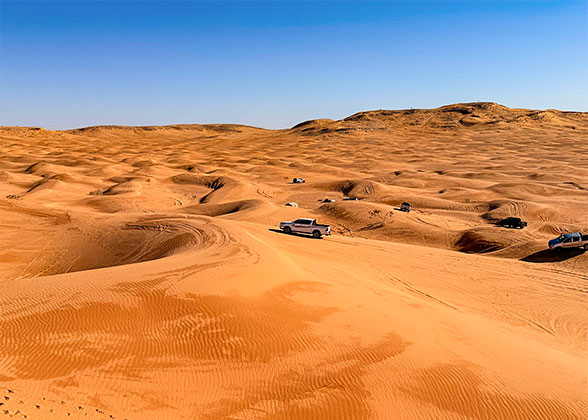
After breakfast, bid farewell to the spectacular canyon and head towards the Erg Admer sand sea with your guide and driver. As the scenery transforms from chocolate brown rocks to golden dunes, you’ll find yourself in a vibrant painting. The shifting sands, withered trees, and the blue sky, together create the painting with their simple lines and exquisite colors. As an old Tuareg saying goes, “The desert cannot be narrated; it must be lived.” Only when you step into the dunes yourself will you understand the beauty of the Sahara. Some of the dunes of Erg Admer reach heights of 150 meters (492 ft.), changing with the wind throughout the day, and presenting a mesmerizing view of the interweaving light and shadow. Then, follow your guide to find the prehistoric remains and rock paintings hidden within this boundless expanse. You can see stone dishes, pots, and arrowheads used by Neolithic humans. Here, each grain of sand carries history, taking you through time and space to dialogue with the ancient desert inhabitants. Later, we will make our way back across the Wadi of Hell and camp in the desert at Tiouitatirine, where you can appreciate the twisted rock formations. ► Old Allies of the Sahara: One-Humped Camels & Tuareg People Camels are the animal companions you’re most likely to encounter in the desert. Compared to the two-humped Bactrian camels native to Central Asia, one-humped camels have evolved characteristics better suited for desert. They are smaller, faster, and have greater endurance. 3,000 years ago, they were domesticated by Tuareg people, who are also known as “camel drivers.” In the desert, they rely solely on memory and experience to tell the directions. For centuries, caravans of people and camels have traversed the Sahara like this, promoting the prosperity of trans-Saharan trade. Meals: Breakfast, Lunch, Dinner Accommodation: Desert Campsite, Tassili
|
Day 7: Tiouitatirine - Tassili (Visit Guelta at Agzel) - In Aramas
This morning, your guide and driver will escort you to continue the exploration of the Tassili Plateau. First, let’s walk along the dried-up riverbeds between the cliffs to get to Guelta at Agzel, where rocks block the groundwater and create a small, turquoise pool.
Next, let’s head to In Aramas. Along the way, we’ll go across rocky plateaus resembling the Mars’ surface. Try to name the rocks in the sandy corridors. Ferocious dragons, nimble hedgehogs, and World Cup trophies… use your imagination! See the footprints you left on the sand, and enjoy the breathtaking beauty of the ever-changing colors and bizarre rock formations. In the warm embrace of the Sahara, we’ll find cool shade in the narrow gorges. Tonight, camp for your last night in Sahara at In Aramas. Sip a cup of sweet mint tea, peacefully enjoy the breeze and night sky, and drift off under the moonlight and stars.
Meals: Breakfast, Lunch, Dinner
Accommodation: Desert Campsite, Tassili
|
Day 8: Sahara Sightseeing, Djanet Museum & Local Market, Fly back to Algiers
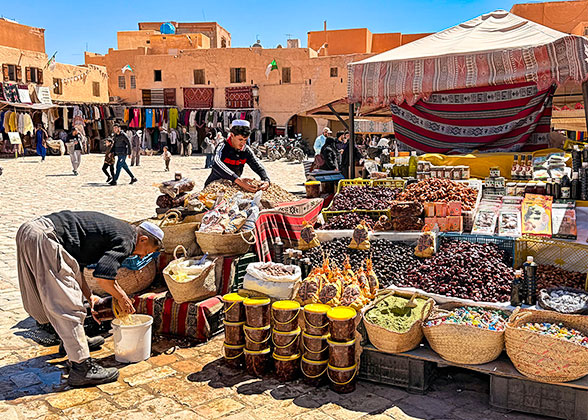
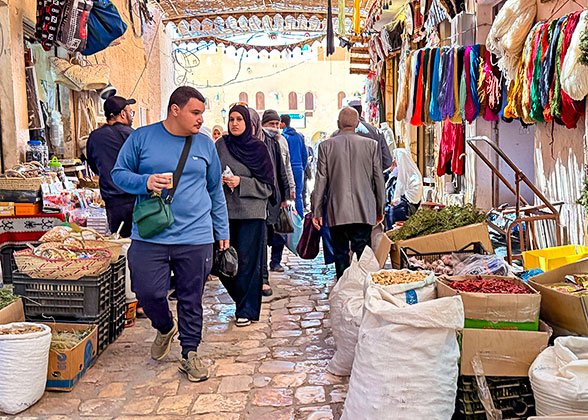
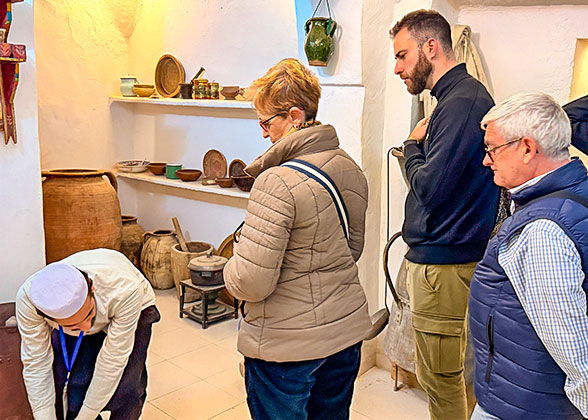
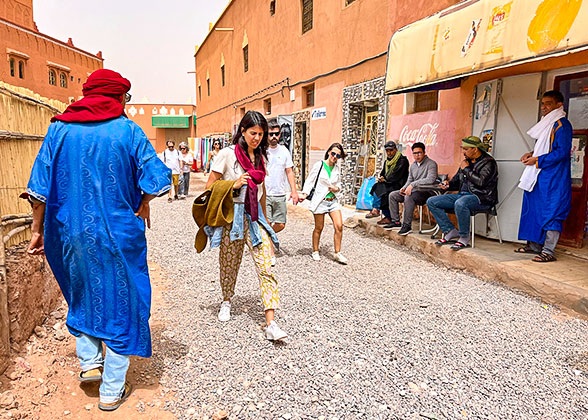
Today, with your guide and driver, you’ll first visit Oued Tekkat N’Tenere, a vast, intermittent river valley surrounded by sandstone towers. Then, at Dag Iharadj, we’ll see early human remains, including pottery and stone tools. Afterward, we’ll leave the Tassili region and return to Djanet for a town sightseeing. The first stop is the Palm Oasis. Locals maintain favorable conditions for date palms by irrigating low areas to reduce temperature and increase humidity. And in turn, the 30-meter trees provide shade and fertile soil to the land - this is the oasis effect. Next, at Djanet Museum and the 16th-century Ksour, we’ll see houses and tools of ancient desert dwellers and learn about Berber tribal life. Then, let’s visit the Artisan Workshops. Through the exquisite traditional clothing, silver ornaments, and leather crafts, you can catch a glimpse of the Tuareg culture rooted in Djanet. In Tuareg tribes, artisans hold a high status comparable to nobility, because they make and repair a wide range of items, from furniture and bags to silver jewelry, for their people. Each Tuareg craft is hand-carved and polished, carrying its unique meaning. We’ll also find Tuareg handicrafts in the local market (souk). You may discover the colorful traditional headscarves called Cheche, which protect the desert people from the scorching sun and strong wind. After the visit, your guide and driver will escort you to the airport for your flight back to Algiers. Upon arrival, your local guide and driver will pick you up and escort you to your hotel in the city center. Meals: Breakfast, Lunch, Dinner Accommodation: Hotel El Aurassi, Algiers (4 stars) or similar Djanet Local Market Djanet Traditional Ksour
|
Day 9: Algiers: Kasbah Ancient Town & Basilica of Notre-Dame d’Afrique; Airport See-off
This morning, your guide and driver will meet you at your hotel and accompany you to explore Algiers. We’ll first head to the UNESCO-listed Kasbah Ancient Town, a “white labyrinth” built on the hillside. See people chatting at mint tea stalls and children playing in the alleyways, and feel the aroma of grilled meat fills the air. Don’t worry about the police officers patrolling in the streets. It doesn’t mean there’s a security problem but is a standard security measure. Next, let’s visit the National Museum of Arts and Popular Traditions in an 18th-century palace. It was Algiers’ first city hall after the French conquest of Algeria in 1830 AD. Here you can admire traditional clothing, pottery, and textiles from different regions and ethnic groups of Algeria. It is said that Napoleon III (1808-1873 AD) resided here every time he visited Algeria. Then, let’s go to the Basilica of Notre-Dame d’Afrique, the largest Roman Catholic church in North Africa. From its garden, you can enjoy panoramic views of the architecture and the Mediterranean Sea.
After the tour, your guide and driver will escort you to the airport and see you off there. Wish you a pleasant journey!
► Note: Today’s sightseeing can be adjusted based on your time schedule. We recommend you book a late flight to fully enjoy the beauty and food of Algiers before leaving.
Meals: Breakfast, Lunch
|