Day 1: Algiers Airport Pick-up; Fly to Ghardaia
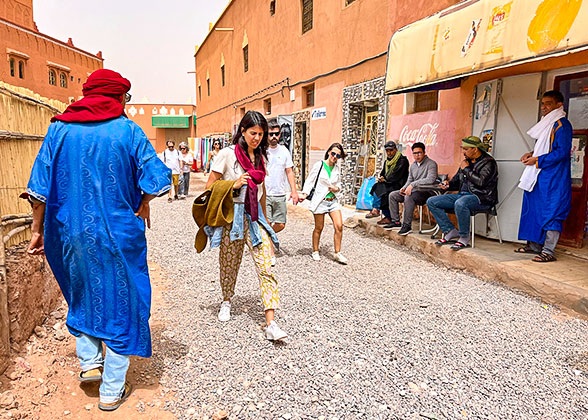
Beni Isguen, Ghardaia, M’Zab Valley Welcome to Algiers, the capital of Algeria! Your private assistant will meet you at Algiers Airport for your 1.5-hour connecting flight to Ghardaia. After arriving, your guide and driver will greet you, with a smooth private car transfer to your city center hotel. Tonight, get good rest to ease your travel fatigue and prepare for the upcoming Sahara Desert adventure. As the world’s largest desert, the Sahara covers over 80% of Algeria’s land, and weaves a tapestry of desert tribal cultures and historical heritage. ► Why You Should Pick Our Guided Sahara Tour 1. The Algerian visa application process is very complex. We can provide you with a detailed itinerary that meets official requirements to help you obtain a visa smoothly. 2. For independent travelers, oasis towns in the northern Sahara can be difficult to reach because of the harsh natural environment and underdeveloped transportation system. 3. The desert inhabitants are mostly conservative Berber tribes that may not welcome visitors. Some areas require tourists to enter with a local guide. 4. We can help you with the application process and security checks, and arrange the most convenient transportation routes during desert tours, ensuring your safety and allowing you to better understand the local culture and traditions. ► Clothing Tips As we venture deep into the Sahara, the temperature difference between day and night can reach over 20 ℃ (68 ℉), so please wear layers of clothing. Equipment to protect against sand and wind, such as sunglasses, multi-functional headscarves, and durable boots, is also necessary. Accommodation: Belvedere Hotel, Ghardaia (4 stars) or similar
|
Day 2: Ghardaia: M’Zab Valley Exploration with Beni Isguen, Ghardaia Ksar & Bounoura Town
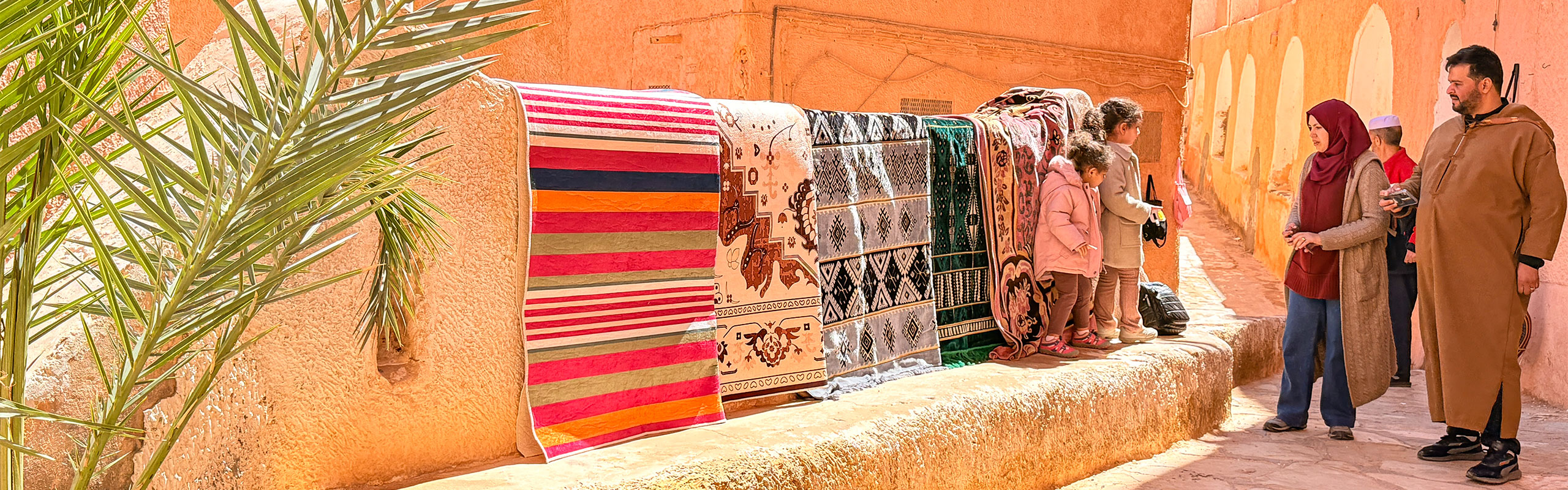
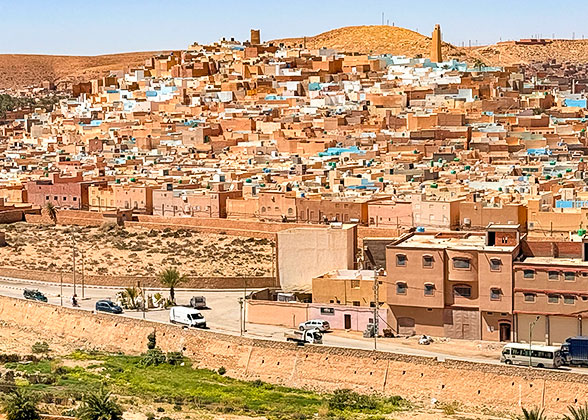
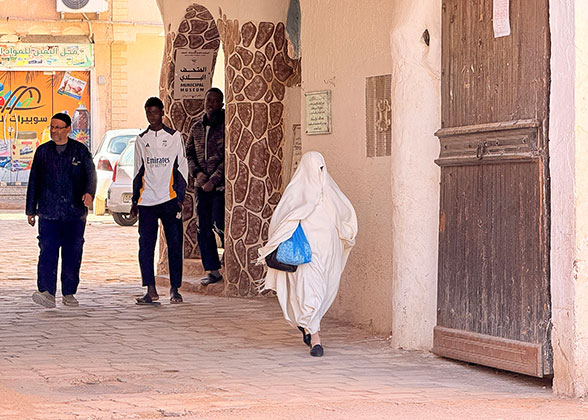
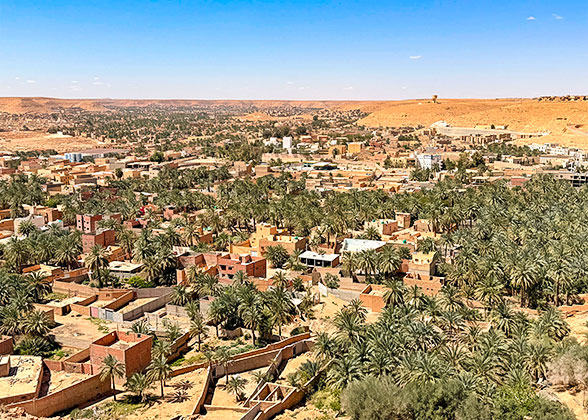
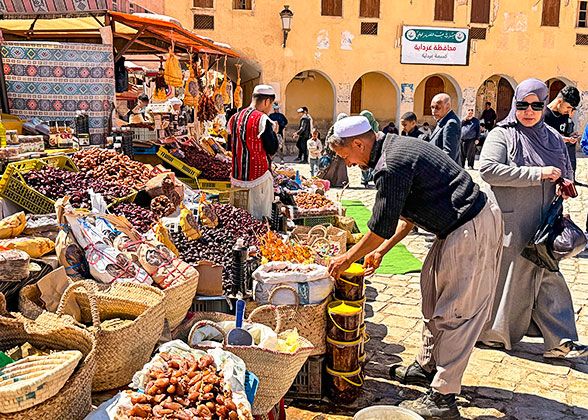
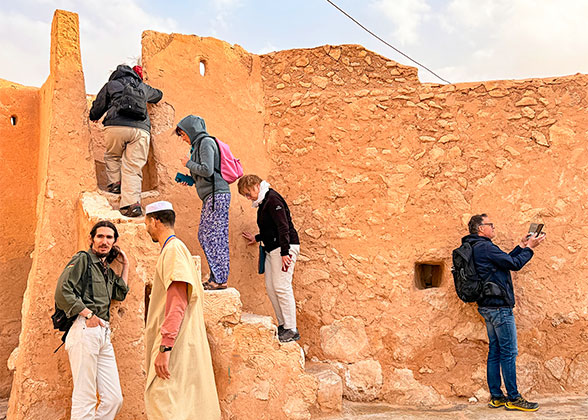
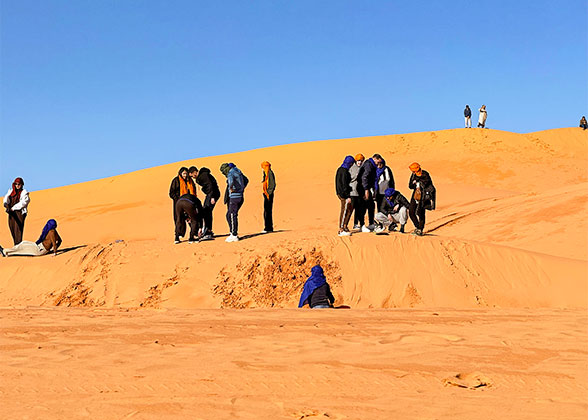
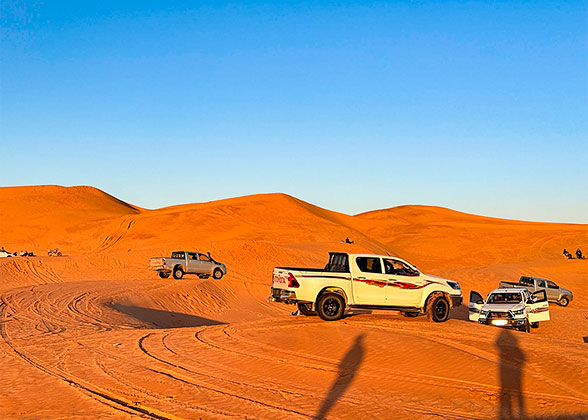
This morning, your private guide and driver will pick you up from your hotel to start today’s discovery of the M’Zab Valley, a UNESCO World Heritage Site. Since the 11th century AD, five ancient towns, including Ghardaia, have been built in the valley. The hillsides are full of beige or blue houses like toy bricks, pouring down from the top to the bottom. Local houses in each town are surrounding a minaret, which is an iconic scenery of the M’Zab Valley. Our first stop is Beni Isguen, the most traditional town in the valley, surrounded by a 3-meter-high (10 ft.) ancient city wall. To this day, Beni Isguen still strictly follows ancient rules. Every evening, the city gates are closed tightly, and no outsiders are allowed to enter. You may encounter conservative Berber women. They typically cover themselves from head to toe in a white robe, leaving only a small triangular opening for eyes to see. It’s better not to photograph them as it’s usually considered impolite. Then, let’s move forward to Boulila Tower. It is an important watchtower used in ancient times for surveillance and defense against raiders, and you can overlook Beni Isguen and the neighboring Ghardaia from here. Next, let’s return to Ghardaia to visit the Ghardaia Ksar. A ksar is a type of fortified village common in the North African desert. Traditional desert settlements often consist of one or more ksars. The doors and windows of each house are very small for defense. Still, each family can see the mosque on the hilltop from their house, which indicates the local religious culture. Ghardaia has been the largest trading center in the Sahara Desert for millennia, and we’ll visit the rectangular open-air Stone Market to discover local specialties such as dates, peanuts, and handmade carpets. In the afternoon, let’s head to Bounoura, and explore Ksar Tafilelt, the youngest town in the valley, unique for its low-carbon and energy-efficient construction built with local materials. Here, the public lighting is powered by solar energy, and wastewater is recycled as well. At the Eco Park, you can gain a comprehensive understanding of local environmental protection and organic agriculture. Every resident of Ksar Tafilelt is responsible to maintain at least one palm tree, one ornamental tree, and one fruit tree of the park. ► For your information: If you prefer desert exploration, we can change this afternoon’s Bounoura visit into desert activities in the Sebseb area. Please note that extra charges for additional mileage and experiences like camel riding, sandboarding, and 4x4 dune driving will be at your own expense on-site. It all depends on your preference. After all the visits today, your guide and driver will escort you back to your hotel. Meals: Breakfast, Lunch Accommodation: Belvedere Hotel, Ghardaia (4 stars) or similar
|
Day 3: Ghardaia - El Menia: Visit Boulila Tower, Vieux Ksar, Notre Dane des Sables
After breakfast, your guide and driver will pick you up and escort you to your hotel in the oasis town of El Menia, a journey of 3.5 to 4 hours. After checking in and having lunch, let’s start our sightseeing.
First, we’ll head to Boulila Tower. Similar to the watchtower of Beni Isguen, it’s also a part of the city’s defense system. From here, you can enjoy sweeping views of the oasis, where there are thriving palm trees, earning El Menia the title of the “Oasis of One Hundred Thousand Palms.” Then, follow your guide to climb Vieux Ksar on a 75-meter-high (246 ft.) dune. It’s like an isolated island outside the oasis, and has overlooked the palm groves and the distant Sahara trade routes since the 10th century.
Next, let’s return to the city center and visit Notre Dane des Sables, or Church of Saint Joseph. It was built 100 years ago during the French colonial period. To better integrate into the local culture and promote Christianity in the Sahara, the architecture has a beige façade that echoes the local buildings, and mosque features including a circular entrance and two minarets. The famous French Saint Charles de Foucauld (1858-1916) is buried here. He lived in North Africa for decades and made significant contributions to missionary work. In the late afternoon, we’ll go to the Salt Lake. You can leisurely wait for a sunset, enjoy the scenery, and take photos. Afterward, your guide and driver will accompany you back to your hotel.
Meals: Breakfast, Lunch
Accommodation: Hotel Oasis El Menia (3 stars) or similar
|
Day 4: El Menia: Visit Musee Public National, Palm Grove, Local Market, Oasis Lake
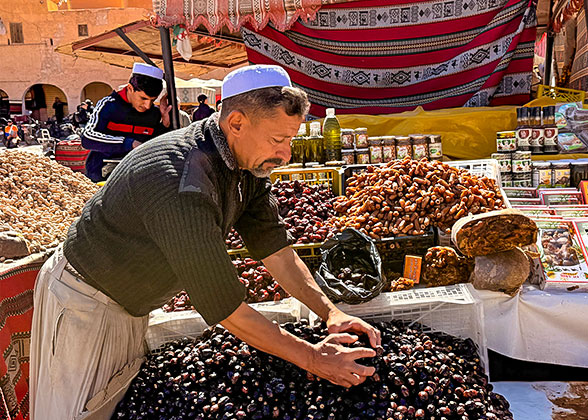
This morning, your guide and driver will pick you up from your hotel for our further exploration of El Menia. First, visit the Musee Public National d’El Menia, and see animal fossils, dinosaur bones, and evidence of prehistoric human activity from the Sahara Desert. Notably, you can admire dazzling Sahara Desert Roses which are naturally formed flower-shaped crystal clusters. They are not only natural wonders, but also carry spiritual significance of bringing good luck and energy. Next, let’s go to the Palm Grove to uncover the ancient date palm planting and irrigation techniques. There are over 180,000 date palm trees in El Menia. As early as around 4000 BC, the people of Mesopotamia had already mastered date palm cultivation. A single tree can yield hundreds of kilograms of dates. They are nutritious and sweet, perfect for arid regions. That’s why they are called “Bread of the Desert.” You can also find them at the local market we’re going next. After lunch and a short rest, we’ll drive for an hour to Oasis Lake. This vast saltwater lake is a significant gathering place for migratory birds from Europe in Africa. Every November, tens of thousands of pink flamingos stop here to rest. You can take a walk around the lake and overlook the sand dunes in the distance. Later, your guide and driver will escort you back to your hotel. Meals: Breakfast, Lunch Accommodation: Hotel Oasis El Menia (3 stars) or similar El Menia Palm Grove Dates in Local Market
|
Day 5: El Menia - Timimoun: Visit Ighzer Castle, Feraoun Caves & Tindjillet Dunes
Today, your guide and driver will pick you up from your hotel for your 5.5 to 6-hour private ride to Timimoun, the “Red Oasis” with red mud-brick houses. We’ll drive along the edge of the Grand Erg Occidental, one of the largest sand seas in the Sahara, and pass several checkpoints and encounter people from different regions or wild dromedary camels. If you wish to stop to capture the scenery, please feel free to tell your driver. Upon arrival, your guide will assist with check-in at your hotel. After a short rest, we’ll head to Ighzer Castle, a ksar standing atop a rocky plateau with crumbling ruins. Below the castle is the Ighzer Cave, a large and deep natural red cave, perfect for photography. From here, you can enjoy views of the tranquil Ighzer Village in the distance. Next, let’s go to the Feraoun Caves that have served as shelters and storage for centuries. Stepping inside, you can be embraced by a refreshing coolness completely different from the outside. Locals usually come here to escape the summer heat. Before dusk, we’ll climb the red Tindjillet Dunes, and admire a Sahara sunset, watching the Grand Erg Occidental dyed golden. After that, your guide and driver will escort you back to your hotel. Meals: Breakfast, Lunch Accommodation: Guest House in Timimoun
|
Day 6: Timimoun Ksar Exploration with Foggara Irrigation System & Tmana Village
Today, your guide and driver will pick you up from your hotel to explore Timimoun. First, we’ll visit Timimoun Museum if it’s available. Afterward, witness some of Timimoun’s historic ksars, including Old Ksar Tahatayt, Aghlad’s Ksours, and Ouled Haroun Castle. They were built both for defense and residence, and each of them tells the wisdom and adaptability of people thrived in the harsh Sahara Desert for hundreds, even thousands of years.
★ Hidden Facts about Ksar 1. Narrow, Maze-like Alleyways: The width of the alleyways was based on the width of a pregnant donkey, convenient for carrying goods, escaping from the heat and wind, and confusing the enemy.
2. Clever Site Selection: Most of the ksars are situated on the highland next to an oasis for people to observe enemy movements and avoid natural disasters like floods.
3. Unique House Design: Houses in ksar typically have only a few small windows, which is the most direct way to minimize indoor sunlight to get shade.
Next, in Ouled Said and Hadj Guelmane, get ready to be amazed by the secret to the enduring vitality of desert oases - Foggara irrigation system. As early as the 11th century AD, desert inhabitants had built foggaras. They dug underground channels to bring precious groundwater into the oases and settlements, supporting local crop irrigation and water consumption. It is a true miracle to see flowing water in the Sahara!
Finally, let’s go to Tmana Village, also known as Small Tassili, to discover the spectacular wind-eroded landscape and prehistoric human relics. You can admire the dramatic ochre rock formations, explore the lunar-like landscape, and watch sunset over the dunes. After that, your guide and driver will escort you back to your hotel.
Meals: Breakfast, Lunch
Accommodation: Guest House in Timimoun
|
Day 7: Timimoun - Beni Abbes: Visit Hermitage of Foucauld, See Rock Paintings & Engravings
This morning, let’s bid farewell to Timimoun and drive northwest for 4.5 to 5 hours to our next destination, Beni Abbes. Upon arrival, your guide and driver will assist you with hotel check-in. After having a local lunch, let’s explore this oasis town.
We’ll start from the Hermitage of Charles De Foucauld. Remember Saint Foucauld mentioned during our visit to El Menia? This is where he spent the last years of his life in Beni Abbes. There are still several monks living here and celebrating daily mass in his memory. Next, if time permits and the site is open, we’ll visit the Sahara Museum, and see insect and animal specimens from the Sahara. Then, follow your guide to the Marhouma area, where you can admire the precious rock paintings and engravings from the Neolithic Age (around 10,000 BC to 3,000 BC). The depictions of carts and trading scenes are testaments to the ancient trade between West and North Africa.
Later, enjoy a breathtaking sunset over the Saoura Valley in the vast desert, and then your guide and driver will escort you back to your hotel.
Meals: Breakfast, Lunch
Accommodation: Hotel Saoura, Beni Abbes (4 stars) or similar
|
Day 8: Beni Abbes - Taghit: Visit Petroglyphs, Valley of Ksour & Grand Erg Occidental
After breakfast, your guide and driver will pick you up from your hotel for a 2-hour journey to Taghit in a narrow valley, which is one of the most beautiful oases in the Sahara, with abundant groundwater. Upon arrival, we’ll first visit the historical petroglyphs hidden in the desert. Around 15,000 years ago, the Sahara was a fertile plain teeming with grassland animals. That’s why you can spot rock paintings of antelopes, giraffes, ostriches, and elephants. They look simple with only a few lines, but remarkably vivid and captivating. Next, in the Valley of Ksour, let’s enjoy the color contrast of the verdant palm groves and golden sand dunes. There are six ancient ksars dating back 600 to 700 years, together forming today’s Taghit. Afterward, we’ll have lunch and take a short rest to avoid the intense midday sunlight. In the afternoon, follow your guide into the Grand Erg Occidental. These massive sand dunes were formed over 2 million years ago, and are still changing with the wind, sometimes creating crescent-shaped dunes. Take a stroll and enjoy the desolated desert scenery, and then watch the rolling sand dunes turn from gold to pink at sunset. After that, your guide and driver will accompany you back to your hotel. Meals: Breakfast, Lunch Accommodation: Hotel Bladi Palace Taghit (4 stars) or similar
|
Day 9: Taghit Palm Grove & Old Ksar - Bechar Airport - Fly back to Algiers
This morning, your guide and driver will meet you at your hotel for your Taghit center exploration. First, we’ll head to Taghit Palm Grove. As we go deep in the dense forest, you can see a natural lake formed by groundwater from the valley. Strolling along the lake, you can try to find the black and white Moula-Moula bird, which is believed to bring good luck and vitality. We’ll also visit the Old Ksar of Taghit, admiring its ancient wells, mosques, and ochre houses.
Later, you’ll enjoy a 1.5-hour private transfer to Bechar Airport, and take a 2-hour flight back to Algiers. Upon arrival, your guide and driver will pick you up and escort you to your hotel.
► Flight Information for Your Reference
Direct flights from Bechar to Algiers are not available daily. If it’s on a Sunday, you may need to transfer in Oran. There are no flights on Tuesdays or Thursdays, so we’ll arrange a private transfer for you to get back to Algiers, which may take a full day. You can consult our travel advisors for more details before finalizing your itinerary.
Meals: Breakfast, Lunch
Accommodation: Hotel El Aurassi, Algiers (4 stars) or similar
|
Day 10: Algiers: Kasbah Ancient Town, Martyrs Memorial & Basilica; Airport See-off
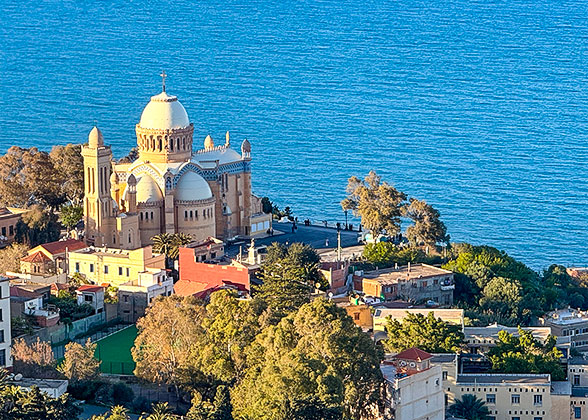
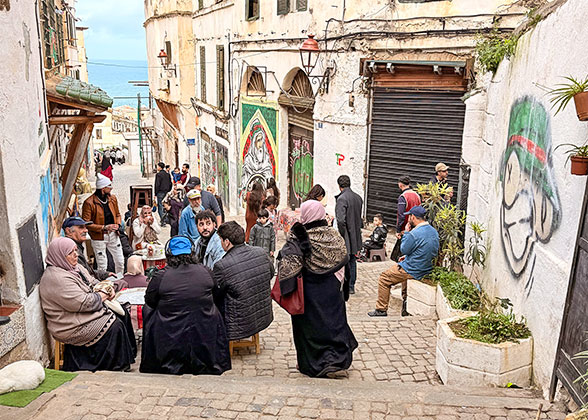
This is the last day of your vacation. Before leaving, follow your guide to explore the capital’s important historical sites. The first one is the Kasbah Ancient Town, a UNESCO World Heritage Site. From afar, you can see a cluster of houses on the hillside. As you go inside, prepare to be overwhelmed by a spiderweb of streets and stairs. Driving is almost impossible within the Kasbah, and the residents still rely on donkeys, which is why it was a significant refuge during the Algerian War of Independence (1954-1962). Continuing south, the cityscape before you will change as the houses shift from white Muslim architecture to French colonial buildings with porches and verandas. If it weren’t for the spice stalls and people in robes at Martyrs’ Square, you might think you were in Paris. Adjacent to the square is Algiers’ oldest mosque, El Djedid Mosque, where you can take photos in front of its Byzantine-Ottoman architecture. Afterward, we’ll visit the Basilica de Notre Dame d’Afrique overlooking the Bay of Algiers. Built in 1872 AD, it’s a French colonial legacy. This is perhaps the most special Catholic church you’ve ever seen. Its façade is adorned with Arabic-style carvings and mosaics, and it welcomes everyone regardless of faith, including Muslims. Then, we’ll visit Martyrs Memorial, which was built to commemorate the martyrs of the War of Independence. After the sightseeing, your guide and driver will escort you to Algiers Airport in about 30 minutes and see you off there. Have a nice journey! ► Note: Today’s itinerary can be adjusted based on your departure flight time. We suggest you book a late flight to have ample time to explore the historic city. Meals: Breakfast, Lunch
|