Day 1: Algiers Airport Pick-up; City Sightseeing with Martyrs’ Square & Grande Poste
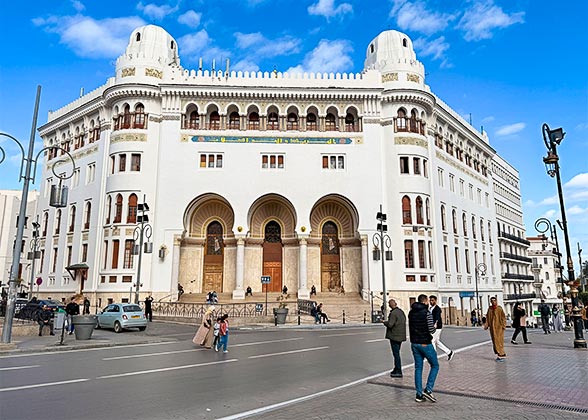
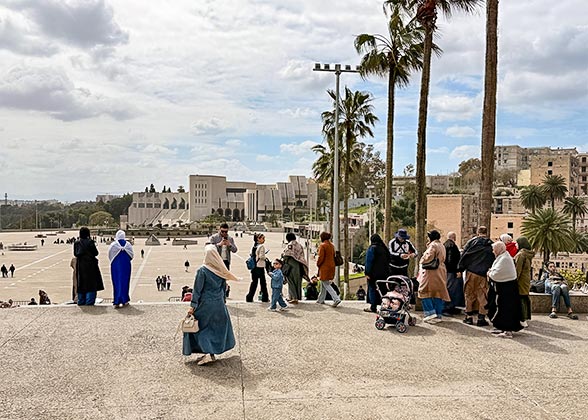
Welcome to Algiers! Upon your arrival at Algiers Airport, your private guide and driver will pick you up and escort you to your hotel. Later, we’ll arrange a wonderful Algiers city tour for you based on the remaining time today. Let’s start from Martyrs’ Square. Once served as the French Government Square, it was a main venue for demonstrations during the Algerian War of Independence (1954-1962), and later a memorial to the martyrs who died in the war. Now, the turbulent years are long gone, and you can sit on a bench and experience the relaxed atmosphere, admiring the French colonial buildings that has become an integral part of the city. Afterward, let’s visit the century-old Grande Poste, admiring its iconic Neo-Moorish horse-shoe arches and intricate plaster carvings. Then, stroll along the Esplanade, and admire the balconies with wrought ironwork and graceful arcades of the white buildings. You can overlook the Bay of Algiers and the Mediterranean Sea. After the city tour, your guide and driver will accompany you back to your hotel. ► Why Choose Us Although Algeria has abundant tourism resources, it has not prioritized tourism development. So, the infrastructure and services may be inadequate, especially in the Sahara Desert region, for independent travelers. Choosing our private guided tours can simplify your visa application and itinerary planning, and help you better experience the local culture and history without concerns about transportation and accommodation. Accommodation: Hotel El Aurassi, Algiers (4 stars) or similar Algiers Grande Poste Algiers Street View
|
Day 2: Round-trip to Cherchell: Tipasa Roman Ruins & Royal Mausoleum of Mauretania; Fly to Ghardaia
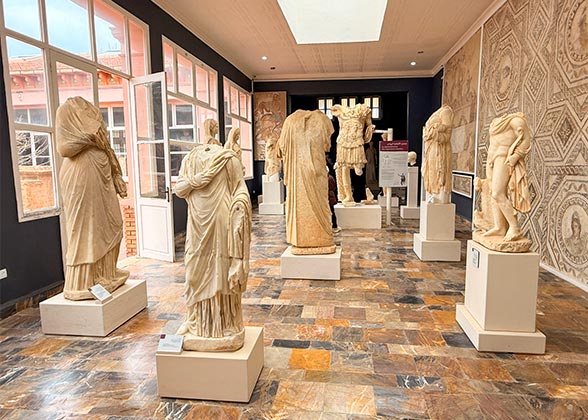
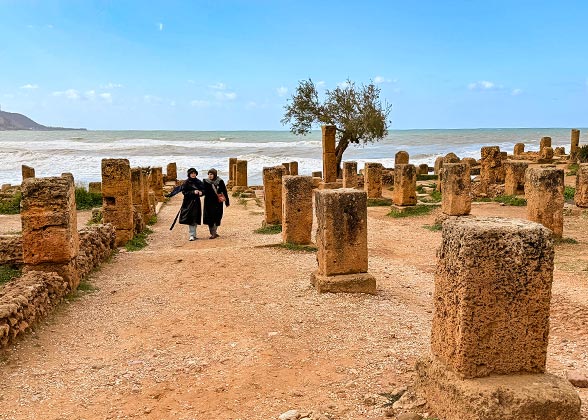
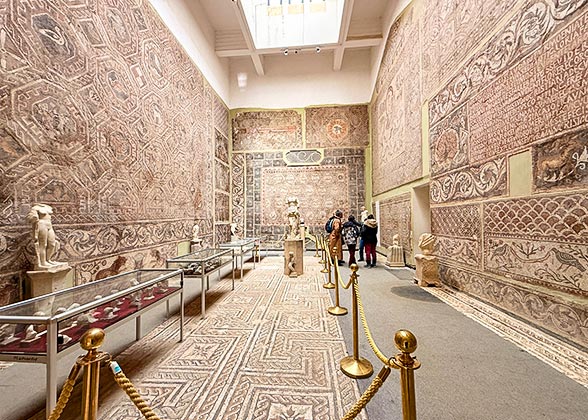
This morning, your guide and driver will meet you at your hotel, and accompany you to Cherchell by a 1.5-hour drive. This tranquil port city was once the capital of the Kingdom of Mauritania in Roman times. King Juba II (50 BC-24 AD) built theaters and libraries, and collected a lot of marble sculptures, transforming Cherchell into a cultural city imbued with Greek and Roman classical charm. At the Archaeological Public Museum of Cherchell, we can see the statues and Roman mosaics collected by the king. Next, let’s proceed to Tipasa Roman Ruins, where your guide will lead you to discover the traces of the glorious empire on the Mediterranean coast. 2,000 years ago, Tipasa, with its brilliant sea scenery, attracted wealthy Romans and merchants to build villas and luxurious residences. We’ll also admire one of the oldest Christian cathedrals in North Africa, the Basilica of St. Salsa, built in the 4th century AD. Later, on our return journey to Algiers, let’s explore the Royal Mausoleum of Mauretania, the final resting place of King Juba II and his wife Cleopatra Selene II, where you can learn more about the two legendary monarchs. Then, your guide and driver will escort you to Algiers Airport for your 1.5-hour evening flight to Ghardaia, a desert city in the M’Zab Valley. Upon landing, a local driver will pick you up and escort you to your hotel in 20 minutes. Meals: Breakfast, Lunch Accommodation: Belvedere Hotel, Ghardaia (4 stars) or similar
|
Day 3: M’Zab Valley Exploration: Beni Isguen, Ghardaia Ksar, Stone Market, Ksar Tafilelt & Eco Park
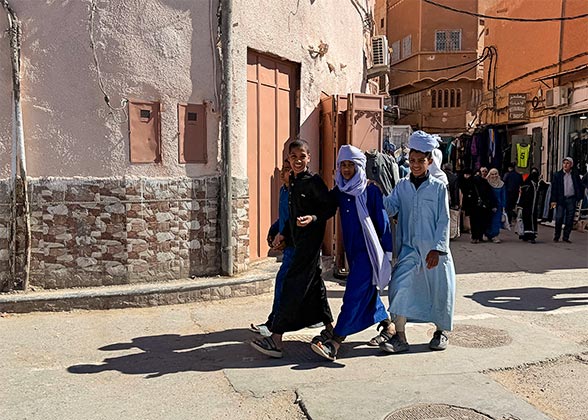
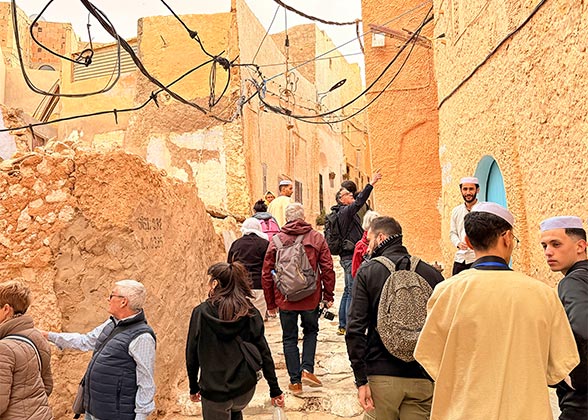
After breakfast, your guide and driver will pick you up from your hotel, and accompany you on a tour of the architectural wonders of the UNESCO-listed M’Zab Valley. First, head to Beni Isguen, an ancient oasis town founded around 1347 AD. As you pass through the city gate, you can feel a strong conservative Islamic atmosphere. The ochre houses are built close together, each with only tiny windows and closed doors, and there are few people on the streets. As we wind our way up the narrow alleyways, the surrounding buildings will be more historic. At the Boulila Tower atop the hill, you can enjoy the panoramic views of the entire valley. However, for locals, this watchtower is used to monitor floods and the movements of people outside the city after the gate closes at night. ► Note: Smoking and photographing local women are strictly prohibited inside Beni Isguen, so please respect local religious culture during our visit. Next, let’s carry on to visit Ghardaia Ksar. The Ksar, meaning fortified fortress, is a testament to Mozabite people’s ingenuity in building settlements in the desert. You’ll find the buildings here typically light beige or white, which is not only because white symbolizes purity in Islam, but also because light-colored walls can reflect solar radiation and reduce indoor heat. In addition, the narrow streets create natural ventilation, helpful in a place where the summer temperatures can reach 48°C (118 ℉). Later, at Ghardaia’s vibrant Stone Market, we’ll discover local food customs and traditional handicrafts through stalls selling burnous cloaks, dates, and tapestries. After having a local lunch, our exciting day will conclude with a visit to Ksar Tafilelt, a low-carbon pilot zone, and its Eco Park, in the town of Bounoura. Your guide and driver will then escort you back to your hotel. Meals: Breakfast, Lunch Accommodation: Belvedere Hotel, Ghardaia (4 stars) or similar
|
Day 4: Fly from Ghardaia back to Algiers; Visit Djemila Roman Ruins; Drive to Timgad
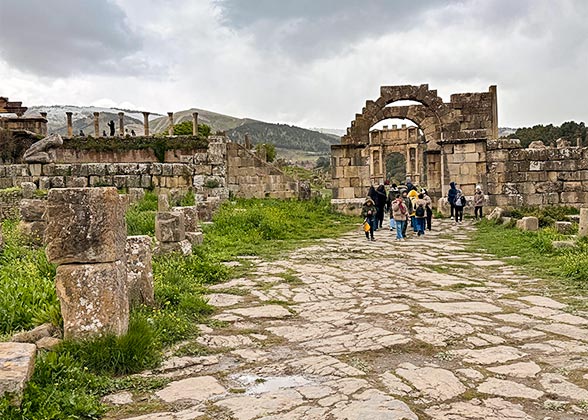
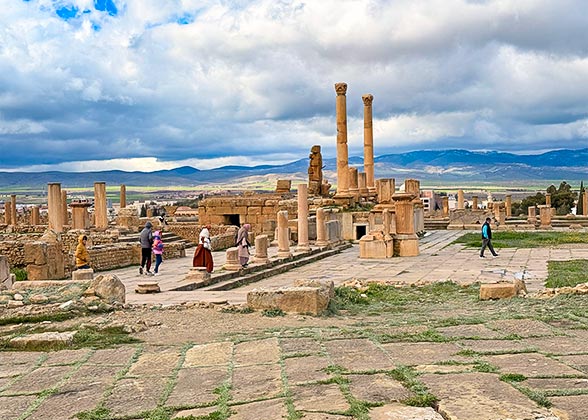
In the morning, your driver will pick you up from your hotel for your private transfer to Ghardaia Airport, from which you will take a 1.5-hour flight back to Algiers. Upon arrival, your Algiers guide and driver will escort you to today’s highlight, Djemila Roman Ruins, by a 1.5-hour drive. Despite the long journey, Djemila will make your visit worthwhile. In Roman times, Djemila was a thriving city because it’s on a major transportation route. Even today, it’s not hard to discover traces of its former prosperity through the remaining architectural fragments and ruins. The ancient forum, once a venue for public gatherings, speeches, and even trials, was also a marketplace with shops, banks, inns, and pubs. Following your guide, you can discover the drainage channels, food stalls, horse watering points, and even public spaces with toilets! From these, you can get a glimpse of the lives of ordinary citizens two thousand years ago. And when you see the whole walls covered in Roman mosaics in the Archaeological Museum of Djemila, you can be captivated by the astonishing artistic achievements of the Romans. After the tour, your guide and driver will accompany you on a 3-hour drive to your hotel in Timgad and assist you with check-in. Meals: Breakfast, Lunch Accommodation: Timgad Trajan Hotel (3 stars) or similar
|
Day 5: Timgad Roman Ruins Discovery
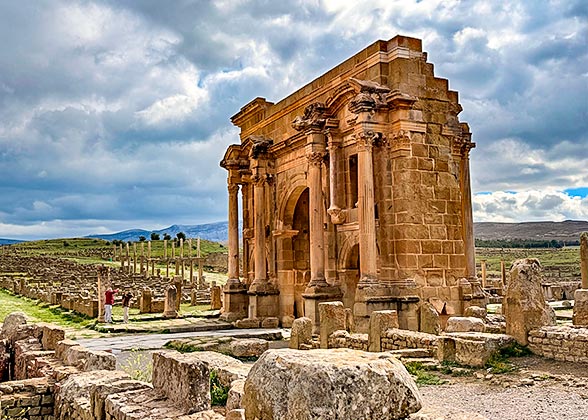
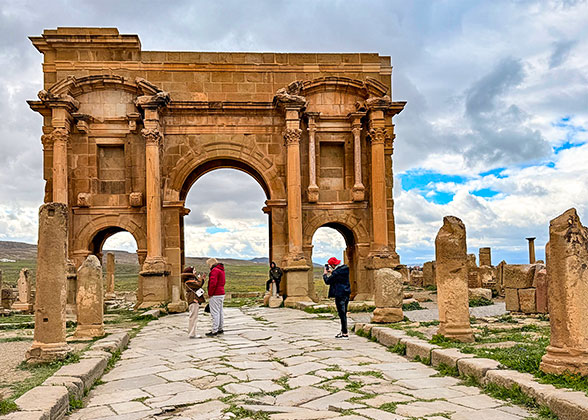
Today, with your guide and driver, prepare to further explore Timgad Roman Ruins. The city has a strict grid layout, with meticulous zoning and water systems. Remarkably, as early as the 1st century AD, the Romans were constructing apartment buildings with storefronts on the ground floor. These buildings called Insulae were typically six stories high, and each floor was divided into multiple apartments for different families. Generally, the higher the floor, the poorer the family. However, for the rich, building and decorating their villa, or Domus, was a symbol of status and wealth. Exquisite frescoes and mosaics are often found on the walls and floors of these residences. After admiring the best-preserved building in Timgad, the 12-meter-high (40 ft.) Arc of Trajan, your guide and driver will escort you back to your hotel. Meals: Breakfast, Lunch Accommodation: Timgad Trajan Hotel (3 stars) or similar
|
Day 6: Timgad - Madghacen Royal Mausoleum - Tiddis Roman Ruins - Constantine
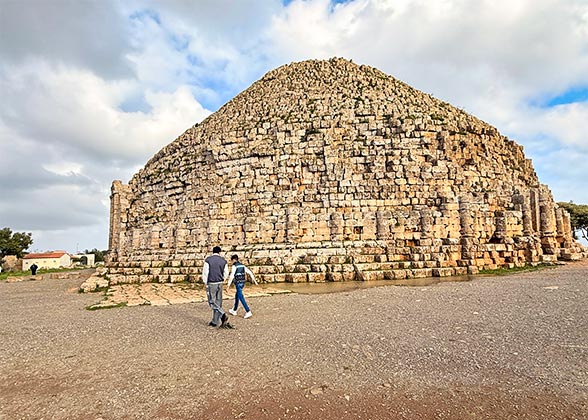
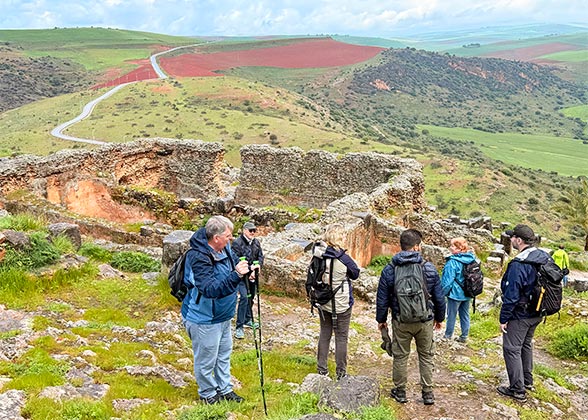
Let’s bid farewell to Timgad and head north to Constantine, the “city of bridges”, and explore historical sites along the way. After one hour’s ride, your guide and driver will first accompany you to Madghacen Royal Mausoleum. Belonged to a pre-Roman Numidian king in North Africa, it is a larger version of the traditional Berber conical tomb called “Bazina”, measuring 59 meters (193 ft.) in diameter! You can see the 60 classic Doric columns that surround the exterior, which is proof of the Hellenistic influence here before Roman expansion. We’ll then visit Tiddis Roman Ruins after a two-hour drive. Compared to the Roman sites we have visited before, Tiddis may not be the largest or most extensively excavated, but it shows unique features as a former military camp. There is no open forum and regular layout, and every road and every building are built on the hillside. You could find an underground cistern in every building, which is to make the best use of natural rainwater. The largest cistern even had a capacity of 350,000 liters! Let’s explore the Bazinas, Arch of Memmius and Roman temples, and enjoy the delightful scenery of the valley. After that, we’ll continue to Constantine. As an ancient military stronghold, it’s perched atop steep cliffs and accessible only via bridges spanning Rhumel Gorge. Upon arrival, your guide will assist you with hotel check-in. Meals: Breakfast, Lunch Accommodation: Novotel Constantine (4 stars) or similar
|
Day 7: Constantine City Tour: Cirta Museum, Old Town, Monument aux Morts & Souika District
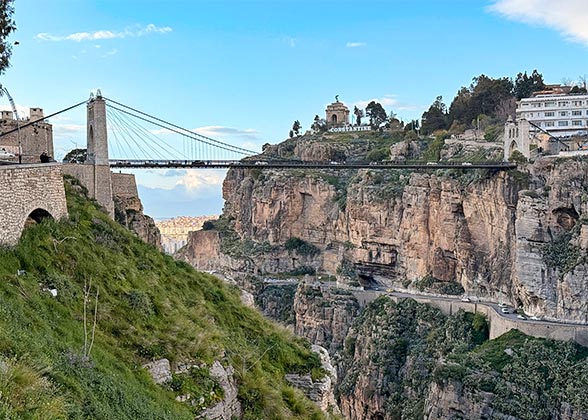
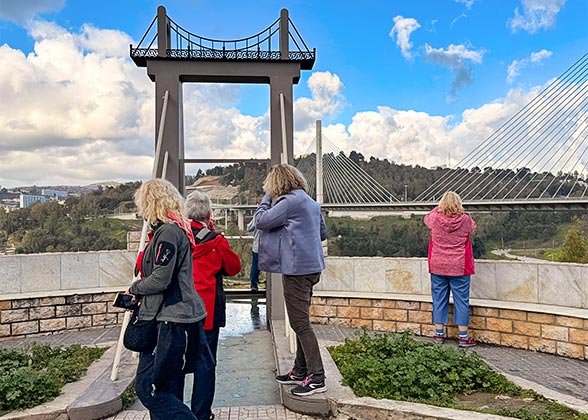
This morning, your guide and driver will be waiting for you at your hotel for your Constantine city tour. We’ll start from Cirta Museum. This 19th-century Ottoman palace houses artifacts from the 3rd century BC to the French colonial period (1830-1962 AD). Your guide will show you the exquisite statue of Dionysus, the god of wine. You can clearly see the wine cup in his hand and the vines and grapes beside him. Next, let’s stroll through the vibrant alleyways of Constantine Old Town, immersing into the rich history amidst the bustling crowds. After admiring the colorful Ottoman frescoes at Ahmed Bey Palace, we’ll walk along the Boulevard of the Abyss for breathtaking views of the 170-meter-deep (557 ft.) Rhumel Gorge. Also, you can overlook the white-walled, red-roofed French-style houses and the great bridges over the gorge. Sidi M’Cid Bridge, connecting the Old Town to Sidi M’Cid Hill, is the city’s most spectacular suspension bridge and once the world’s highest one. Via this bridge, we’ll reach the iconic Monument aux Morts. It is modeled after Timgad’s Arc of Trajan, and on its top, there is a statue of the Victory of Constantine, a replica of an ancient Roman bronze artifact unearthed here. Then, we’ll go across the hidden Mellah Slimane Footbridge. It’s 125 meters (410 ft.) long and over 100 years old. Walking on it, you might even feel a slight sway, but don’t worry, its structure remains sturdy today. Later, we’ll return to the Old Town and explore the bustling Souika District, a lively hub of artisans and street vendors for centuries. Then, witness the intricate Moorish Islamic architecture of the Great Mosque before your guide and driver escort you back to your hotel. Meals: Breakfast, Lunch Accommodation: Novotel Constantine (4 stars) or similar
|
Day 8: Fly from Constantine to Djanet
Today, let’s depart for Djanet, the gateway to the Sahara Desert. Enjoy a private transfer to Constantine Airport, and take a two-hour flight to Djanet. Upon arrival, your local driver will pick you up and escort you to your hotel.
► Note: Flights from Constantine to Djanet are not daily available. If there are no direct flights, your driver will escort you back to Algiers Airport in about 4 hours and then assist you with your 2.5-hour flight from Algiers to Djanet.
► Warm Tips for Desert Exploration
We will spend the next three nights in remote desert camps. All your meals are included, but the electricity may be unreliable, so we recommend you bring your own high-capacity power bank. Besides, please be prepared that you may not be able to shower since water is limited in the desert. Additionally, bring a windproof headscarf, boots, and warm clothing to cope with the unpredictable Sahara weather. Sleeping bags and blankets are provided for free, and you can also consider bringing your own lightweight down sleeping bag for warmth at night.
Meals: Breakfast, Lunch
Accommodation: Hotel Tenere Djanet (3 stars) or similar
|
Day 9: Sahara Adventure: Djanet – El Biredj Canyon – Moul el Naga – D’In-Djarena Canyon
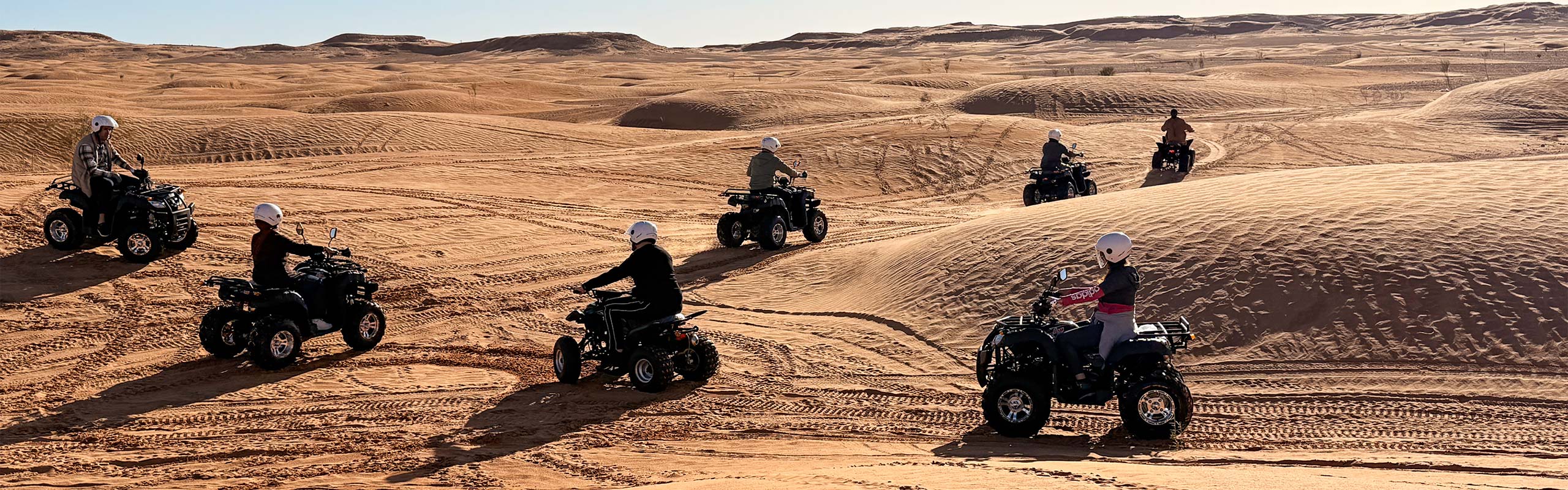
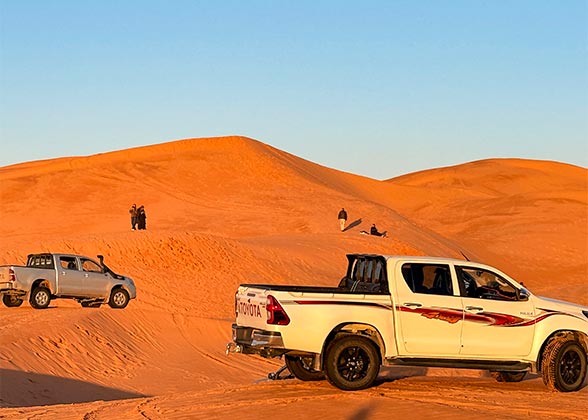
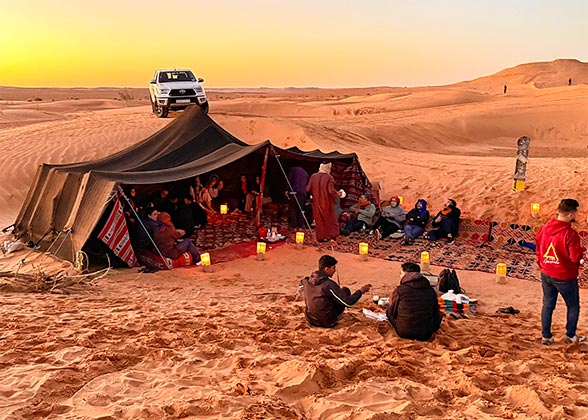
This morning, follow your experienced local guide and driver in a 4x4 into Tassili n’Ajjer National Park, the most breathtaking area of the Sahara. Along the way, your guide will share you the stories of the Tuareg nomadic people while you admire the majestic desert canyons, rock arches and sand dunes. We’ll drive along the expansive El Biredj Canyon, where there are no roads or signs, with only pure, desolate beauty and the air of freedom. Every cliff and rock you see may have stood here silently for tens of thousands of years. When you see the petroglyphs on the rock walls left by prehistoric humans, depicting herds of cattle and hunting scenes, it’s as if you’ve been instantly transported to that ancient oasis. Upon reaching the end of the canyon, Moul el Naga will greet you with its vibrant orange-red sand dunes. Continuing on, we’ll stop at D’In-Djarena Canyon, the entrance to the Tadrart region. Before 8000 BC, it was a human settlement with fertile pastures. As wind and sand gradually spread, the Tuareg people had to abandon their stable lives and search for reliable water sources and shelters. Tonight, let’s camp in the canyon, enjoying our first night in the Sahara Desert. Meals: Breakfast, Lunch, Dinner Accommodation: Desert Campsite
|
Day 10: Sahara In-depth: Red Tadrart with In Zouatane Prehistoric Rock Art & Dunes
Waking up to a resplendent sunrise in D’In-Djarena Canyon can be one of the most unforgettable memories of your life. Today, with your private guide and driver, you’ll delve into the Tadrart region to explore its iconic area, In Zouatane.
Perhaps in most people’s impression, the Sahara is a lifeless expanse with endless golden sand. In fact, however, only about a quarter of the Sahara is covered in sand, and the majority consists of rugged rocky plateaus and gravel plains. In Tadrart, get ready to witness the Sahara’s diverse landscapes and vibrant colors. Hiking in In Zouatane, you may feel like entering a labyrinth of sand and rock. Massive, dark brown wind-eroded rocks are scattered across the ground, creating a vision of an abandoned alien city. The rock arches of various shapes have been sculpted by continual wind and rain erosion. Beneath the rocks, your guide will lead you to discover the prehistoric rock art gently protected by the desert.
Admiring the petroglyphs and rock carvings depicting giraffes, elephants, and other large herbivores, you might wonder if they really ever lived in the Sahara. The truth is, the Sahara is never invariable, and every approximately 41,000 years, it gradually transforms from a desert into a water-rich savanna. And the Sahara was actually a habitable place thousands of years ago.
As evening approaches, we will arrive at the beautiful sand dunes, and you can climb to admire the magnificent panoramic views and immerse in this surreal beauty. Later, we’ll camp among the dunes. In this land completely free of light pollution, you’ll have chance to witness one of the world’s most awe-inspiring starry sky at night.
Meals: Breakfast, Lunch, Dinner
Accommodation: Desert Campsite
|
Day 11: Tadrart Extension to Tin Merzouga: Circuit Featuring the “Hedgehog” Rock Formation
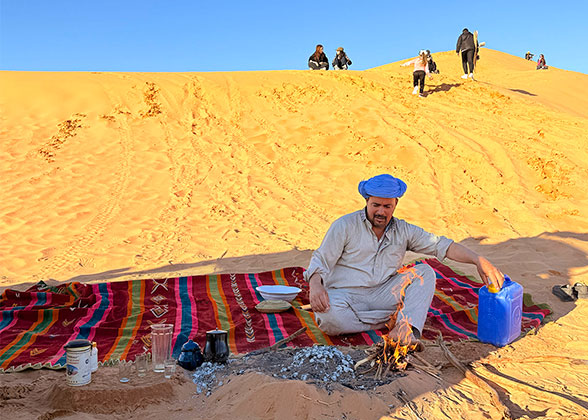
Baking Bread with Hot Sand After breakfast, let’s continue to explore the Tadrart region. We’ll head to Tin Merzouga area by 4x4. It’s one of the driest places in the Sahara, where some remote basins have gone without rain for up to 20 years! The extreme climate has dried up all the ponds, but also created the most stunning scenery, the red sand dunes, reaching heights of up to 1,300 meters (4,265 ft.)! Some soar into the clouds, exceeding 200 meters (656 ft.) in vertical height, and others are expansive, stretching to the horizon. The sharp edges of the dunes are constantly changing with the wind, creating a new look every day. In this splendid sea of sand, the rocks are like scattered reefs, shaped like mushrooms, torches, etc. Follow your experienced guide to hike within the dunes, and find a unique natural artwork, the “Hedgehog” rock formation. No one can help but marvel at this enormous sandstone standing three stories high. It has been perfectly sculpted by the wind into the shape of a lifelike hedgehog, with even its clear four legs and spines! It’s looking at the distance quietly, as if lost in thought. This evening, we’ll spend another night among the dunes, enjoying the romance of being far from the hectic world. Around the campfire, your local guide will be happy to share stories about this ancient land, or you may enjoy the desert blues and immerse yourself in the boundless charm of the Sahara. Meals: Breakfast, Lunch, Dinner Accommodation: Desert Campsite
|
Day 12: Tadrart – Visit Rock Paintings in Tilfazou & Oued Amais – Djanet; Fly back to Algiers
This morning, let’s drive to explore Tilfazou and the adjacent Oued Amais region, which is a dry valley and a major settlement and ritual site for prehistoric humans. People recorded their lives on the rock cliffs with simple lines, depicting large herds of cattle, hippos, and lions hunting. Thanks to the arid desert climate and the secluded location, most of the Sahara rock paintings have been preserved almost intact. We won’t miss the famous “Crying Cows,” one of the most affecting rock paintings in the Sahara. It depicts more than just two long-horned cattle with their heads bowed. Looking closer, you can see a tear rolling down the corner of a cow’s eye. Why the cow is crying, and why this painting was created, remain a mystery. Locals believe it echoes an ancient legend. When the Sahara was becoming uninhabitable, a shepherd led his cattle to search for the last remaining water source. Unfortunately, all the springs had dried up, and he could only helplessly watch his cattle die one by one. And that’s the tragic scene we see now. Time to say goodbye to the Sahara! After the tour, we’ll return to Djanet. You can shower and rest at a local guest house, and enjoy a farewell dinner with your desert crew. Then, your guide and driver will escort you to Djanet Airport for your night flight back to Algiers. Upon arrival, a local driver will pick you up and accompany you to your hotel. Meals: Breakfast, Lunch, Dinner Accommodation: Hotel El Aurassi, Algiers (4 stars) or similar
|
Day 13: Algiers: Kasbah Ancient Town & Basilica of Notre-Dame d’Afrique; Airport See-off
After breakfast, your guide and driver will accompany you to visit Algiers’ famous landmarks before you leave.
► Note: We’ll arrange your sightseeing based on your departure flight time. If you want to make the most of your last day in Algeria, we recommend you book a late flight.
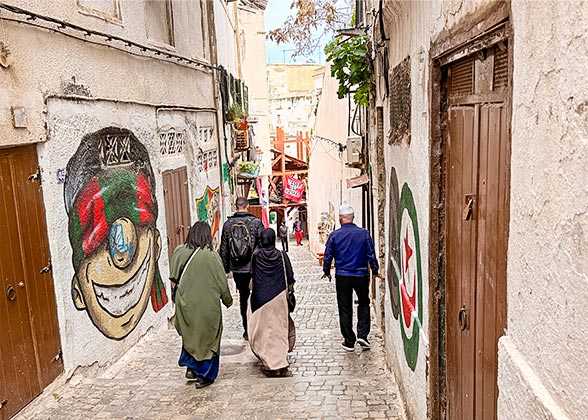
First, we’ll visit the Kasbah Ancient Town on a hillside. Looking up from here, you can see the prominent Ketchaoua Mosque and its slender minarets. Feel the historical charms in every street and alley, and see the crumbling walls and graffiti that tell a story of the wounds left by the independence war. Next, at the Arts and Crafts Museum, your guide will share stories about Algeria’s nation and history. Afterward, we’ll visit the Basilica of Notre-Dame d’Afrique, pray before the Black Madonna statue, and experience the city’s inclusiveness and friendliness.
Then, your guide and driver will see you off at Algiers Airport and help with check-in. See you next time!
Meals: Breakfast, Lunch
|