Day 1: Algiers Airport Pick-up; City Sightseeing with Botanical Garden & Museums
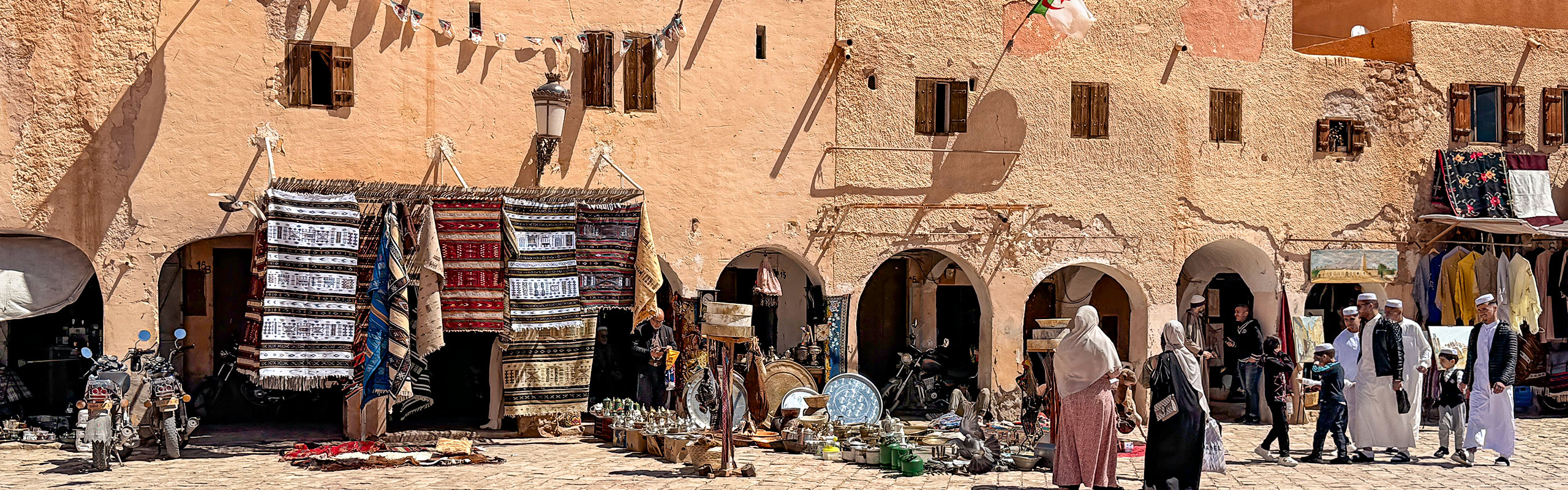
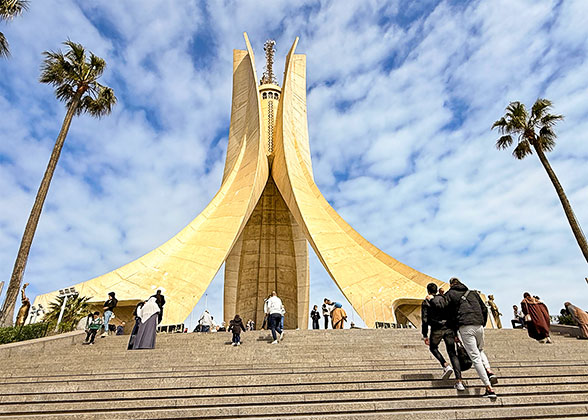
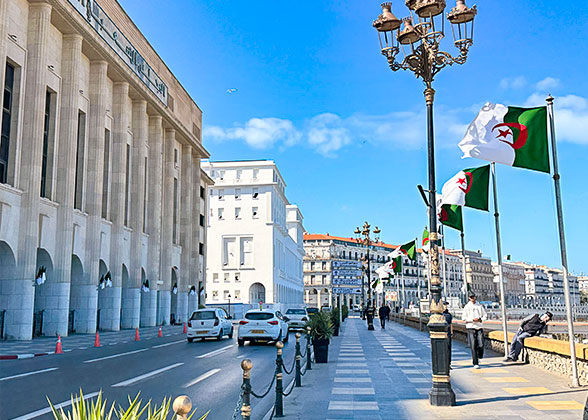
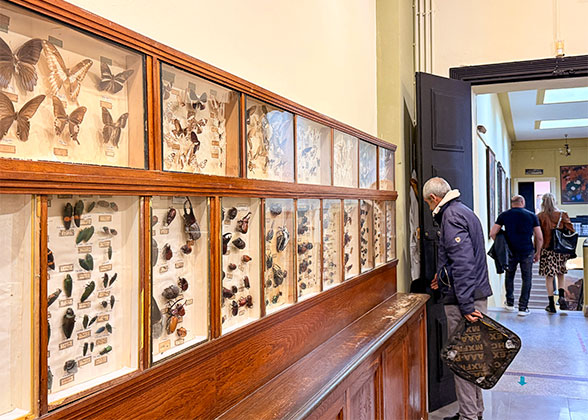
Welcome to Algiers! Your private guide and driver will be waiting for you at the airport, and then escort you to your downtown hotel. After check-in, we will arrange an Algiers city tour for you based on your arrival time. We’ll first take a stroll through the refreshing Botanical Garden Hamma, which is famous since 1932 for being the filming location of Tarzan the Ape Man. Afterward, visit the National Museum of Fine Arts of Algiers, one of Africa’s largest art museums. We’ll admire exquisite Algerian and European paintings from the 14th to the 20th centuries AD, and enjoy panoramic views of the botanical garden and Bay of Algiers. Next, let’s head to Bardo National Museum of Prehistory and Ethnography, where you can witness prehistoric African musical instruments and animal fossils. Then, proceed to the Martyrs Memorial to learn about Algerians’ sacrifices for independence. Your guide and driver will escort you back to your hotel after the visit. ► Algeria Visa Tips To enter this conservative country, most travelers need to apply for a visa 1-2 months ahead of time and provide a detailed itinerary. The visa will be valid for the exact dates of your stay. If you are planning to visit Algeria, please contact us in advance to get a customizable itinerary, and obtain your visa more easily. Accommodation: Hotel El Aurassi, Algiers (4 stars) or similar Algiers Martyrs Memorial Algiers City View
|
Day 2: Algiers Kasbah Ancient Town, Bastion 23 & Basilica of Notre-Dame d’Afrique
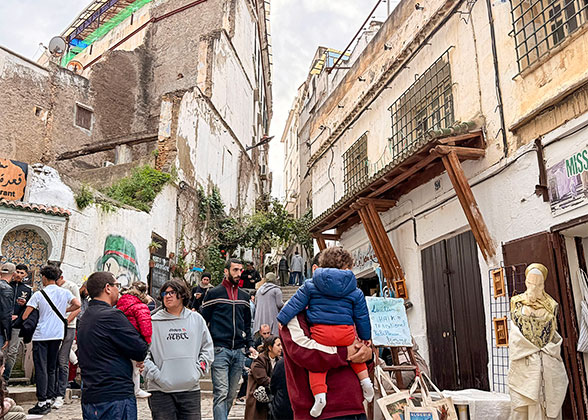
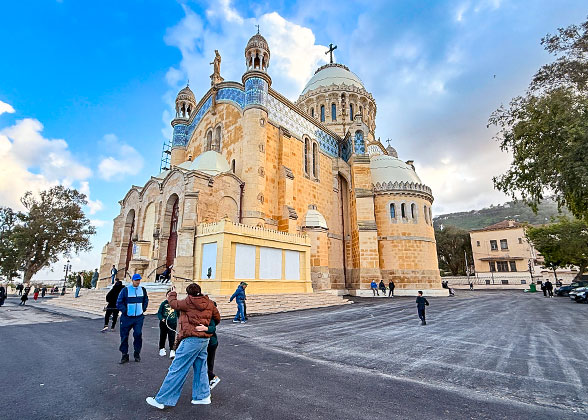
After breakfast, your guide and driver will pick you up from your hotel, and accompany you on a further Algiers exploration. First, let’s tour the charming Kasbah Ancient Town. “Kasbah” is an ancient Arabic word for fortress or stronghold, and most of the kasbahs in North Africa are over 1,000 years old. Here, you can see rows of old houses decorated with paintings or mosaics of the crescent moon and star, symbols of Islam. Locals usually stroll through the alleyways or sit around tea stalls chatting and drinking mint tea. Although the town seems old-fashioned and less convenient, residents are content with their life. Thanks to the abundant oil and gas resources, Algeria’s economy is above average in Africa, and government subsidizes gasoline, electricity, and food, and healthcare system covers the entire country. Therefore, even in the capital, the pace of life is quite relaxed. Enjoy a traditional lunch, and then let’s visit Bastion 23, also known as Rais Palace. It was once the residence of a naval commander in the 16th century and the administrative center of Algiers. Your knowledgeable local guide will share its stories with you. Our final stop is the Basilica of Notre-Dame d’Afrique, the last cathedral built by the French in Algeria. Different from the Catholic churches we are familiar with, this building incorporates Neo-Byzantine elements like the blue and white Moorish mosaic tiles. Sunlight streams through the stained-glass windows of the dome, making the statue of the Virgin Mary in the center even more sacred. Besides the cathedral itself, it’s also a fantastic point for overlooking the Bay of Algiers and the city skyline. After that, your guide and driver will escort you back to your hotel. Meals: Breakfast, Lunch Accommodation: Hotel El Aurassi, Algiers (4 stars) or similar
|
Day 3: Algiers Round Trip to Cherchell: Tipasa Roman Ruins & Royal Mausoleum of Mauretania
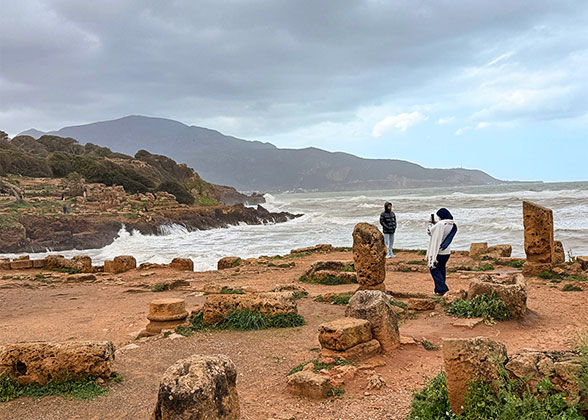
This morning, your guide and driver will meet you at your hotel for your 1.5-hour private ride to the seaside town of Cherchell along picturesque Mediterranean coastline. Once a major city in North Africa during Roman rule, it’s now a peaceful fishing port, with architecture blending Roman, Greek, and Egyptian styles. ★ Follow Camus’s Footsteps, “Return to Tipasa”Next comes today’s highlight: Tipasa Roman Ruins! Nestled against the hills and facing the sea, it offers a perfect blend of ancient ruins and natural scenery. This UNESCO World Heritage Site was once a prosperous port, with a population of around 100,000 at its peak. Now, only the remaining Roman columns of the theater, temples, and forum stand in stark contrast to the azure coastline. Enjoy a journey through time, and get a glimpse into the glory of the empire in North Africa 2,000 years ago. In the summer of 1945, Albert Camus (1913-1960) traveled from war-torn Europe to Tipasa. This is where he had spent his impoverished years. He wrote about the air full of the sweet scent of ripe figs, local fishermen carrying their nets by the sea, and children laughing and playing behind the collapsed ruins. Maybe today, we can still sense the same as Camus’ “spiritual sanctuary.” Have lunch featuring fresh fish prepared in the traditional way, and later, we’ll learn about the history of the Kingdom of Mauritania in Algeria at the magnificent Royal Mausoleum of Mauretania. Your guide and driver will escort you back to your hotel in Algiers. Meals: Breakfast, Lunch Accommodation: Hotel El Aurassi, Algiers (4 stars) or similar Cherchell City Square Tipasa Roman Ruins
|
Day 4: Algiers - Setif Archaeological Museum - Djemila Roman Ruins - Constantine
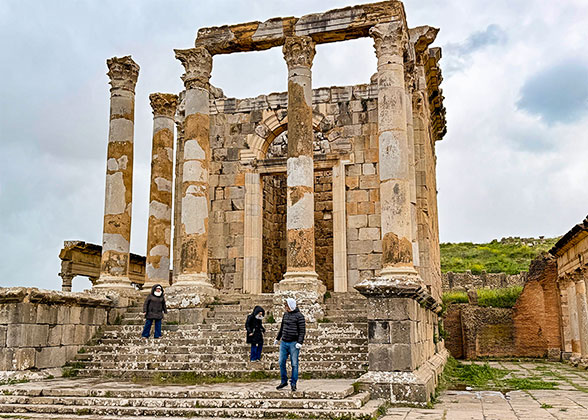
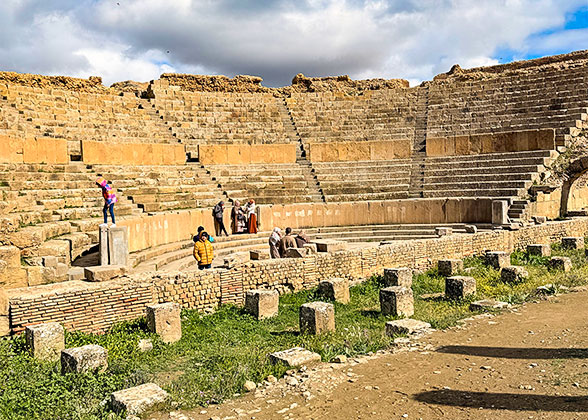
Today will be a fulfilling and informative day! Your guide and driver will pick you up from your hotel early in the morning for a 3-hour drive to Setif, the “trading capital” of Algeria. Upon arrival, we’ll take a lunch break before we visit Archaeological Museum of Setif. Let’s discover a wide range of relics from prehistoric times to modern times, and admire some of the best-preserved Roman mosaics in North Africa, including the 4th-century Triumph of Venus and Triumph of Dionysos. ★ Find the Roman Architectural Secrets at DjemilaNext, let’s continue to Djemila Roman Ruins by a 1.5-hour drive. It was built in the mountains in the 1st century BC. Here, you can see well-preserved triumphal arch, market, square, and amphitheater which have stood the test of time for two thousand years. So, what was the Romans’ architectural secret? It’s significantly connected to their use of concrete. As early as the 2nd century BC, or even earlier, the Romans had mastered the skills of making concrete. They mixed lime, volcanic ash, sand, and water to create concrete that remained strong even in seawater. Whether it’s the standing stone columns, or the town hall’s foundation stone which is up to one meter in diameter, we can spot the traces of concrete and feel the brilliant architectural technology of that era. Afterward, at the nearby Archaeological Museum of Djemila, you can admire the Roman relics unearthed from the site, especially mosaics and statues. After that, your guide and driver will escort you to your hotel in Constantine within 2 hours. Upon arrival, you may take a good rest and recharge for tomorrow’s city exploration. Meals: Breakfast, Lunch Accommodation: Novotel Constantine (4 stars) or similar Djemila Roman Ruins Constantine Cityscape
|
Day 5: Constantine Discovery: Great Mosque, Casbah & Monument aux Morts
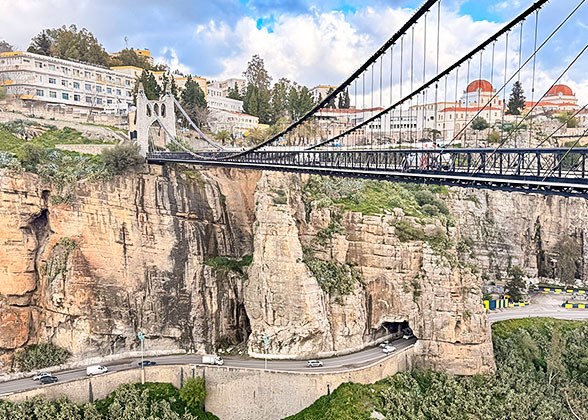
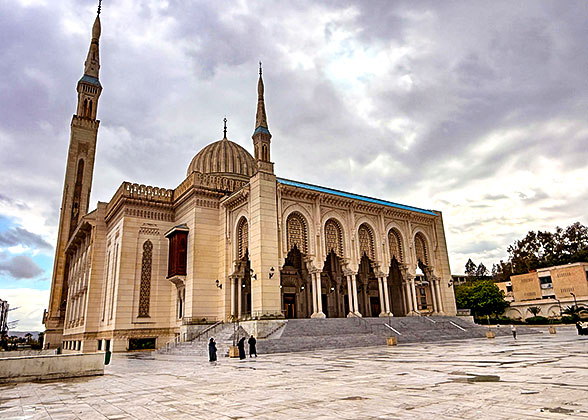
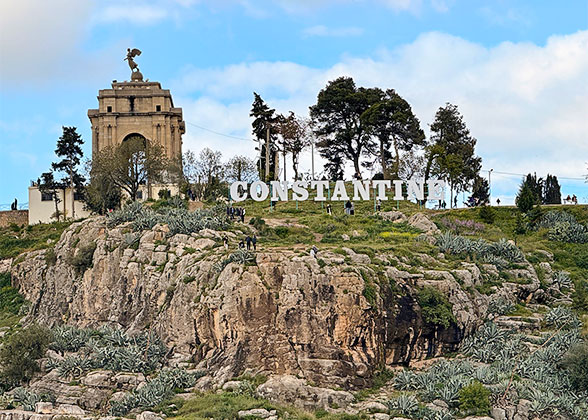
Today, your guide and driver will meet you at your hotel and accompany you on a Constantine tour. Let’s start from Amir Abdel Kader Mosque, or the Great Mosque. It is the third largest mosque in Africa, built to commemorate the 19th-century anti-French hero, Emir Abdelkader (1808-1883 AD). You can see the 27 columns symbolizing the 27 provinces of Algeria, and the star trail pattern on the dome symbolizing the fusion of faith and science. Then, enjoy lunch at a traditional restaurant, and we’ll explore the Casbah of Constantine, with over a thousand years of history. The town, steeped with Medieval ambience, features narrow alleyways lined with pristine white Islamic houses, small mosques, and bustling markets. With its impregnable cliffside location, Constantine attracted the Phoenicians to establish a city here 3,000 years ago, and was once the capital of the Numidian Kingdom in the 3rd century BC. Thus, the local culture is diverse and inclusive, and you can surprisingly find local Muslim women wearing colorful robes, not only white or black, and even going out without veils. Let’ s make a stop at Ahmed Bey Palace, strolling through its exquisite palace and tranquil gardens, and admire the frescoes depicting city scenes of Cairo, Istanbul, and Algiers, dating back over 200 years. Later, let’s proceed to the iconic Monument aux Morts. This 21-meter-high (70 ft.) triumphal arch, situated on a 695-meter (2,280 ft.) cliff, was built to commemorate the Algerian soldiers who died in World War I (1914-1918 AD). From here, you can overlook the 164-meter-long (538 ft.) Sidi M’Cid Bridge. It has no piers and has a dramatic drop, and is the most famous one of the 8 bridges spanning the Rhumel Gorge in Constantine. On our way back, you’ll have the opportunity to admire the breathtaking three-dimensional landscape of this bridge city from different perspectives. After a brief stroll through the city center, your guide and driver will escort you back to your hotel. Meals: Breakfast, Lunch Accommodation: Novotel Constantine (4 stars) or similar Great Mosque, Constantine Monument aux Morts, Constantine
|
Day 6: Constantine Round Trip to Timgad Roman Ruins
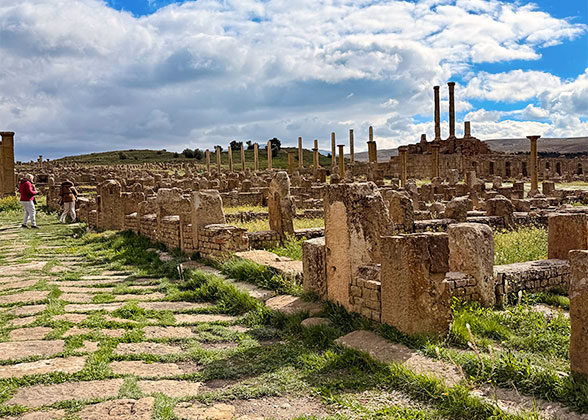
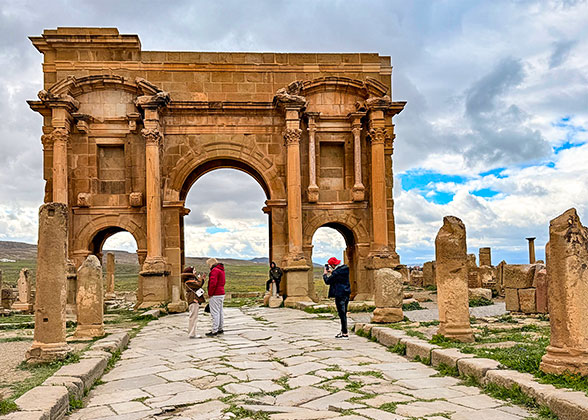
Today, let’s take an exciting day trip to Timgad Roman Ruins, one of Algeria’s most marvelous ancient Roman cities. Your guide and driver will pick you up from your hotel and escort you to Timgad in 2.5 hours. ★ Explore Timgad: A City Exemplifying Roman Strategies of Territorial GrowthAfter viewing the precious Roman mosaics and relics at Timgad Museum, let’s begin our exploration of the ruins! In the 1st century BC, when the Roman Empire expanded its territory into North Africa, it encountered fierce resistance from local tribes. The Romans then built campsites and outposts, including Timgad, in the mountains northern Algeria. Later, to break down the local hostility, the Romans expanded Timgad to a standard Roman city capable of housing 15,000 people. Soon, the comfortable life in the city drew attention of locals who came to trade. Since only Roman citizens could live in the city, many locals even volunteered to serve in the Roman legions for 25 years to obtain citizenship for themselves and their descendants. Gradually, the size of Timgad city grew rapidly, reaching four times its original size! After the tour, your guide and driver will escort you back to your hotel in Constantine. Meals: Breakfast, Lunch Accommodation: Novotel Constantine (4 stars) or similar
|
Day 7: Fly to Ghardaia: M’Zab Valley Tour with Ksar Tafilelt, Beni Isguen & Palm Grove
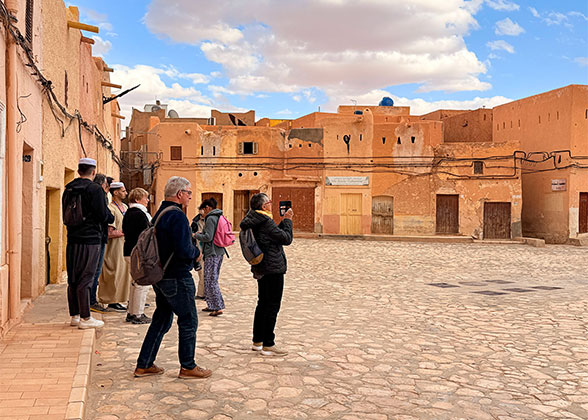
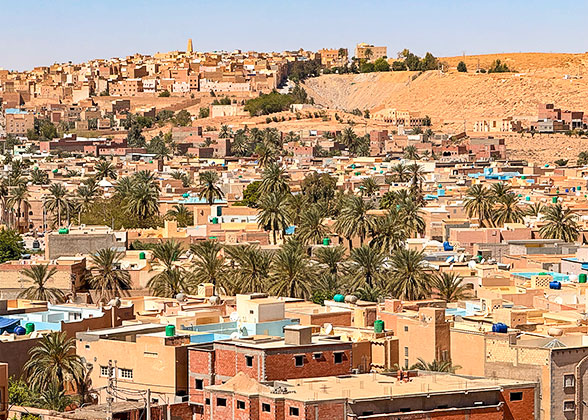
This morning, your driver will escort you to Constantine Airport for a one-hour flight to Ghardaia, deep in the Sahara Desert Upon arrival, your local guide and driver will meet you at the airport and escort you to your hotel. After lunch and a short rest, let’s start today’s adventure. Ghardaia, along with its four neighboring oasis towns, is part of the M’Zab Valley, a UNESCO World Heritage Site. In the 10th century AD, Ibadi Muslims who lost a war came and settled here. We’ll first visit Ksar Tafilelt, the youngest area of the valley. This eco-city planning project began in 1997. At first glance, Tafilelt looks the same as the surrounding towns, filled with traditional mud-brick and palm-wood buildings. However, you can soon discover the modern solar-powered streetlights and waste sorting system. Form its eco-park, we’ll learn about the benefits that organic farming brings to the local ecology and residents. Next, let’s head to Beni Isguen, the only walled town in the M’Zab Valley. You may notice the hilltop mosque and watchtower, and the layers of houses surrounding them. People of the secluded town still live in the ways that have existed for centuries. The conservative Berber women, especially the married, typically cover their whole body with a white robe called haik when going out. You won’t even see their faces, as they observe the outside world through only one eye. In the evening, let’s take a leisurely stroll in the tranquil Palm Grove, enjoying the rare coolness in the desert and watching the setting sun cast its glow on the beige buildings and palm trees. Afterward, your guide and driver will accompany you back to your hotel. Meals: Breakfast, Lunch Accommodation: Belvedere Hotel, Ghardaia (4 stars) or similar Beni Isguen Oasis Town Panorama of the Oasis
|
Day 8: Ghardaia: El Atteuf, Mausoleum of Sheikh Ammi Brahim, Ghardaia Craft Market & Museum
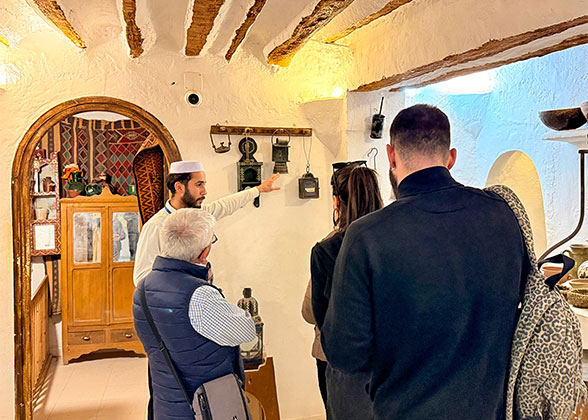
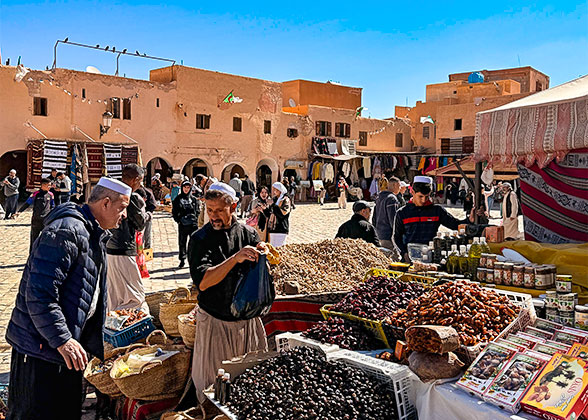
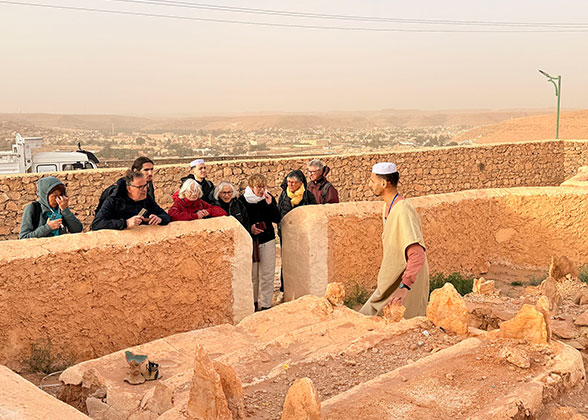
Today, your guide and driver will pick you up from your hotel for our in-depth M’Zab Valley exploration. We’ll first go to El Atteuf, the oldest town in M’Zab, also known as Ksar Tajnint. Founded in 1012 AD, this oasis is inhabited by traditional Mozabits. An interesting fact is, all the minarets here are square, because they were easier to build with local stone in the past, and the structure is also more stable to withstand the strong winds of the desert. Then, we’ll visit the Mausoleum of Sheikh Ammi Brahim, a 15th-century burial and mosque where a revered Ibadi saint is buried. After lunch, let’s return to Ghardaia and take a walk through Ghardaia Craft Market. In this bustling open-air market, you’ll have chance to see various dates and admire traditional Mozabit handmade carpets, spices, and pottery. These carpets are mostly made by local female artisans using a blend of wool and camel hair, giving a strong nomadic style. Every March, Ghardaia hosts a “National Carpet Day” competition for skilled weavers from all over the country. Then, we’ll learn more about local handicrafts and millennia-old traditional techniques at Ghardaia Craft Museum. Your guide and driver will escort you back to your hotel after that. Meals: Breakfast, Lunch Accommodation: Belvedere Hotel, Ghardaia (4 stars) or similar
|
Day 9: Ghardaia - El Menia: Visit Church of Saint Joseph & El Menia Vieux Ksar
This morning, say goodbye to Ghardaia and leave for El Menia with your guide and driver. The journey will take about 3.5 hours. We’ll gradually go deep into the vast Sahara Plateau, and when golden dunes come into view, we’ll reach El Menia, located on the eastern edge of the Grand Erg Occidental, the third largest sand seas in the Sahara.
Let’s first visit Church of Saint Joseph, one of the oldest Christian churches in the Sahara. Unlike the typical Gothic or Baroque churches in Europe, it features not only two bell towers resembling minarets, but also a yellowish-brown exterior echoing the local architecture. It has become a pilgrimage site as the final resting place of Charles de Foucauld (1858-1916 AD), a French saint who preached in the Sahara and dedicated himself to the study of Tuareg language and culture.
After that, let’s tour El Menia Vieux Ksar built in the 10th century AD. Ksar refers to the fortified villages in the desert of North Africa, which are the prototypes of oasis towns. People built these settlements for defense, and surviving in the extreme desert environment. Your guide will share you more details about the ancient architectural wisdom behind the ksar. Take some time enjoying the panoramic views of El Menia from the ksar, and then your guide and driver will accompany you to check in at your hotel.
Meals: Breakfast, Lunch
Accommodation: Hotel Oasis El Menia (3 stars) or similar
|
Day 10: El Menia - Timimoun: Visit Sebkha, Ksar, Sudan Gate, Marabout of Sidi Othmane, & Local Market
Golden Sand Dunes in Sahara Desert After breakfast, your guide and driver will wait for you at your hotel for your 4-hour private transfer to Timimoun, also known as the “Red Oasis”. Buildings there are constructed of red mud bricks rich in iron, making the town look like a burning flame in the desert. Have lunch upon arrival, and we’ll then travel to Sebkha by a 4x4 vehicle to embark on a salt flat adventure! You could find beautiful “desert roses” formed by crystallization at the dried-up salt lakes. Surrounded by glorious orange-red sand dunes of the Grand Erg Occidental, the area enjoys a stunning landscape like the surface of Mars. Capture the impressive views with your camera. Next, we’ll return to the town to visit the Ksar of Timimoun, built by Berber tribes in the 12th century AD. You can feel the decaying beauty in its crumbling walls and narrow, sandy alleyways. Then, let’s visit the iconic Sudan Gate, a majestic red clay structure built by the French. During the prosperous Sahara trade of the 18th and 19th centuries AD, Timimoun was a vital transit point connecting the interior with the coastline. The gate has witnessed countless camel caravans trading gold and spices. After that, let’s head to the Marabout of Sidi Othmane. The word “marabout” is the tomb of an Islamic saint in North Africa. It features a pyramid-shaped clay spire, and your guide will tell you stories about Sidi Othmane - the revered saint. Finally, after visiting Timimoun’s local market, your guide and driver will escort you back to your hotel. Meals: Breakfast, Lunch Accommodation: Gourara Hotel, Timimoun (4 stars) or similar
|
Day 11: Timimoun - Beni Abbes: Visit Flora and Fauna Museum, Old Ksar, & Hermitage of Foucauld
This morning, your guide and driver will pick you up from your hotel, and let’s depart for Beni Abbes, the “Pearl of the Saoura,” in about 4.5 hours. After checking in, have lunch and take a break before our afternoon sightseeing starts. First, at Beni Abbes Museum, we’ll learn about the traditions and life of the indigenous people of the Sahara. Beni Abbes is one of the main settlements of the nomadic Tuareg people, who are respectful of nature, believing that all wild animals, plants, and even minerals are the property of elves. They carve animal and plant patterns onto their everyday utensils, and wear silver amulets called “Agadez Cross” to protect them during their journeys across the desert. Next, let’s visit the Old Ksar on a hill. You can explore its labyrinthine narrow alleys while overlooking the valley below. Then, take a walk in the cool shade of Palm Grove. Precious natural freshwater springs flow here, and date palms, pomegranate trees, and fig trees thrive, bringing vitality to the oasis. Our last stop is the Hermitage of Charles De Foucauld, where the saint once lived over 100 years ago. Afterward, your guide and driver will escort you back to your hotel. Meals: Breakfast, Lunch Accommodation: Hotel Saoura, Beni Abbes (4 stars) or similar Beni Abbes Museum Old Ksar of Beni Abbes
|
Day 12: Beni Abbes - Taghit: Visit Ksar of Taghit, Admire Sunset in Sand Dunes
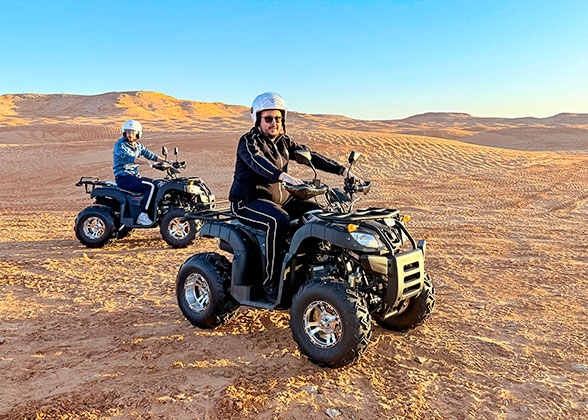
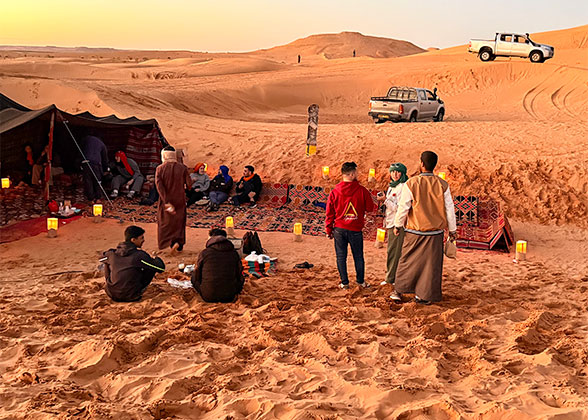
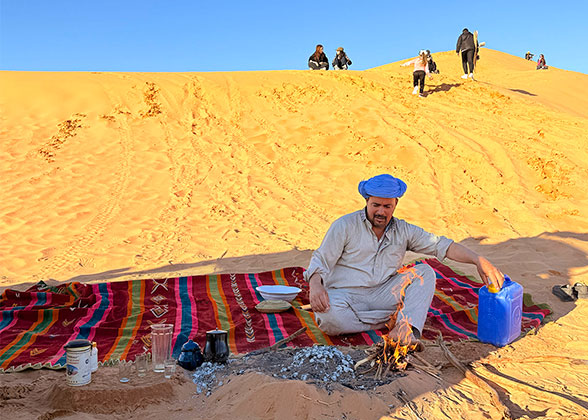
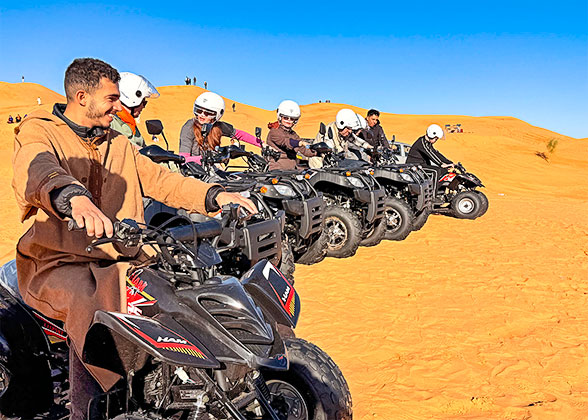
This morning, your guide and driver will meet you at your hotel, and let’s bid farewell to Beni Abbes and drive 2 hours to Taghit, an oasis hidden deep in the desert. With a long, narrow lake, Taghit enjoys abundant water resources that nourish more than 120,000 date palm trees, making it one of the largest transit points in the ancient trans-Saharan trade. Upon arrival, follow your guide to first visit the Ksar of Taghit. This 11th-century fortified village has over a hundred ancient adobe houses. The truth is, there were once 37 Ksars in Taghit, indicating the city’s past prosperity. As evening approaches, take your sand-protective headscarf and phone pouch, and let’s drive to the city’s edge to explore the towering sand dunes! They belong to the Grand Erg Occidental, the second largest sand sea of the Sahara. Some of the dunes reach nearly 200 meters (656 ft.) high! Choose a dune you like, and climb to its highest point to gaze at the endless, undulating sea of sand. Four-wheel drive vehicles and quad bikes are available. If interested, you can experience thrilling off-road adventures at your own expense. After enjoying a romantic Sahara sunset, your guide and driver will escort you back to your hotel. Meals: Breakfast, Lunch Accommodation: Hotel Bladi Palace, Taghit (4 stars) or similar
|
Day 13: Transfer from Taghit to Bechar Airport; Fly back to Algiers
Today, you will enjoy a 1.5-hour private transfer from your hotel to Bechar Airport, from which you will take a 2-hour flight back to the capital, Algiers. Upon arrival, a local driver will pick you up and escort you to your hotel.
For the rest of the day, you can relax at your hotel and relieve your travel fatigue. Alternatively, explore the city center by yourself. You may go to Place des Martyrs, a vibrant hub of local life filled with stylish cafes and restaurants. Every evening, the square comes alive with vendors and street performers. You may find a teahouse to sample classic Algerian mint tea and immerse yourself in the rich local atmosphere.
Meals: Breakfast
Accommodation: Hotel El Aurassi, Algiers (4 stars) or similar
|
Day 14: Departure from Algiers; Airport See-off
Today marks the end of your tour. Your driver will escort you to the airport at the agreed time and assist you with the check-in process. Have a nice trip!
Meals: Breakfast
|