Day 1: Ulaanbaatar Airport Pick-up, Visit Sukhbaatar Square & Museum of Mongolian National History
Welcome to Ulaanbaatar! Upon arrival, your private guide and the driver will meet you at the airport or railway station and escort you to the well-selected hotel. Afterward, follow your guide to start your 14-day Mongolia hiking tour.
Begin our trip in Sukhbaatar Square, which is encircled by the city’s several vital buildings like the Government Palace and the Central Cultural Palace, and admire the equestrian statue of Sukhbaatar (1893-1923), the Mongolian People's Republic's founding hero, along with statues of Genghis Khan, Ogedei Khan, and Kublai Khan. Then, head to the Museum of Mongolian National History for an overview of Mongolia’s history, including Genghis Khan's westward expedition and the founding of the Mongol Empire (1206-1368 AD). You’ll learn that Genghis Khan initially sought peaceful trade with the Khwarezm Empire (1077-1231 AD) located in Central Asia, but a Khwarezm governor slaughtered almost all 450 of his traders. Enraged, Genghis Khan retaliated by razing the empire. From then on, the Mongol Empire’s legendary westward expedition began.
► Special Treat:In the evening, your guide will accompany you to enjoy a welcome dinner with traditional Mongolian music and dance shows, featuring throat singing, acrobatics, and Shamanistic ritual dances. At last, your guide and the driver will escort you back to your hotel.
► Network and SIM Card Tips
In Ulaanbaatar, 4G is reliable, and a Mobicom SIM card offers a decent signal, which can be purchased at the airport or city center. A 15-day, 30 GB data package generally costs about USD 15. However, in steppes and deserts, Unitel cards offer better signals, though signal loss is still common.
Meal: Dinner
Accommodation: Grand Hill Hotel Ulaanbaatar (4 stars) or similar
|
Day 2: Ulaanbaatar - Baga Gazriin Chuluu
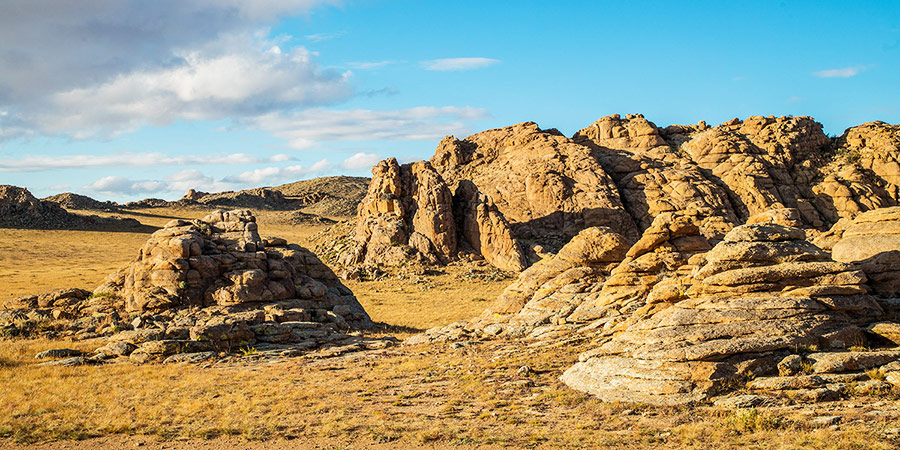
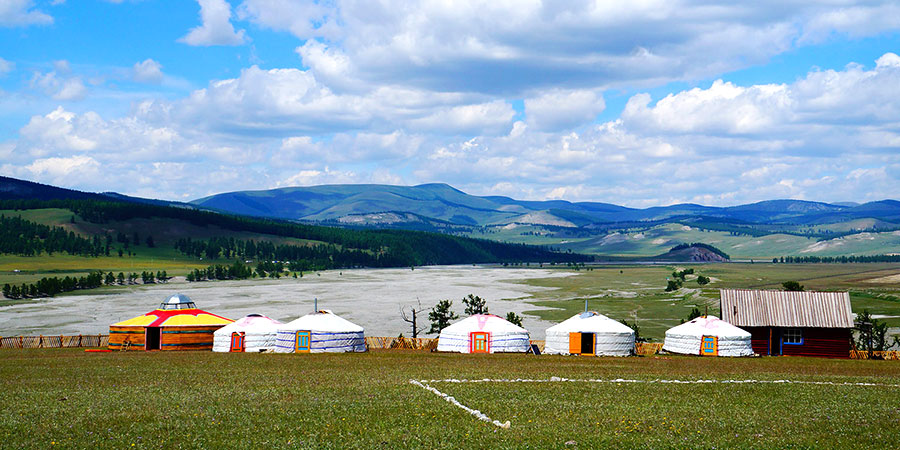
Today, your guide will accompany you on a 4.5-hour private transfer to the Central Gobi to view the striking granite landscape of Baga Gazriin Chuluu, literally meaning “stones of a small land.” As we leave the city, paved asphalt roads gradually give way to grassland paths, which are actually tracks left by passing cars. The vast landscape is dotted with a few white mushroom-shaped gers and is a paradise for wildlife such as prairie rats and eagles. Feel free to request photo stops along the way. Besides, motion sickness pills are recommended due to the bumpy journey. Upon arrival, rest at your ger, and then follow your guide to hike through the mysterious rock formations, which resemble layered cakes. You may find scattered caves, herds of sheep and horses roam freely, and even bizarre inscriptions left by 19th-century monks. We’ll also explore the Eye Spring, emerging from a rock aperture even smaller than a fist, which is said to be able to improve eyesight. Before dusk, your guide will escort you back to your ger. These movable lodges are mostly located within or near scenic spots, offering authentic Mongolian cuisine and Western-style buffets. Typically, we reserve standard ger camps equipped with shared bathrooms. Gers with private bathrooms usually cost twice as much. Please let us know if you prefer the latter. Meals: Breakfast, Lunch, Dinner Accommodation: Erdene Ukhaa Tourist Camp or similar
|
Day 3: Baga Gazriin Chuluu - Tsagaan Suvarga (White Stupa)
Today, we’ll head south into the heart of the Gobi Desert to admire Tsagaan Suvarga, aka the White Stupa. During the 5-hour drive, primarily on rugged dirt roads with low shrubbery, feel free to stop and interact with the local herders we come across. Upon arrival, check in and have lunch, and then let's explore Tsagaan Suvarga.
Over millions of years, the limestone cliffs here have been eroded by wind into various shapes, including mushrooms and pagodas, interspersed with breathtaking mineral layers of red, pink, and yellow-brown colors. Touch the sedimentary rock layers and feel the textures that once existed on the seabed. You can also use your drone to capture stunning panoramic views. Please hold your belongings firmly and stay away from the edges due to strong winds. Finally, your guide and the driver will escort you back to your ger camp.
► Gobi Travel Tips
1. Protect yourself from intense UV rays, plenty of sand, and insufficient shade with a sun hat, sunglasses, sunscreen, and cooling oil.
2. Dress in layers with lightweight, breathable, quick-drying clothing, a windproof jacket, sturdy long pants, and hiking shoes.
3. As supplies are limited on the way, bring some of your favorite snacks and enough water, and drink in tiny amounts regularly.
Meals: Breakfast, Lunch, Dinner
Accommodation: Tsagaan Suvarga Tourist Camp or similar
|
Day 4: Tsagaan Suvarga - Eagle Valley (Yol Valley)
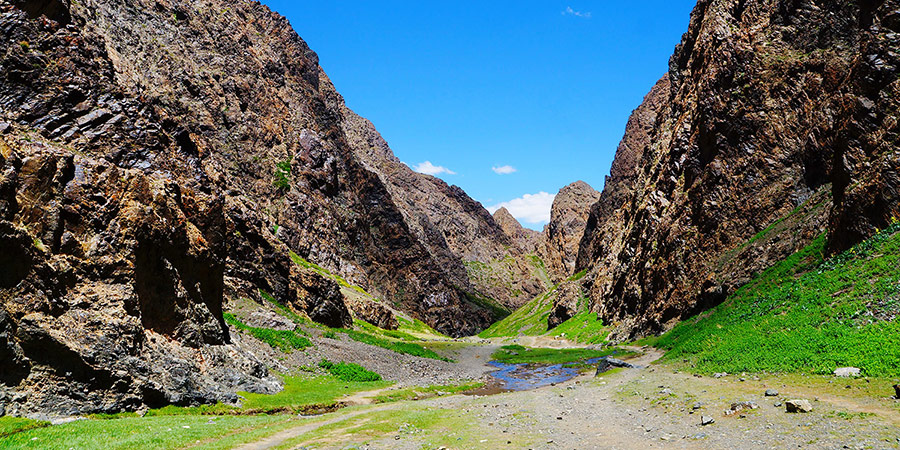
After two days of the desolate and barren Gobi, today, let the greenery of Eagle Valley in the Southern Gobi refresh your eyes! After a 3-hour private drive, we’ll reach the narrow valley stretching between mountains and rocks. Let’s embark on a 2-hour hike through the verdant foliage, across winding streams, and with the chance to spot rare creatures like argali, ibex, and bearded vultures. Capture the breathtaking sight of vultures soaring over the valley's sheer cliffs! Furthermore, you might even see stunning ice fields in the deeper valley! However, now it may be hard to see in the hot summer months of July and August due to global warming, whereas it used to be possible. Wear sturdy hiking shoes to navigate the uneven terrain. If you don’t want to hike, riding a horse through the valley is also possible. Finally, your guide and the driver will escort you to your ger. Meals: Breakfast, Lunch, Dinner Accommodation: Juulchin Khanbogd Tourist Camp or similar
|
Day 5: Eagle Valley - Khongor Sand Dunes
Today, let’s discover Khongor Sand Dunes, one of Mongolia’s largest sand landscapes. Upon arrival, begin with a visit to a local herder family. In the ger, a warm fire blazes merrily in the center, exquisite tapestries and ethnic ornaments adorn the walls, and saddles, kitchenware, and a Buddhist shrine are neatly placed. Gobi herders seldom receive visitors, so they are always delighted to welcome guests and offer traditional Mongolian snuff bottles and suutei tsai, Mongolian milk tea. Due to a lack of agricultural resources, most vegetables in Mongolia are imported, which are too expensive for herders, while milk tea helps to supplement vitamins. The sheep are also adorable. Try bleating toward the pen, and all of them will follow you!
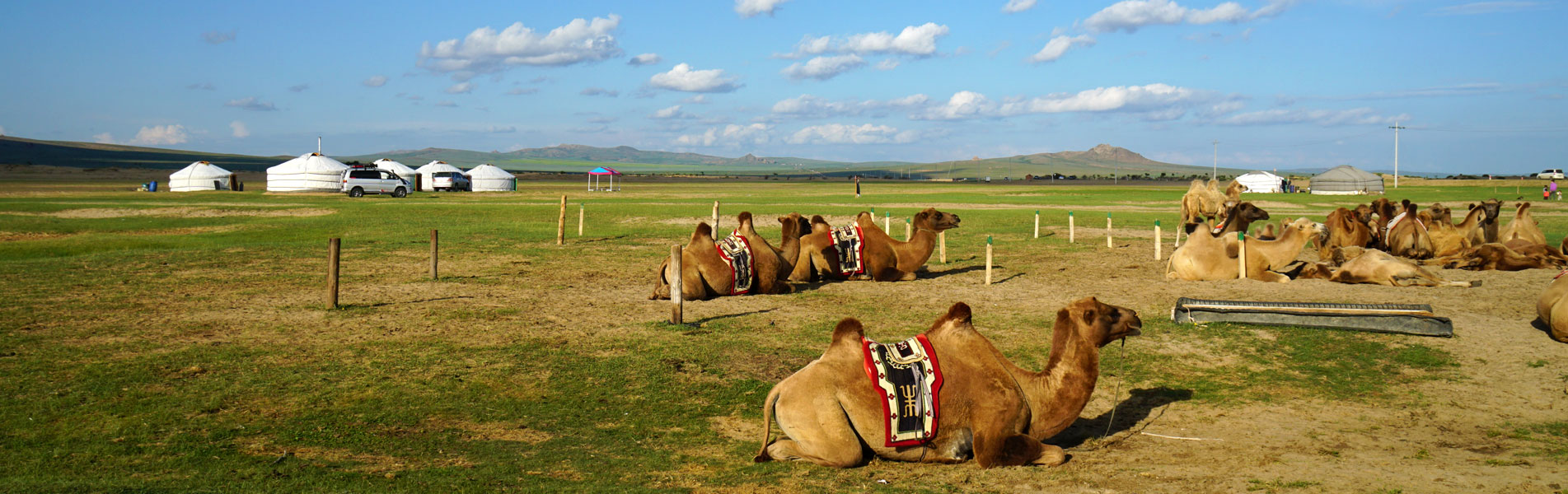
Afterward, enjoy a Bactrian camel ride across the dunes! Bactrian camels move more steadily and slowly than horses. Sitting high between the humps, and swaying gently, you may feel as if you are traveling through time. Climb to the top of a sand dune for a broad vista of the surrounding landscape. The wind from the north fails to cross the southern mountain range, leaving the finest sand behind on the northern slopes, forming this golden silk-like belt stretching for nearly 180 kilometers (110 miles), with hardy shrubs and small animal tracks revealing the life that thrives. In the evening, this sandy sea is painted golden by the setting sun’s rays, flowing silently in the gentle breeze. At last, your guide and the driver will escort you back to your ger camp.
Meals: Breakfast, Lunch, Dinner
Accommodation: Gobi Discovery Ger Camp or similar
|
Day 6: Khongor Sand Dunes - Flaming Cliffs (Bayanzag)
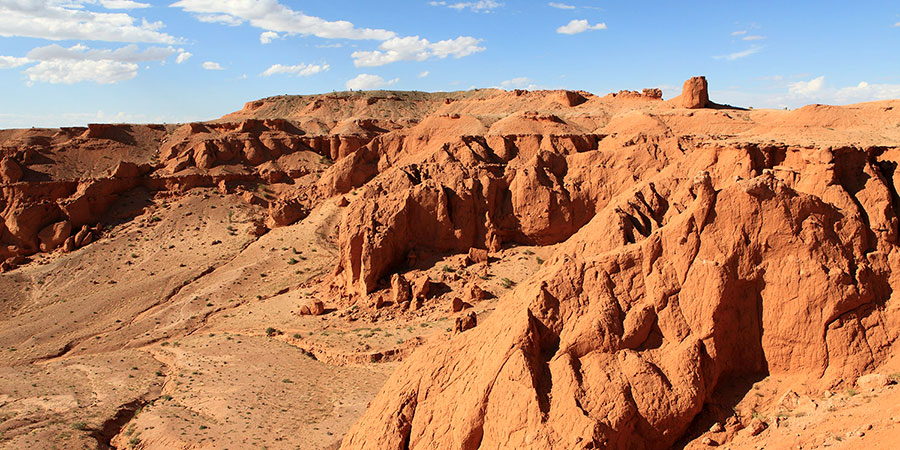
After breakfast, enjoy a 4-hour private transfer to Bayanzag, where the first dinosaur eggs were discovered! In 1922, American scientists found dinosaur fossils dating back 70 to 80 million years, confirming that dinosaurs laid eggs rather than giving live birth, and later, Neolithic stone tools were unearthed. The iron-rich sandstone features a reddish-brown hue, especially magnificent at sunset, resembling leaping flames - this is why Bayanzag is also known as the "Flaming Cliffs". Strolling among the bizarre rocky terrain dotted with hardy greyish-green shrubs and sporadically emerging animal bones, you may feel as if you were at the end of the world. There are no trails or guardrails, so proceed with care. Additionally, small stalls at the entrance offer unique stones with historical charm. Finally, your guide and the driver will escort you to the nearby ger camp. As night descends, the clear sky is filled with dazzling, dense stars, seeming like you could reach out and touch them. Meals: Breakfast, Lunch, Dinner Accommodation: Mongol Gobi Tourist Camp or similar
|
Day 7: Flaming Cliffs - Ongi Monastery
This morning, your guide and the driver will escort you to Ongi Steppe on a 4-hour drive. Upon arrival, settle into the ger camp, enjoy a lavish lunch, and then follow your guide to walk along the winding Ongi River to explore Ongi Monastery. Once one of Mongolia’s largest and most important monastic complexes, it consisted of 28 temples and 4 Buddhist colleges, housing over 1,000 monks. Tragically, it was destroyed during the Great Repression in 1939, leaving only scattered cornerstones, broken walls with lotus carvings, and a few structures. Catch a glimpse of the rebuilt temple adorned with green roofs and vibrant colored upper structure, which incorporates original wooden beams from the ruins. Beside it is a ger museum, displaying remnants of the original monastery, including its only surviving painting and various ceremonial objects. Wander around and imagine the grandeur of what once stood there. Finally, your guide and the driver will escort you back to your ger camp.
Meals: Breakfast, Lunch, Dinner
Accommodation: Secret of Ongi Tourist Camp or similar
|
Day 8: Ongi Monastery - Karakorum
★ Unveiling Karakorum: the 13th-Century World Political CenterAfter breakfast, we’ll drive 6 hours to the Orkhon Valley Cultural Landscape, Mongolia’s first UNESCO World Heritage Site. En route, stop at a local canteen for lunch. Upon arrival, visit the ruins of Karakorum, a 13th-century cosmopolitan capital city built by Genghis Khan’s descendants, attracting envoys and travelers from all over Asia and Europe. The remains of the ancient city, including shattered stones of a grand royal palace, lie peacefully on the vast grassland. In the nearby museum, glimpse the restored model of the once glorious capital, including Chinese and Muslim quarters that reflect the Mongol khans’ openness to foreign cultures. Today’s Karakorum is a quiet town with square blocks, grayish-white buildings, and wide, empty roads.
Then, tour around the nearby Erdene Zuu Monastery, one of Mongolia’s oldest Tibetan Buddhist monasteries, built in the late 16th century when Tibetan Buddhism was established as the state religion. The three surviving temples and the enclosures adorned with 108 white stupas offer a glimpse into the splendor during its heyday in the 18th century, when it contained over 60 temples. After the visit, your guide and the driver will escort you to your ger camp.
Meals: Breakfast, Lunch, Dinner
Accommodation: Munkh Tenger Tourist Camp or similar
|
Day 9: Karakorum - Tsetserleg - Terkh White Lake National Park
Today, your guide and the driver will accompany you to Tsetserleg, a scenic provincial capital amidst stunning peaks, with the Tamir River flowing through it. Upon arrival, discover Taikar Chuluu, a 20-meter (66-foot) granite cliff carved with various patterns, images, and symbols dating back to the Paleolithic Age (6000-3000 BCE), as well as over 150 inscriptions from the 6th century onward, among which you can see what the ancient Turkic script looks like. Most of them are about blessings, poems, and prayers.
Then, make our way to the Khorgo Extinct Volcano in Terkh White Lake National Park. The 8,000-year-old crater is 200 meters (656 feet) in diameter and 80 meters (262 feet) deep, with its slopes covered in basalt, offering excellent bird’s-eye views of both its bottom and the surrounding landscape. By the way, locals believe taking stones away from here brings misfortune. Finally, your guide and the driver will escort you to your ger camp near Terkh White Lake.
Meals: Breakfast, Lunch, Dinner
Accommodation: Maikhan Tolgoi Tourist Camp or similar
|
Day 10: Terkh White Lake National Park
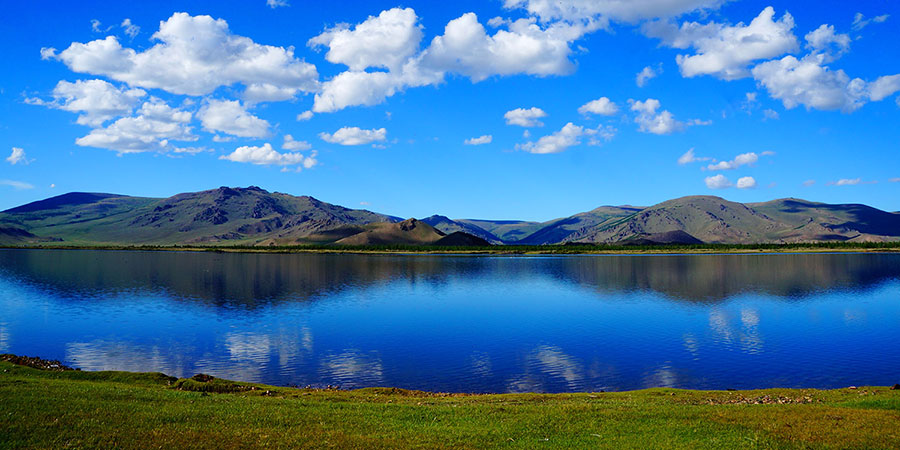
Today, enjoy a free day at your own pace, discovering the Terkh White Lake National Park, a scenic blend of volcanoes, grasslands, and lakes. At an altitude of 2,060 meters (6,758 feet), the White Lake features clear water, lush steppes, and a black lava landscape, ideal for hiking, horseback riding, and fishing. Moreover, it is home to various birds, including swans, wild ducks, cormorants, and gulls. Bring your binoculars, as you may have a chance to see elegant swans if you visit before they fly to China for the winter in November. In the evening, follow your guide to visit a local family. Savor homemade yogurt or milk tea, play the Shagai shooting game with the hosts, and chat with them about their nomadic life. It’s not easy, as they have to herd, milk, chop firewood, and move several times a year with their livestock for grass and water. Sometimes they even need to move 6 times in a summer! Afterward, your guide and the driver will escort you back to your camp. Meals: Breakfast, Lunch, Dinner Accommodation: Maikhan Tolgoi Tourist Camp or similar
|
Day 11: Jargalant Hot Springs - Northern Mongolia
Today, your guide will accompany you on a 5-hour drive heading to northern Mongolia. Crossing vast grasslands, the journey is mostly along gravel roads, dirt tracks, and naturally rutted paths. However, in summer, the Khangai Mountains’ alpine meadows bloom with wild flowers such as golden camellias and gentians, creating a magnificent floral carpet. Feel free to ask the driver to stop anytime for stunning photos and leg stretches. Around noon, we’ll take a short break at Jargalant Hot Springs. The hot spring water originates from the Jargalant River, which never freezes even when the temperatures drop to -40℃ (-40℉), hence the locals call it "living water". Afterward, keep going north to your ger camp.
Meals: Breakfast, Lunch, Dinner
Accommodation: Ulziit Khishig Tourist Camp or similar
|
Day 12: Murun Town - Khovsgol Lake National Park
Today, prepare for a 4-hour private transfer with your guide to Khovsgol Lake. En route, stop at Murun town for lunch, and continue driving to the tranquil Khatgal Village. Stroll through the little wooden houses with vibrant roofs, and visit the local market and port to feel the local vibe.
Next, explore the crystal-clear Khovsgol Lake, dubbed the "Blue Pearl of Mongolia." The lake is suitable for kayaking around July, offering a striking view of colorful pebbles on the lakebed; in winter, it transforms into an ice fishing ground with clear ice bubbles. Perhaps you’ll encounter locals drilling holes for water. Moreover, during the summer months from June to August, the Tsaatan Tribe, the last nomadic reindeer tribe in Mongolia, would come to live in the deep forest of the north and west sides around the lake. If we are fortunate enough to encounter them, we’ll visit their conical tents, locally named “tipis”, chat with them, and learn about their reindeer-herding life. In the evening, your guide and the driver will escort you to your ger camp by the lake.
► Tips:
1. Signal strength is weak or nonexistent in the lakeside area, so you can inform your family of your safety in advance.
2. If you want to explore the Tsaatan nomadic community deep in the remote taiga, 3-7 days are needed, and we can customize the itinerary for you.
Meals: Breakfast, Lunch, Dinner
Accommodation: Khuvsgul Eco Tour Tourist Camp or similar
|
Day 13: Full Day at Khovsgol Lake National Park
★ Explore Khovsgol Lake by Horseback Riding Today, keep discovering more about Khovsgol Lake. After some basic riding instructions, begin your relaxing horse riding! Spend time bonding with your horse, gently stroke its neck to help it get used to you, and then your guide will accompany you ride a horse around the lake. It is quite different from riding in an equestrian center, but more of a small adventure. You can ride through a larch forest to a hilltop for a stunning panoramic view, overlooking the blue gem-like lake. The surrounding pine-forested mountains turn lush green in spring and summer, golden in autumn, and become a snow-covered wonderland in winter. You may also spot rare waterbirds, antelopes, moose, and other wild animals, as well as edible mushrooms. Please note that long rides may cause discomfort to the hips and lower back, and feel free to take a break whenever needed.
In the afternoon, you are free to explore at your own pace. For example, go boating or hiking to the southwestern corner of the lake, around 3 km away from the village, to see what netizens jokingly call “Mongolia’s only navy”: a tugboat. Mongolia once established a waterway bureau, which operated an aging Russian tugboat named Sukhbator III with a crew of seven, primarily to transport oil, coal, and furs across the lake. In the late 1920s, the bureau was abolished, and the abandoned tugboat was moored on the shore. After dark, enjoy another night in the ger camp by the lake.
Meals: Breakfast, Lunch, Dinner
Accommodation: Khuvsgul Eco Tour Tourist Camp or similar
|
Day 14: Fly from Murun back to Ulaanbaatar
On the last day of your 14 days Mongolia hiking tour, your guide and the driver will escort you to the airport in Murun town. If time permits, we’ll detour to the Uushig Ancient Deer Stone Monument to admire mysterious upright stones etched with human faces, arrows, and leaping deer. Nomadic tribes believe these deer are divine beasts leading to the afterlife.
Our services in Mongolia conclude after seeing you off at Murun airport for your flight to Ulaanbaatar. Once you arrive at Ulaanbaatar airport, please connect your flight to the next destination by yourself. If you want to stay overnight in Ulaanbaatar or explore the neighboring countries, Russia and China, please contact us, and we’ll tailor a hassle-free itinerary for you!
Meal: Breakfast
|