

Todaiji Temple
Todaiji Temple stands in Nara Park, Nara City. With a history of over 1,300 years, it is an ancient Buddhist temple and one of Japan’s most representative World Heritage Sites. It is home to the world’s largest surviving wooden temple hall and a massive bronze Buddha statue that is over a thousand years old.
The temple was first built in the 8th century on the orders of the Japanese emperor of the time. Once served as the most authoritative official temple in the country, its architecture and culture were deeply influenced by China’s Tang Dynasty. After the eminent Tang monk Jianzhen traveled to Japan, he first introduced Buddhism to the Japanese emperor and nobility right here at Todaiji.

Todaiji Temple Photos ( 20
 ) |
Three Layers of Landscape: From Afar to the High Ground
When you first stand before the gates of Todaiji, the sheer scale of the wooden structure will take your breath away. But this is only the first layer of the experience. As you walk from the gate to the main hall, and then climb up to the high ground behind the temple, the landscape and the weight of the history shift completely.Looking Up from the Ground: The Outer Grandeur of Wooden Architecture
For visitors on a tight schedule, simply walking around the South Gate and the plaza is enough to get a feel for Todaiji, without even stepping inside the main hall. Standing on flat ground and taking in these two sights from outside already gives you a strong sense of the temple’s majesty.The first stop is the South Gate at the entrance. This two-story wooden gate stands 25.46 meters (85.53 feet) tall and is the largest surviving temple gate in Japan. Eighteen massive pillars, each over one meter (3.3 feet) in diameter, support the entire structure, built completely through joinery without a single nail. Inside the gate, two 8.4-meter-tall (27.6-feet-tall) wooden Kongorikishi statues stand on either side. They are National Treasures with over 800 years of history. One has its mouth open and the other closed, both staring fiercely with sharp defined muscles, projecting an imposing presence. Even if you don’t know the cultural stories behind them, you can still appreciate the mastery of ancient wood carving craft.
If you are especially interested in Buddhist culture, be sure to visit the Todaiji Museum near the South Gate. It houses a large collection of ancient Japanese Buddhist statues and ritual objects.
Walking past the South Gate and the full scale of the Great Buddha Hall opens up before you. This is the largest surviving wooden structure in the world, measuring 57 meters (187 feet) wide and 48 meters (157.5 feet) tall, roughly equivalent to a 16-story apartment building. From the plaza, you have to crane your neck all the way back just to see the roof ridge. Standing directly in front of the hall are bronze octagonal lanterns, also National Treasures. Cast at the same time as the Great Buddha inside, it is over 1,300 years old. Its walls are finely carved, and the details remain remarkably clear after all these centuries.
|
|
|


Inside the Hall: Up Close with the Thousand-Year-Old Bronze Buddha
The moment you step into the Great Buddha Hall, the giant Buddha in the center will immediately catch your eye. Cast in bronze and covered in gold leaf, this seated statue of Vairocana Buddha stands 14.98 meters (49.15 feet) tall and weighs about 250 tons, making it one of the largest ancient bronze Buddha statues in the world. A single ear alone measures 2.54 meters (8.33 feet) long, taller than the average adult.There is also a popular must-do activity inside the hall: at the base of a giant wooden pillar next to the Buddha, there is a hole roughly the same size as the Buddha’s nostril. It is said that crawling through the hole brings good luck. Adults need to turn sideways and duck their heads to squeeze through. It is a rare interactive experience you don’t often find in an ancient temple.
|
|


A View from Above: Seeing the Temple from A Different Angle
A five-minute walk uphill from the east side of the Great Buddha Hall brings you to Nigatsu-do, a hall built on a hillside. Its highlight is the panoramic open corridor that appears to hang in midair. The entire structure is supported by several keyaki wooden pillars nearly 2 meters (6.6 feet) in diameter, a classic example of Japanese mountain-side architecture. Thanks to this elevated, cantilevered design, the wooden platform in front of the hall offers sweeping views. Look down and you can take in the full roof of the Great Buddha Hall and the entire temple complex. Look into the distance and you can see the streets of Nara City and the outline of distant Mount Wakakusa. At sunset, when the warm light touches the roof tiles, it becomes the perfect spot for photographing the whole Todaiji.
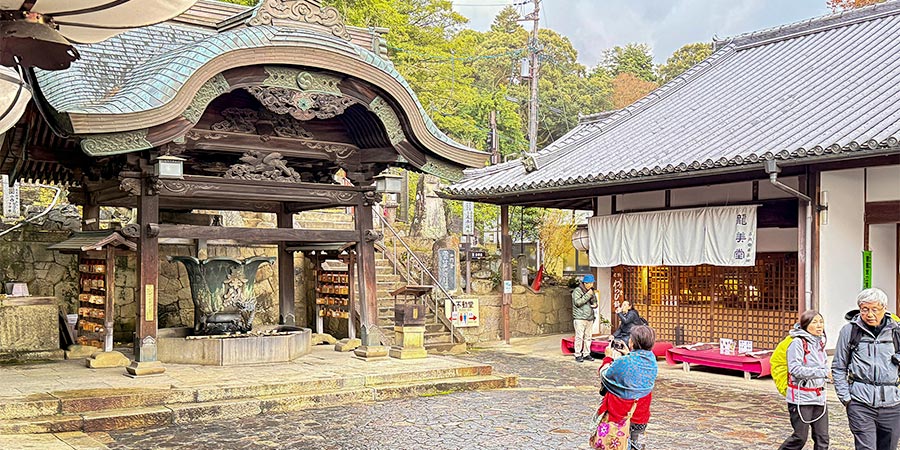
Nigatsu-do Built on Hillside
|
A Thousand Years of History: The Building and Rebirth of the Great Buddha
Most people are simply amazed by the sheer size of Todaiji and its Great Buddha, but few know the two dramatic stories behind it. From its very beginning, this ancient temple has never had an easy journey.When the Vairocana Buddha was first cast, the project nearly came to a halt: the bronze body itself posed little trouble, but the statue meant to be gilded all cover, and Japan produced almost no gold of its own back then. As a result, the gilding work simply could not move forward. Just when everyone was at a loss, gold was unexpectedly discovered in northeastern Japan. The emperor of the time took this a sign from the gods and Buddha and was overjoyed. In the end, people from all across Japan contributed money and labor to complete the giant statue.
Also, the Great Buddha Hall you see today is actually a smaller version. It has been destroyed by fire twice in its long history. At one point, the Great Buddha was left out in the open and exposed to wind and rain for nearly a hundred years. Thus, the gold leaf gilding wore away over time, with only traces of it remaining on the statue today. When the hall was rebuilt, the country’s resources were limited, so it was restored to only two-thirds of its original width. Even so, it remains the largest surviving wooden structure in the world. During the first reconstruction, craftsmen from China’s Southern Song Dynasty were brought in to lead the work, and the South Gate still carries traces of that ancient Chinese style.
Catch the Shunie Ceremony
If you happen to visit in early March, don’t miss the Shunie ceremony, a tradition that spans a thousand years. Also known as the “Water Drawing Festival”, it dates back to 752 AD and has never been interrupted for over 1,200 years, making it one of Japan’s oldest Buddhist rituals. During the ceremony, monks run along the corridors carrying giant torches several meters tall each night. Sparks rain down like golden showers, and it is said that the flames ward off misfortune and bring good fortune. On the morning of March 13, the highlight of the ceremony begins: the water-drawing ritual. Monks draw sacred water from a thousand-year-old well at the foot of the mountain to offer to the Buddha. Locals believe that once the ceremony ends, spring has officially arrived in Nara.Opening Hours
|
|
Apr - Oct |
Nov - Mar |
|
Great Buddha Hall |
7:30 - 17:30 |
8:00 - 17:00 |
|
Todai-ji Museum |
9:30 - 17:30 (Last admission 17:00) |
9:30 - 17:00 (Last admission 16:30) |
Admission
Great Buddha Hall only: Adults 800 yen (5 USD); children aged 6 - 12 400 yen (2.5 USD)Great Buddha Hall + Museum combo ticket: Adults 1,200 yen (7.6 USD); children aged 6 - 12 600 yen (3.8 USD)
How to Get There?
From Kintetse Nara Station, take the Loop Bus Route 2 and get off at the Todaiji Great Buddha Hall·Kasuga Taisha-mae Station. The temple is a 5-minute walk from the station. Alternatively, you can walk east from the station in about 10 minutes.From JR Nara Station, the park is further off, and the 30-minute walk is not worth it. Taking the bus is the better option; use the same bus as above.
Tips
1. The Great Buddha Hall ticket counter only accepts Japanese yen in cash. Credit cards and mobile payments are not accepted, so be sure to have small change ready.2. Please turn off the flash when photographing the Buddha statues inside, and drones are not allowed.
3.The paths to Nigatsu-do includes stone steps, so flat shoes are recommended.
4.During peak seasons, to avoid the crowds, visit before 9:00 AM or during the last hour before closing.
See more:

You May Like
-
 7 Days Best Japan Private Tour of Tokyo - Mt. Fuji - Tokyo - Kyoto - Nara - Osaka from USD2401
-
 10 Days Mini Group Tour to Tokyo - Hakone (Mt. Fuji) - Kyoto - Nara - Osaka - Hiroshima - Kanazawa - Shirakawa-go - Tokyo from USD3554
-
 13 Days Japan Private Tour of Tokyo - Kamakura - Tokyo - Mt. Fuji - Kyoto - Nara - Hiroshima - Osaka from USD4443