Day 1: Maun Airport Pick-up
Welcome to Botswana, the paradise of wildlife! Upon your arrival at Maun International Airport, your driver guide will meet you at the exit and accompany you to check in the lodge lying beside the Thamalakane River. Then, you can spend the remaining time freely, for instance, having a good rest or exploring this town by yourself.
It is suggested to walk 2 minutes to the Single Ln Bridge near your lodge to overlook the wide running river. Along the bridge, you can go to the Mall of Maun or Wimpy Mall of Maun on the opposite riverside to have meals. The Boma Restaurant & Riverview Bar neighboring your lodge is a good choice, too. After that, just take a leisure walk along the river bank.
► Important Note:
To control animal infectious diseases such as the foot-and-mouth disease, Botswana strictly requires foreign visitors to disinfect their shoes when entering the country and travelling to different regions. Both the shoes you wear and the shoes in your bag or suitcase need to be disinfected at the checkpoints. For convenience, you’d better put your shoes together in one bag or wear one pair only.
Accommodation: Maun Lodge (3 stars) or similar
|
Day 2: Maun to Okavango Delta, Walking Safari
After breakfast, your driver guide will wait at your lodge and escort you to Okavango Delta, the world’s largest inland delta. When arriving at the Mokoro Station, change to a mokoro, the local traditional dugout canoe, and go deep into the Delta. Then, we will pitch camp on one of the islands and have a short break.
In the late afternoon, you’ll have a guided walking safari. At this right period when wild animals become active, you can see wildebeest herds strolling along the river, giraffes eating leaves on the treetops, and a cluster of vultures gathering around the carcass of animals. During the safari, ant nests taller than humans and skeletons of wild animals can be frequently seen. It’s time to go back to the camp to have dinner when the dusk falls. Then, you may drift off to sleep with countless shimmering stars and the soft rustling of leaves. At night, some animals might pass by your camp, but don’t worry and they will leave soon as long as you stay quiet inside your tent.
► Best Time to Visit the Okavango Delta
May to October, the dry season of Botswana, is an ideal time to visit the Okavango Delta, since the water levels during this period are usually high enough to support mokoro safaris. Due to the gentle terrain, flood from Angola in rainy season takes months to fill the Delta, so the water levels mostly peak in July. Moreover, it is of higher possibility to see more wild animals in dry season when they often gather around water sources. The sparse vegetation also makes them more visible. However, for birdwatchers, December to March would be a better choice. It is also a good time to view the great migration of zebras and wildebeests.
Meals: Breakfast, Lunch, Dinner
Accommodation: Camping in Okavango Delta
|
Day 3: Okavango Delta: Guided Game Walk and Mokoro Canoe Safari
After breakfast, we’ll start a game walk to explore the Okavango Delta. Your guide will lead you to find different wild animals through recognizing their footprints on the ground, smelling the scent and hearing the sounds. You may find some big but docile animals like elephants, giraffes and zebras. Besides, various birds could be commonly seen and you can hear their melodious songs in the early morning. Of them, African Fish Eagles can be easily recognized through their white parts of heads, breasts and tails, even if you know little about birds. When they chirp, their necks arch backward almost completely. Their unique and loud call sounds like high-pitched laughter from humans, which is known as the “Sound of Africa”.
Around noon, we go back to the camp for lunch and have a brief rest.
★ Featured Highlight: Mokoro Safari through Picturesque Waterways
In the afternoon, you’ll experience the characteristic mokoro safari in the Okavango Delta, a good way to spot wild animals appearing from time to time while immersing yourself in the serene beauty of natural views. Mokoros used to be made of trunks of big trees, but to be environmental-friendly, new materials like fiberglass are applied to make the canoes. Though they become relatively lighter consequently, a mokoro allows only 1 to 2 passengers still. The dugout canoes are single-person-wide so that they can freely shuttle through the waterways narrow like the capillaries of the land. On the mokoro, you’ll navigate sometimes through reed-lined narrow channels and sometimes open water areas. The water lilies everywhere might make you mistakenly believe that it was in Monet’s paintings. Crocodiles swimming underwater, floating hippos with only their heads visible, and elephants slowly crossing the river would bring you surprises along the way. Remember to observe the reeds and a small frog might be found.
► As Okavango Delta changes with the seasons, if the water level fails to support a mokoro safari, we will take a game walk instead in the afternoon.
As the sun sets, let’s return to the camp for dinner.
Meals: Breakfast, Lunch, Dinner
Accommodation: Camping in Okavango Delta
|
Day 4: Travel to Moremi Game Reserve, Afternoon Game Drive
After breakfast and luggage packing, we are to take a mokoro back to the Mokoro Station, from where your driver guide will escort you on a private car ride to Moremi Game Reserve, the heart of Okavango Delta.
► Travel Tips:
1. Botswana sees a large diurnal temperature difference, especially in the Okavango Delta. So, even in the hottest January, a thick jacket should be prepared to deal with the low temperatures around 15℃ (59℉) in the early morning. While for the coldest July, one of the best months to visit there, a down coat is necessary since the low degrees are usually around 0℃ (32℉) though the daily highs hover around 22℃ (72℉).
2. Roads to and within the Okavango Delta are rather bumpy, which means the seemingly short distance may take much time. You’d better prepare motion sickness pills just in case. Especially in wet season, you should be mentally prepared for the possible muddy roads and subsequently longer transfer time.
Upon arrival, have a break first and then the afternoon safari starts. At this time, the sunlight turns no more scorching, so the animals come out for food and water. With the gentle winds and bright sunshine, you’ll go across the pristine and wild African savanna in a 4x4 safari vehicle to search for the hints of wild animals. As the journey ends around dusk, return to the campsite for dinner.
Meals: Breakfast, Lunch, Dinner
Accommodation: Camping in Moremi Game Reserve
|
Day 5: Moremi Game Reserve: Full-day Safari for African “Big Five”
Full-day game drives are arranged for you in order to find as diverse animals as possible. We’ll start off in the early morning to appreciate wild animals foraging in the wilderness covered by morning mist and faint rays of dawn. Moremi Game Reserve boasts varying terrains involving grasslands, forests, wetlands, and dry plains as well as various wild animals, making it ideal for game drives. Both herbivores and carnivores are likely to appear frequently in the morning. You might see the well-known African “Big Five” including ubiquitous elephants, leopards hunting on the plains, lions patrolling their territory, buffaloes grazing by the river, as well as rhinos that require a bit of extra luck to find. Around noon, we will drive back to camp for lunch.
After a short break to revive energy, we’ll continue with an afternoon safari. In Moremi Game Reserve, the endangered lechwe could be observed more easily. They tend to show up in groups of dozens or even hundreds, presenting a magnificent scene. Lechwe seems like sika deer in size, especially the females, while lechwe are distinguished by their brown back without any white spots. Instead of branch-like antlers, the male lechwe have long black horns. Their gender differences are not only embodied in the appearances but also the living environment. Female and young lechwe often live near the water sources, while males, needing less water, prefer drier land far away. Therefore, the herds you see usually share the same gender, except during their mating season.
Meals: Breakfast, Lunch, Dinner
Accommodation: Camping in Moremi Game Reserve
|
Day 6: Drive to Khwai Concession, Afternoon Safari
This morning, we are going to drive east along the border of Moremi Game Reserve to reach Khwai Concession. After lunch in the campsite, we’ll start a game drive in the afternoon.
Khwai Concession consisting of grasslands, woodlands and floodplains attracts a large number of mammals and birds. Thus, it enjoys both great diversity and high density. At dusk, the setting sun, the peaceful river surface tinged red and the silhouette of elephants drinking water together create a memorable picture. Then, have dinner and a good rest in your camp.
Meals: Breakfast, Lunch, Dinner
Accommodation: Camping in Khwai Concession
|
Day 7: Khwai Concession: Off-road Wildlife Tracking
Today, it is highly recommended to get up early to have a morning game drive. Unlike national parks with strict rules, the community-run Khwai Concession allows off-road tracking. In safe areas, you can step out of the vehicle and take a guided walk to observe wildlife up close, giving you a freer, more adventurous safari experience. Beside common African animals like elephants, giraffes, and zebras, the open waters and woods support a rich variety of birds, such as egrets, cranes and eagles of different species. Of them, egrets often stand out for their long legs and necks. No matter standing still on the shore or flying over the river for prey, they show perfect and beautiful bodylines to feast your eyes. Around noon, we are to back to campsite for lunch. Afterwards, it is advised to have a short sleep to gain strength for the following safari.
In the late afternoon when animals become lively again, we’ll drive to find more of them. It’s worth noting that the density of African wild dogs in Khwai Concession is relatively high, particularly during their denning period from May to July. Rather than brief sightings in other areas, you might be able to watch wild dogs hunting in team for longer periods. Unlike predators such as hyenas and lions, wild dogs give the weak ones in their family the priority to enjoy the prey, being quite “humanitarian”. Meanwhile, roan antelopes normally appear more frequently here than other areas since they cannot run very fast and rely on lush vegetation to hide themselves against the predators. Also, they are picky about plants and feed on only medium-length grass. The black face with mouth and eyes white is their prominent feature, making them very distinctive. As dark falls, we’ll return to the campsite for dinner.
► For Your Information:
Different from other areas alike to national parks, Khwai Concession permits night drives where you may spot nocturnal and rare pangolin. If you are interested in this activity, please consult your guide for more information.
Meals: Breakfast, Lunch, Dinner
Accommodation: Camping in Khwai Concession
|
Day 8: Transfer to Savuti, Afternoon Game Drive
After breakfast, we’ll drive north to Savuti, one of four major zones of Chobe National Park. Upon arrival, have lunch and then take an afternoon game drive.
Savuti, known for vast untamed wilderness and a small number of visitors, brings you a more private and wilder safari. During the safari, dry dunes, woodlands, and vast plains and wetlands will unfold before your eyes. The Savuti Canal over 100 km (62 mi) long shows the most mysterious landscape. It used to get dry and then refilled unpredictably several times. However, the wide floodplains and permanent waterholes serve as water sources for wild animals. So, diverse wild animals remain available here, for example, wildebeest flocks passing across the river, hyenas gnawing on the flesh, and giraffes wandering through bushes.
After sunset, we will come back to campsite for dinner.
Meals: Breakfast, Lunch, Dinner
Accommodation: Camping in Savuti
|
Day 9: Savuti: Game Drives to Encounter Lion Prides
This day involves two game drives in the morning and afternoon. Savuti is characterized by a plenty of big predators, particularly the lions. In view of elephants’ large size and weight up to several tons, normally, most lions don’t disturb this giant animal, but the lions in Savuti are known for their frequent hunting of baby elephants. In dry season, due to the shortage of water, elephant herds grow weak during migration especially the young ones, giving lions an ideal opportunity to hunt. You may find that lions engaging in hunting are mostly female, partly because the males need to protect their territory and safeguard their babies, and partly because their thick mane could lead to troublesome heat dissipation in such a hot land. Around noon, we will return to camp for lunch and rest.
Our safari will continue in the late afternoon when water-loving animals like buffaloes, elephants and antelopes usually appear near the water sources and the pictures of animals drinking in herds are often on. Around dusk, hippos who spend most of the day immersing in water to prevent their skin from cracking tend to walk onto land to find food, allowing you to see their whole appearances. Don’t worry if you find their skin seems to bleed. Instead of getting injured, they are actually covered by protective thick liquid against strong sunshine.
What’s more, if time permits during your safari, the guide will lead you to climb rocks to find hidden ancient Bushman rock paintings there. Those simple brushes and somewhat vague pictures are telling the daily life of the local San People about a thousand years ago.
Meals: Breakfast, Lunch, Dinner
Accommodation: Camping in Savuti
|
Day 10: Transfer to Chobe, Afternoon Game Drive for Massive Elephant Herds
Today, we’ll head northeast towards Chobe National Park for different landscapes and wildlife. The vast African plain here dotted with lush bushes and edged with Chobe River is home to various wild animals. Upon arrival, we’ll first have lunch and rest for a while.
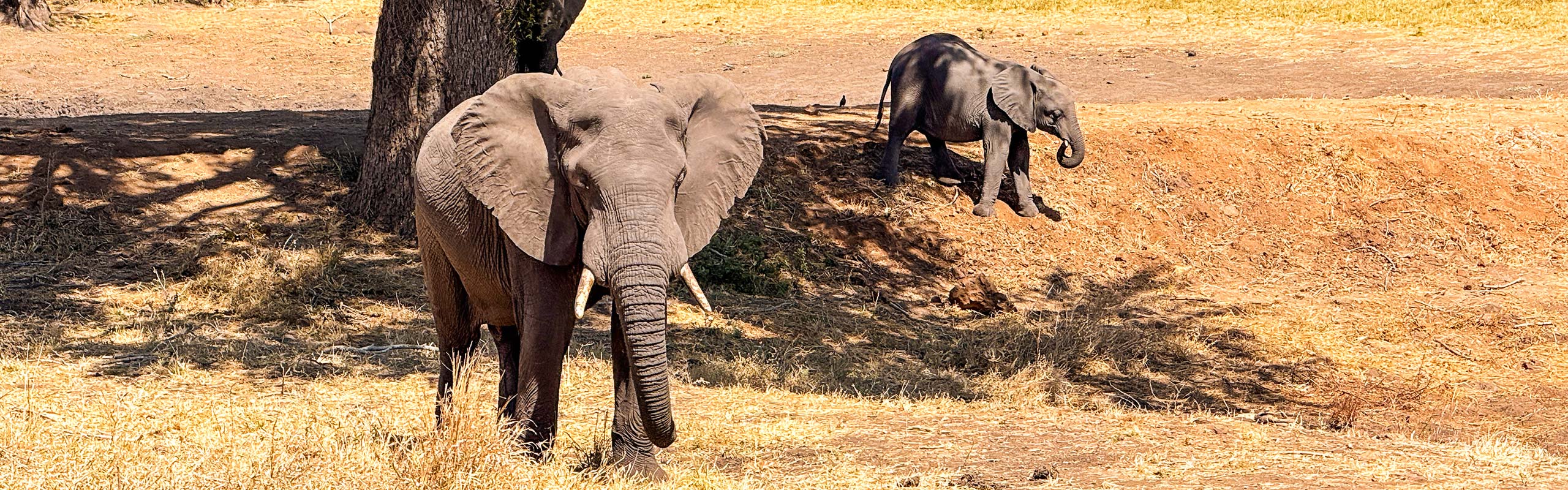
Later, an afternoon game drive begins. In Chobe National Park where live over 50 thousand African elephants, you could see dozens even hundreds of elephants drinking and playing by the riverside, find the dead elephants pecked by vultures, or go past their large skulls and skeletons. Other big animals are active as well and highly possible to be observed around dusk, such as lions, giraffes, and antelopes. When the sun sets, we’ll go back to camp to have dinner.
Meals: Breakfast, Lunch, Dinner
Accommodation: Camping in Chobe National Park
|
Day 11: Chobe National Park: Morning Game Drive, Chobe River Boat Cruise
After breakfast, we’ll have a game drive in the early morning. Besides common carnivores and herbivores in Africa, Chobe National Park is the natural habitat for birds, which are often busy with foraging in the morning. Lilac-breasted roller, the national bird of Botswana and Kenya, must be one of the most eye-catching. They have earned themselves the nickname of “Rainbow Bird” for their colorful feathers. As its name implies, the typical purple on the chest as well as varying blue and green on the wings make them a special view in the African savanna. The safari will end around noon when we go back to camp for lunch.
In the afternoon, we will go aboard the Chobe River cruise ship to unlock a new perspective. With the changing river views, you can observe animals in a more relaxed and safer way. By the riverbanks, there wander grazing wildebeests and elephants. Crocodiles and hippos often hide beneath the river surface, leaving a small part visible. You may see birds standing on their back who peck parasites for them and fly away to alert them when other big animals go closer. When the setting sun like yolk casts a golden filter over the vast plain, the red glow reflected on the river and the silhouette of birds flying over sky will definitely glut your eyes. Finally, let’s return to the camp for dinner.
Meals: Breakfast, Lunch, Dinner
Accommodation: Camping in Chobe National Park
|
Day 12: Kasane Airport Seeing-off
When you finish breakfast and luggage packing, your driver guide will escort you to Kasane Airport at appointed time. Hope you’ve had a good journey with us! If you want to visit Makgadikgadi Pans, Botswana’s vast white Salt Lake, to see meerkats or flamingoes, we can tailor a specialized travel schedule according to your interests.
Meal: Breakfast
|