BT05: 10 Days Paro - Thimphu - Punakha - Gangtey & Phobjikha Valley - Trongsa - Bumthang - Paro
Type: Private tailor-made tour, with an English-speaking guide
Transportation: Private air-conditioned car with an experienced driver
Hotels: Handpicked 3-star hotels, also open to your own choice
Meals: 9 breakfasts, 9 lunches, and 9 dinners
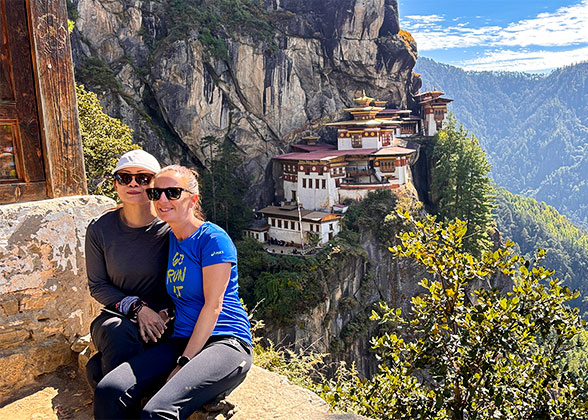
Trek to Tiger’s Nest to explore Guru Rinpoche’s significance in Bhutanese Buddhism.
Witness how Bhutanese people pass down their culture and customs across generations.
Visit ancient temples to observe monastic life and valuable Buddhist relics.
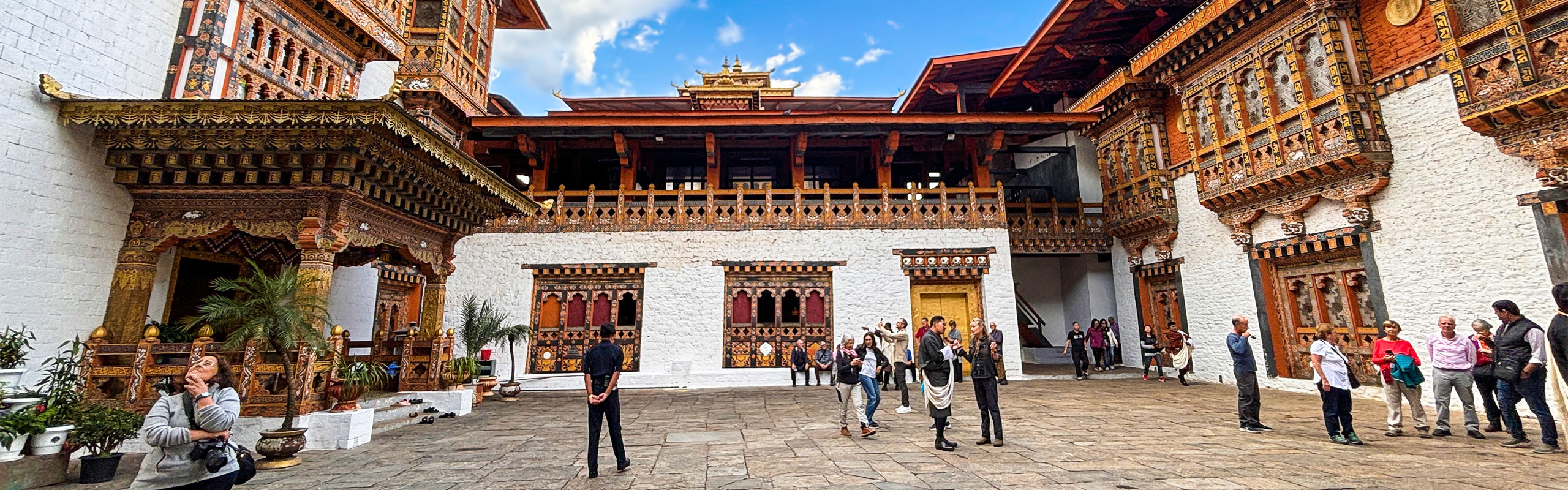
Discover how dzongs serve as centers of national governance, spiritual life, and celebration.
Embark on a nature tour of the pristine Phobjikha Valley and the idyllic Bumthang.
This trip can be tailored to match your dates and interests!
Itinerary
Expand All
Day 1: Arrival in Paro; Transfer to Thimphu for city exploration
View More Videos
Dochula Pass
Congratulations on finding a trusty Bhutan travel companion! Nestled in the Himalayas, this ancient Tibetan Buddhist realm offers a rare, slow-paced sanctuary from modern life. When you land at Paro Airport, your private guide and driver, dressed in traditional attire, will warmly welcome you and bless your journey with a white silk scarf. Then, buckle up for a 1.5-hour drive to Thimphu, the capital, with a stop at Tachogang Lhakhang Bridge - locals swear crossing it locks in good luck!
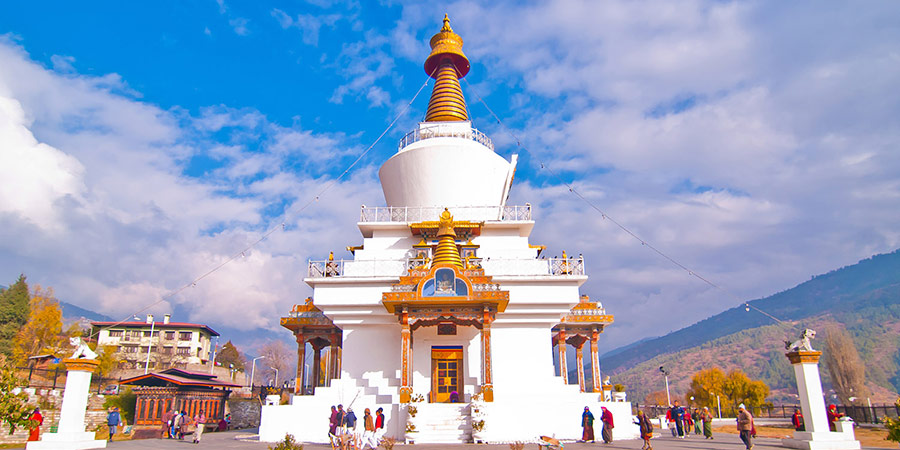
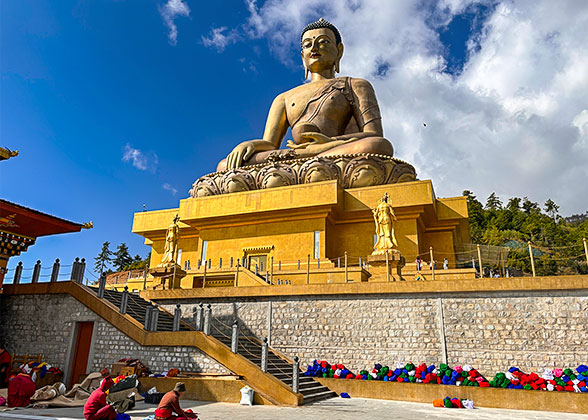
Once arriving, dive into the city’s spiritual pulse accompanied by your guide. The first stop is the National Memorial Chorten, a Tibetan-style stupa that serves as a prayer and social hub for locals. Uniformed kids swirl around the chorten every morning, while elders spin prayer wheels from dawn to dusk. Next up is the 51-meter (167-foot) gilded Buddha Dordenma statue that commands the Thimphu Valley. During the Bhutanese New Year, often late February to March, devotees gather in the square to pray, ignite a sea of butter lamps, and attend celebrations. We’ll wrap up the day at splendid Tashichho Dzong. This impressive fortress doubles as the seat of government and the Central Monastic Body’s summer palace. Since we’ll visit after 17:00, when offices are closed, you might even spot the King walking past by the side gate.
Later, your guide and driver will escort you to your hotel for dinner. Bhutan is a heaven for vegetarians as slaughtering animals is forbidden and meat is mostly imported from Nepal or India. You can try light-flavored local specialties like cucumber salads and Tibetan momos (steamed vegetable dumplings).
► Pre-Travel Reminders: 1.We’ve included visa fee, daily Sustainable Development Fee, and meals in this package, so just prepare USD 50-100 for your personal expenses, as US dollars are widely accepted in most cities. 2.This trip leads you across Bhutan from the west to the central region via winding mountain roads. As the longest drive can take up to 6 hours, we suggest packing motion sickness medicines and a neck pillow for a comfy journey. 3.While locals are quite friendly and enjoy interacting with the camera, please always seek permission before snapping close-up portraits, especially of the monks. Meanwhile, photography inside the temple chambers is strictly prohibited.
Meals: Lunch, Dinner
Accommodation: Hotel Bhutan Home, Thimphu (3 stars) or similar
Day 2: Thimphu: Tango Monastery, School of Thirteen Arts and Crafts, and Takin Preserve
This morning, your guide and driver will pick you up at your hotel for a 1.5-hour hike to Tango Monastery, one of Bhutan’s top Buddhist institutions. In the country, young novices often start their temple life as early as age 5, devoting 10 hours a day to cultural knowledge and intensive meditation, starting with the morning prayer between 04:00 and 05:00. While some return to secular life after their teens, more choose to dedicate their entire lives to spiritual mastery, aiming for a member of the Central Monastic Body. This is because they are considered spiritual leaders with a high social status and sometimes enjoy preferential economic treatment, guiding major events and daily life. The supreme religious affairs leader, Je Khenpo, can even directly participate in major state decisions.
National Memorial Chorten, Thimphu
Bhutanese Monks under the Buddha Dordenma Statue
Sandwiched between India and China, Bhutan has survived centuries of invasions, thus sparing no effort to protect its national culture as a weapon to guard Gross National Happiness. Then, we’ll visit the School of Thirteen Arts and Crafts, where young apprentices are summoned to keep ancient traditional crafts including weaving, wood carving, and thangka painting alive. Their production demands high concentration and precision, honing students’ patience and skills while shielding them from commercial influences for a pure cultural revival. Our next stop is the Folk Heritage Museum inside a 150-year-old farmhouse. Climbing up to the third-floor living space, you’ll find an altar room in the center, which reflects how Bhutanese fuse deep faith into their daily life.
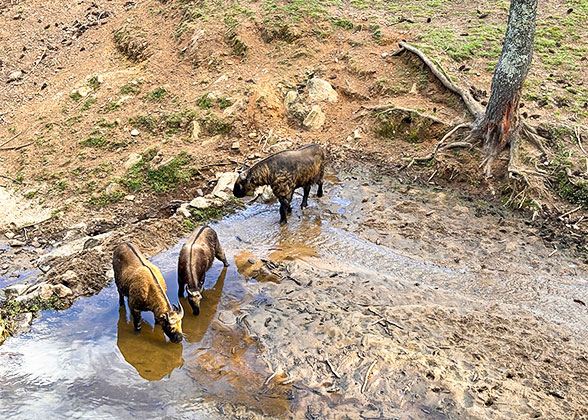
After watching Bhutan’s national animal—Takin—from the elevated boardwalks at Royal Takin Preserve Motithang, we’ll conclude the day at the Traditional Paper Making Factory. There, you can observe master craftsmen transform raw tree bark into delicate Desho paper. Once popular for preserving Buddhist scriptures, this paper is now crafted into gift cards and journals, indicating the glorious Bhutanese craftsmanship. Finally, your guide and driver will escort you back to your hotel.
Meals: Breakfast, Lunch, Dinner
Accommodation: Hotel Bhutan Home, Thimphu (3 stars) or similar
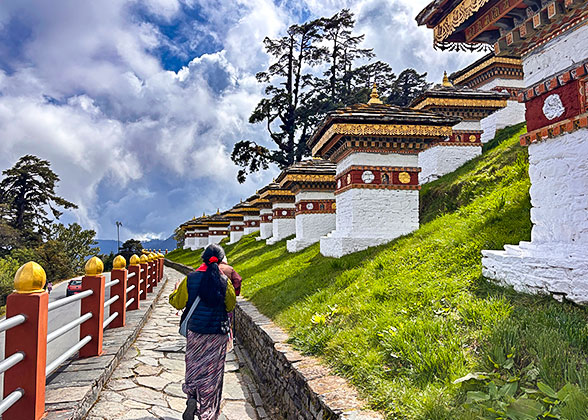
After breakfast, your guide and driver will escort you from your hotel to Punakha in about 2 hours. On the way, we’ll briefly stop at Dochula Pass to see the 108 stupas, which honor Bhutanese soldiers who lost their lives in a southern counter-insurgency led by the Fourth King. Local culture holds that any loss of life, whether friend or foe, is a tragedy. Thus, the Fourth Queen Mother ordered these stupas, instead of triumphal arches or monuments, to liberate the souls of both loyal soldiers and the insurgents.
Once in Punakha, we’ll visit the 600-plus-year-old Chimi Lhakhang, dedicated to Drukpa Kunley, who was revered as the fertility saint for using his phallus to defeat a demon that prevented local reproduction. We’ll park at the hillock’s base and trek 30 to 40 minutes through local villages to reach the site. Along the way, you’ll be culturally shocked by giant phallus murals on houses to ward off evil spirits. This bold faith also pulses through local customs—new houses often hang wooden phalluses from their roofs, and children wear tiny phalluses on silk cords around their necks as protective amulets.
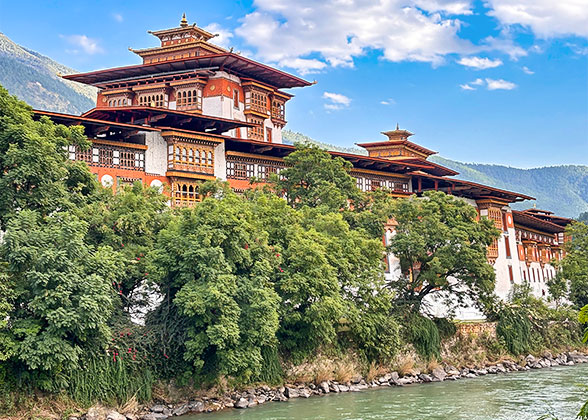
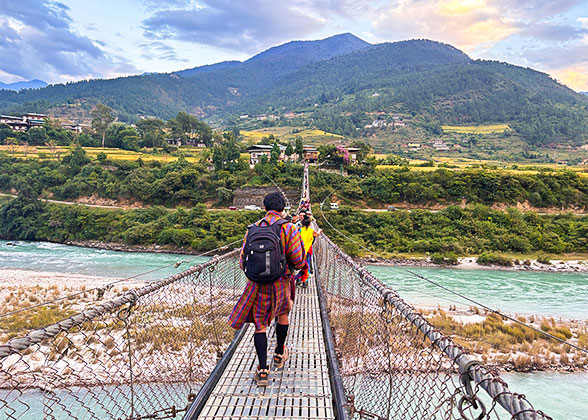
Later, let’s head to Punakha Dzong. Thanks to its low altitude, Punakha Valley remains emerald-green and warm even in the dead of Himalayan winter, which is why Punakha Dzong served as Bhutan’s political and religious hub for nearly 300 years before Thimphu became the capital. Every winter, the royal family and the Central Monastic Body relocate here from Thimphu’s Tashichho Dzong and return in April. Inside, marvel at the central tower’s exquisitely carved wooden windows, auspicious decorations, and murals. Afterward, let’s unwind on the nearby suspension bridge. Looking around, you’ll feel a harmony of religious majesty and blissful country living formed by fluttering prayer flags, rustic rammed-earth homes, and fruit orchards & rice paddies.
After capturing a stunning sunset, your guide and driver will escort you to your hotel.
Meals: Breakfast, Lunch, Dinner
Accommodation: Hotel Zangto Pelri, Punakha (3 stars) or similar
Grand 108 Stupas at Dochula Pass
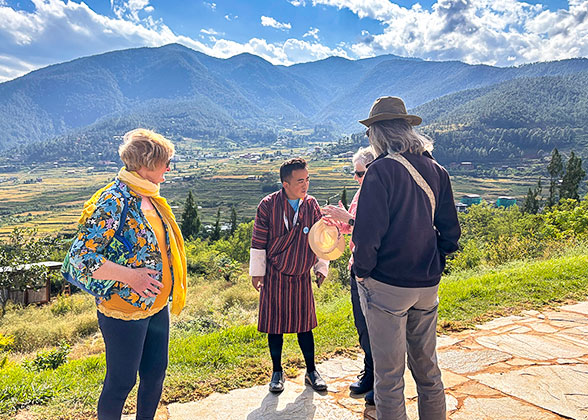
Our Guests with a Local Guide at Chimi Lhakhang
Day 4: Punakha - Rinchengang Village - Gangtey & Phobjikha Valley - Gangtey Monastery
After the hotel meet-up, you’ll enjoy a 3-hour private escort to Phobjikha Valley in Gangtey. En route, your guide will accompany you to discover the Rinchengang Village, well-known for stone masonry. Every structure, from houses to temples, was handcrafted from raw rock by local master masons. Considered the elite builders throughout the country, they were invited to construct numerous fortresses, temple foundations, and traditional bridges.
Once arriving, we’ll visit the Gangtey Monastery, the only Nyingma school of Tibetan Buddhism in Bhutan. Utilize the monastery’s prime hilltop location to take in the unobstructed Phobjikha Valley before entering: splendid glacial vistas colliding with wetlands dotted with traditional houses and grazing cattle. Then you can explore the interior murals and mystical ritual weapons, as well as the ultimate treasure—the Lotus Hat of Guru Rinpoche, who spread Buddhism into Bhutan in the 8th century. According to Tibetan Buddhism, just seeing this hat - regardless of one’s belief or knowledge of Buddhism – can seed liberation from rebirth and bestow great merit and benefits.
Finally, your guide and driver will escort you to your hotel for a soothing night.
Meals: Breakfast, Lunch, Dinner
Accommodation: Gakiling Resort, Phobjikha (3 stars) or similar
Punakha Dzong Standing by Riverside
Thrilling Suspension Bridge
Day 5: Gangtey Nature Trail Hike & Black-necked Crane Center; Drive to Trongsa
After breakfast, your guide will accompany you on a nearly 1-hour hike along the Gangtey Nature Trail. Stroll across a carpet of wild pinecones, breathe in the intoxicating scent of blue pine forests, and glimpse cascading terrace fields of buckwheat and potatoes.
Later, we’ll reach the Black-necked Crane Information Center to make friends with Bhutan’s national birds. Phobjikha Valley’s untouched wetlands provide a natural sanctuary for these rare cranes, which migrate from Tibet every October to escape the harsh winter until March. Farmers leave their fields unplowed during this period, allowing the cranes to forage safely on leftover buckwheat. Thanks to local conservation efforts, the winter crane population has increased from 300 at the end of the last century to over 600 today.
Then let’s meet up with children and teachers at Gangtey Primary School. In Bhutan, students start learning in Dzongkha, the official language, from kindergarten, switching to English from the fourth grade. While this bilingual edge makes young Bhutanese more competitive globally, it has also led to significant brain drain. The domestic job market lacks high-paying, advanced careers, promoting many youths to prefer blue-collar jobs in remote Australia over prestigious civil servants at home, which pay less than USD 300 monthly.
Your guide and driver will then escort you on a 5-to 6-hour drive to Trongsa. En route, we’ll cross Pele La Pass and make a brief stop at the stupa Chenbdji Chorten. Legend has it that a mountain demon once terrorized travelers in this area until the Nyingma master Kongtrul Rinpoche II subdued and trapped it beneath this stupa. Upon arrival at your hotel in Trongsa, rest early to recover from the long journey.
Meals: Breakfast, Lunch, Dinner
Accommodation: Yangkhil Resort, Trongsa (3 stars) or similar
Day 6: Visit Trongsa Dzong & Local Weaving Center; Transfer to Bumthang
View More Videos
Local Dance and Singing Performance
Let’s kick off the day with a visit to Trongsa Dzong, Bhutan’s largest fortress-monastery, accompanied by your guide and driver. Straddling mountain ridges, this architectural masterpiece is considered the ‘throat of Bhutan’, as the only trail connecting eastern and western Bhutan passed through its courtyard, granting the Trongsa governor absolute control over the kingdom. Moreover, as the ancestral home of the Wangchuck dynasty, each king must serve as the governor of Trongsa and reside within the fortress before their coronation. It’s said that they enjoyed people-watching from the fortress’s window and drew inspiration for governance. We’ll walk through its labyrinth of courtyards, corridors, and temples, as well as the Mangde River valley’s dramatic views below.
Our trip will then extend to Bumthang after a 4-hour drive. Bumthang means ‘beautiful garden’ in Dzongkha, reminding you of Switzerland with its vast fields of buckwheat, barley, and apple trees. On the way, we’ll stop at the local weaving center to watch local women skillfully hand-weave ‘yathra’ on horizontal looms. Widely used for traditional robes, raincoats, and furniture covers, this thick wool textile, although not as soft as cashmere, is a lifesaver when valley temperatures plummet to -17℃ (1.4℉) in winter. Additionally, many handicraft shops and cooperatives provide local women with job opportunities, helping families sustain themselves through the sale of yathra textiles. Finally, your guide and driver will escort you to your hotel for check-in.
Meals: Breakfast, Lunch, Dinner
Accommodation: Swiss Guest House, Bumthang (3 stars) or similar
Day 7: Bumthang Highlights with Tibetan Buddhist Sacred Sites
As the spiritual epicenter of Bhutanese Tibetan Buddhism, Bumthang also boasts many centuries-old sacred sites. After the hotel meetup, your guide and driver will accompany you to explore them, beginning with Kurje Lhakhang. Legend has it that in the 8th century, Guru Rinpoche meditated in a cave here to suppress an evil spirit that had cursed the local governor with a deadly disease. His body imprint remains in the rock, attracting pilgrims seeking spiritual energy. Walk miles to the nearby Jambey Lhakhang, one of 108 temples built by Tibetan Emperor Songtsen Gampo (617 - 650 AD) to imprison an ogress blocking Buddhism’s spread across the Himalayas.
Then, let’s head to Tamshing Lhakhang to see what are widely considered the country’s oldest Buddhist murals. Next up is the Jakar Dzong, the administrative center of Bumthang. Among Bhutan’s over 20 dzongs, it stands out with an exclusive protected trail that leads to a spring, ensuring residents an uninterrupted water supply even in wartime. Later, stroll through the nearby village and have some leisure time at a local handicraft shop.
Our afternoon sightseeing will extend to the Lhodrak Kharchhu Monastery. The courtyard will become vibrant with collective monk debates between 16:30 and 18:00. Divided into groups, the monks exchange scriptural quotes in a ‘direct question-and-answer’ style, discussing Buddhist teachings. Photography is strictly forbidden during this process, but you can fully immerse yourself in the atmosphere: the monks slap their hands, stomp their feet, and roll their prayer beads to demand quick responses.
After a day of spiritual baptism, your guide and driver will escort you back to your hotel.
Meals: Breakfast, Lunch, Dinner
Accommodation: Swiss Guest House, Bumthang (3 stars) or similar
Day 8: Fly from Bumthang to Paro: Visit Ta Dzong (National Museum) & Rinpung Dzong
In the morning, your guide and driver will escort you to the airport for a 25-minute flight to Paro. Upon touchdown, your local guide and driver will pick you up and whisk you away to your hotel for check-in.
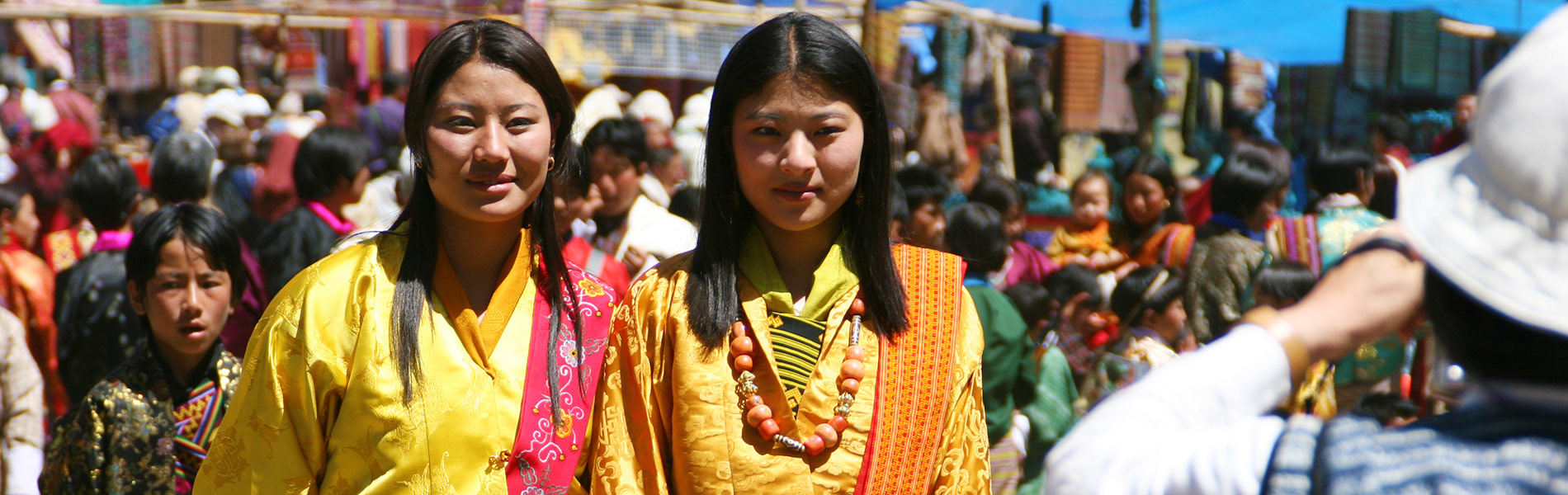
After a brief rest, make our way to the Ta Dzong. Originally built as a strategic watchtower, it now functions as the National Museum, displaying treasures like carved tree-shaped mandalas, thangka paintings, three-dimensional stamps, and especially the traditional national dress. Throughout your trip, you’ve likely noticed locals wearing these garments: men in Gho, a knee-length, belted robe with black knee socks; women in Kira, an ankle-length wrapped dress topped with a short jacket. Besides the mandatory dress code in schools, government offices, and sacred sites, locals wear them daily to showcase their unique identity while contributing to the local textile industry.
Next, we’ll descend to Rinpung Dzong, also known as Paro Dzong, the administrative and religious center of Paro. In late March or April, the massive courtyard hosts the five-day Tsechu Festival. During this celebration, an 18-square-meter thangka of Guru Rinpoche is unfurled down the walls, and masked dancers perform cham dances to crush demons and bless the kingdom with peace. Local flocks from all corners, dressed in their finest national attire, gather to watch these dances, which are believed to generate good karma. Due to potential tourist flows in this period, please lock in your booking at least 4-6 months in advance if you want to experience it. After that, we’ll escort you back to your hotel.
Meals: Breakfast, Lunch, Dinner
Accommodation: Hotel Olathang, Paro (3 stars) or similar
Traditional Costumes Exhibited in Ta Dzong
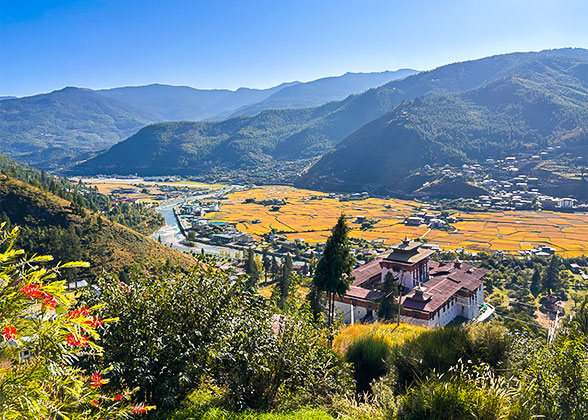
Paro Valley's Natural Scenery
Day 9: Paro: Tiger’s Nest Hike, Kyichu Lhakhang, Old Town Stroll
★ Tiger’s Nest Monastery: A Pilgrimage to Bhutan’s Spiritual Center
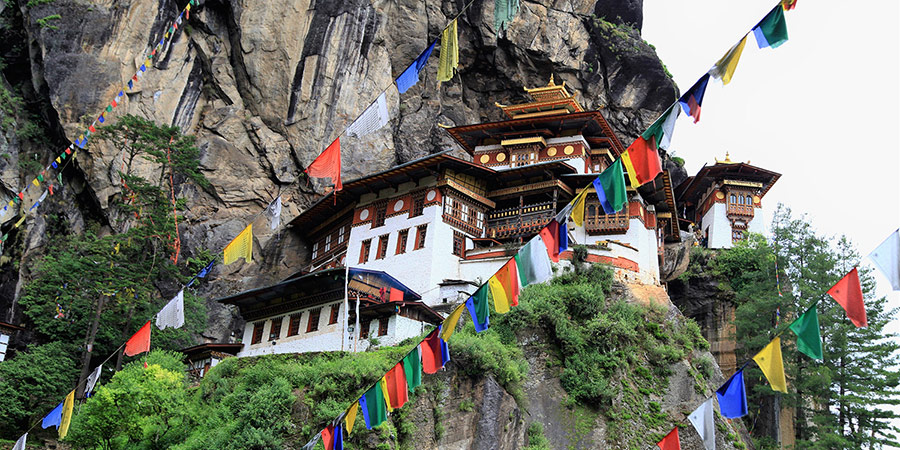
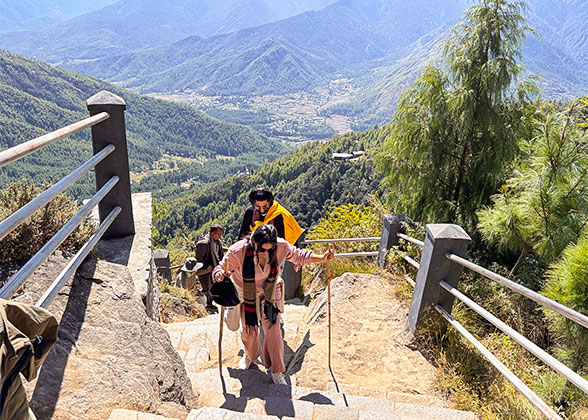
This morning, ready for the epic trek to Tiger’s Nest Monastery with your guide. Every local dreams of making a pilgrimage at least once in their lifetime to retrace the steps of Guru Rinpoche. Lace your hiking boots tight; we’ll begin with a 1-hour hike through dense forests to a café halfway up the mountain for a quick rest. The following 1-hour zigzagging mountain trail brings an obvious altitude ascent, but the ultimate test is the final 40-minute stretch along steep stone steps. While it’s a demanding conquest, the journey is enriched by meditating elders, water-powered prayer wheels, and roaming yaks, which will deeply touch your soul even if you aren’t a Buddhist. Once at the top, unlock this multi-tiered monastery, with various chambers, monks’ quarters, and caves connected by wooden corridors, ladders, and tunnels. FYI: 1.As the monastery survived a devastating fire, all your belongings must be placed in lockers before entry to avoid any potential threats. 2.If a local Lama splashes water on your head, accept it as a genuine blessing from the local tradition. 3.Pack Coke and high-energy bars to ward off altitude sickness.
After descending the mountain, your guide will show you around Kyichu Lhakhang, Bhutan’s oldest temple. Guru Rinpoche once buried vital scriptures and spiritual treasures there, making it a sacred site for the Nyingma sect.
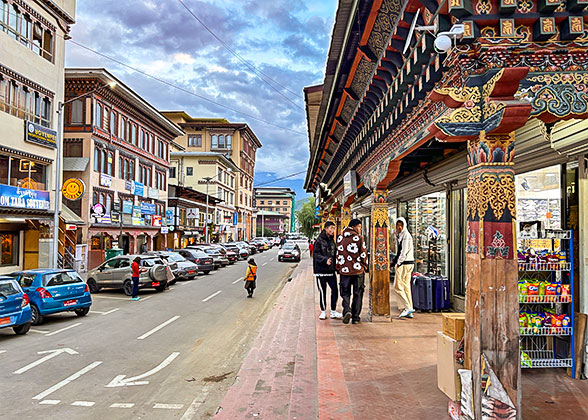
We'll conclude the day with a stroll through Paro Old Town. Breathe crisp mountain air on the streets stretching along the Paro Chhu River, explore colorful national attire, and watch locals sharing hot butter tea with their families when passing by eateries. Finally, your guide and driver will escort you back to your hotel.
Meals: Breakfast, Lunch, Dinner
Accommodation: Hotel Olathang, Paro (3 stars) or similar
Tiger's Nest, Paro
Challengable Hike to Tiger's Nest Monastery
Day 10: Paro Airport see-off
Time to bid farewell today! Your trip will end as your guide and driver escort you to the airport. We know you’ll leave with the happiness secret of Bhutan - inner peace - fostered by hospitable locals and Buddhist rituals woven into daily life. Safe journey!
► Extension Inspiration Three direct flights between Paro and Kathmandu a day make leaping between Bhutan and Nepal quite easy. If your vacation allows, feel free to contact our travel consultants to craft an itinerary for more hidden Buddhist sanctuaries and Himalayan views.
Meals: Breakfast
Expand All
This trip can be tailored to match your dates and interests!
Tour Prices
Christmas & 2027 Specials: 12% off - Book before Oct 31, 2026