BT03: 8 Days Paro - Thimphu - Punakha - Gangtey & Phobjikha Valley - Paro
Type: Private tailor-made tour, with an English-speaking guide
Transportation: Private air-conditioned car with an experienced driver
Hotels: Handpicked 3-star hotels, also open to your own choice
Meals: 7 breakfasts, 7 lunches, and 7 dinners
Take a challenging hike to observe how the Tiger’s Nest Monastery ‘grow’ from the cliff face.
Explore the political and religious functions of dzongs, and stroll through courtyards for different purposes.
Venture into the Phobjikha Valley to discover why black-necked cranes are revered in Bhutan.
Understand how Bhutanese education integrates academic knowledge, spiritual practices, and handicraft skills seamlessly.
This trip can be tailored to match your dates and interests!
Itinerary
Expand All
Day 1: Paro Airport Pick-up; Transfer to Thimphu for a City Tour
View More Videos
Tiger’s Nest Monastery
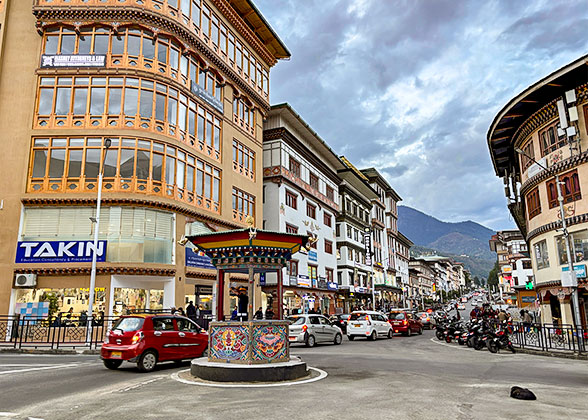
Welcome to Bhutan to explore true happiness! If you fly into Bhutan from Kathmandu, perhaps request a left-side window seat to admire Kanchenjunga and Jichu Drake Peaks soaring below on clear days. Once you land at Paro Airport, your guide and driver will be there to greet you and escort you on a 1.5-hour drive to Thimphu via the Tachogang Lhakhang Bridge. As you enter the capital, you’ll notice traffic lights are absent; instead, vehicles are directed by police officers’ expressive hand gestures. Even during peak hours, any backup clears within 5 to 10 minutes, echoing the unhurried pace of life in the country.
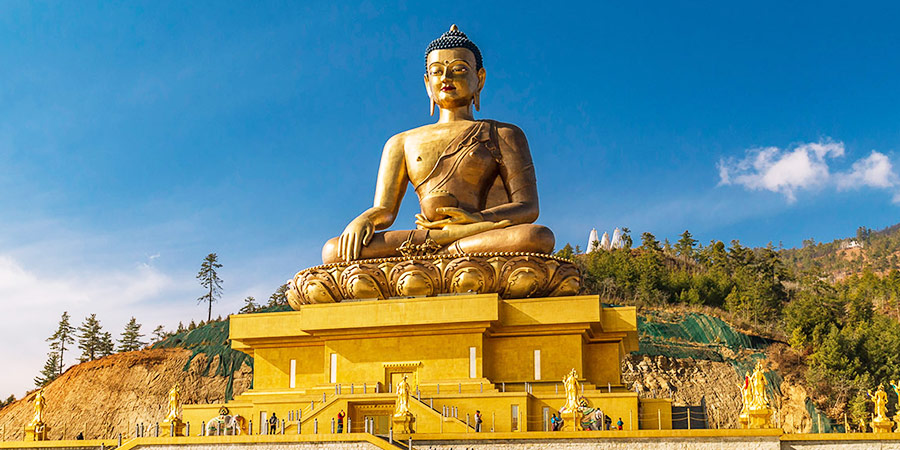
After check-in, let’s kick off our exploration at the National Memorial Chorten. Unlike traditional stupas that enshrine the relics of saints, it features only photos of Bhutan’s Third King on the ground floor, honoring his role in shaping modern Bhutan. Next, we’ll visit the Buddha Dordenma statue. Besides its impressive size, the real treat here is the 360-degree unobstructed views of Thimphu. Our last stop is the Tashichho Dzong, which functions as both a majestic Tibetan Buddhist monastery and administrative headquarters. You may glimpse Bhutan’s harmony between tradition and modernity: government officials working on tablets in the assembly hall, while monks spin prayer wheels in the corridors outside.
Later, your guide and driver will escort you back to your hotel for dinner. Bhutanese cuisine centers on red rice, cheese, and vegetables. Because of the high altitude and cold climate, locals love chili peppers and other warming spices. You can order milder dishes if you prefer.
Essential Tips: 1.Etiquette: Please wear attire that covers your shoulders and knees when visiting temples and dzongs, and remove your shoes and hats before entering shrine rooms. Photography inside temples is strictly prohibited, and you’ll need to ask for permission before capturing monks or religious ceremonies in the courtyards. 2.Health: Local healthcare facilities are limited, and your familiar medicines are not always available. We recommend bringing an ample supply of your essential personal medicines. 3.Plug: Types D, F, and G plugs are common, so remember to pack a universal adapter.
Meals: Lunch, Dinner
Accommodation: Hotel Bhutan Home, Thimphu (3 stars) or similar
Day 2: Thimphu: Tango Monastery, School of Thirteen Arts & Crafts, Folk Heritage Museum, Takin Preserve
After breakfast, your guide and driver will pick you up at your hotel and head to Thimphu Valley. We’ll hike for over 30 minutes along smooth, forested trails to Tango Monastery, the highest-ranked Buddhist learning center in Bhutan. En route, admire stones hand-painted with animals, dzongs, and chortens by monks. As the trail steepens near the top, feel free to pause on a bench and reward yourself with Thimphu Valley’s terraced fields, farmhouses, and rolling silhouettes of the Himalayas.
Post-lunch, we’ll visit the School of Thirteen Arts and Crafts to watch apprentices intently creating handicrafts like thangkas, wooden carvings, and embroidery. These time-honored crafts are the soul of Bhutan’s Buddhist culture and national identity, whose preservation has helped balance material desires with spiritual wealth, contributing to the country’s renowned happiness.
Buddha Dordenma Statue, Thimphu
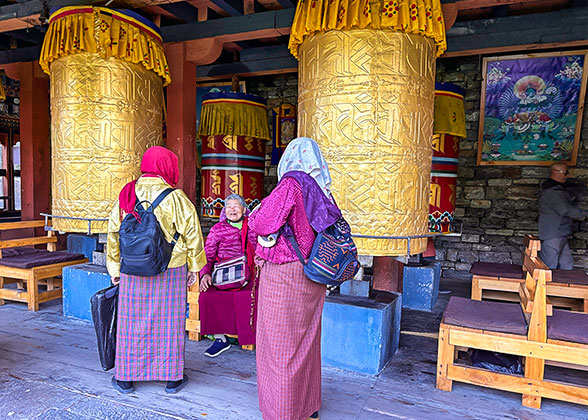
Devout Locals at National Memorial Chorten
Following that, let’s head to the Folk Heritage Museum, designed to mirror a traditional Bhutanese home: the ground floor is for livestock pens, the middle for the granary, and the top for living and dining spaces, providing an immersive portal into ancient farming life.
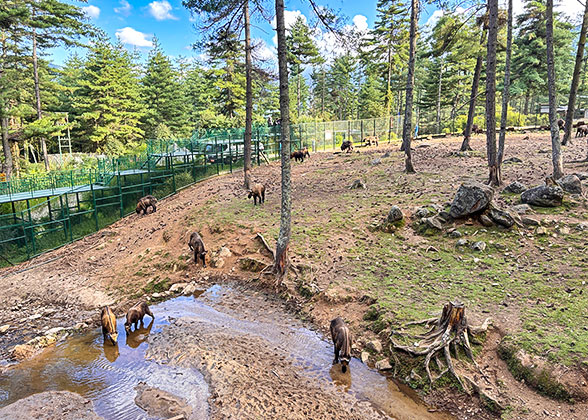
Date with Bhutan’s national animal at the Royal Takin Preserve Motithang to conclude the day. According to legend, Lama Drukpa Kunley—aka the ‘Divine Madman’—created this creature by assembling a goat’s skull and a cow’s skeleton and snapping his fingers to bring it to life. That’s why it holds crucial religious significance in local culture. Today, only about 500-700 takins remain in Bhutan, making them truly precious. After that, you’ll enjoy a private escort back to your hotel.
Meals: Breakfast, Lunch, Dinner
Accommodation: Hotel Bhutan Home, Thimphu (3 stars) or similar
After hotel pickup, join your guide and driver for a trip to Punakha. Shortly after departure, we’ll stop at Simtokha Dzong, a fortress-monastery that historically functioned as Bhutan’s social, religious, and educational center. Currently, it operates as a cultural institute focused on Buddhist studies.
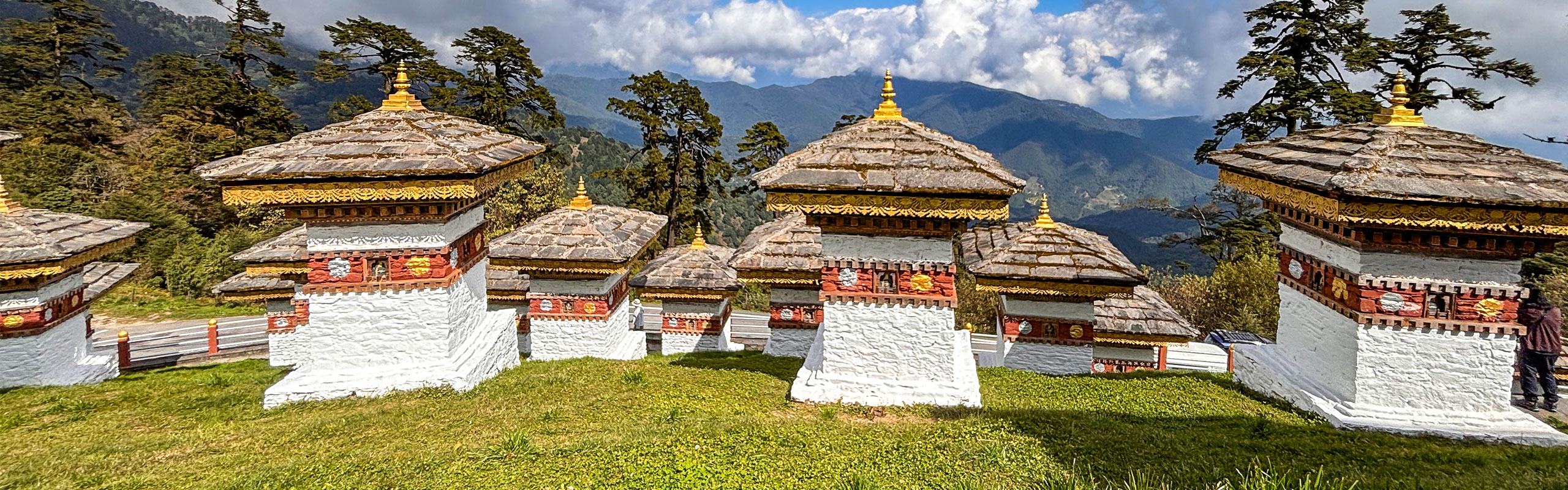
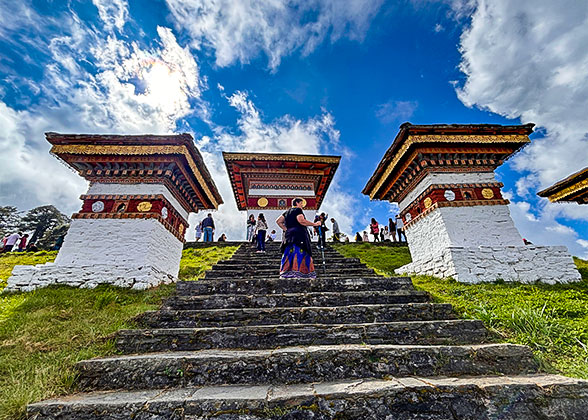
After about an hour’s ride, we’ll come across the Dochula Pass, an ideal spot to update your phone’s lock screen with stunning photos of the snow-covered Eastern Himalayas. Crowning the pass are 108 stupas, standing in circular formations to guard fallen soldiers in a rebellion. Each stupa is built according to Tibetan Buddhist rituals: grains and bronze vessels filled with ghee are buried at its base, and clay deities and scriptures are added during construction to imbue it with spiritual significance. Ultimately, prayer flags are raised to pray for world peace and the safety of all passersby.
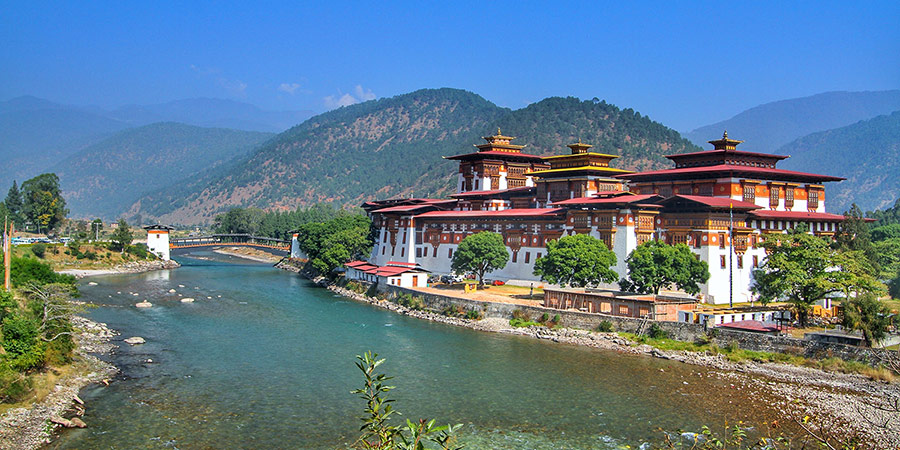
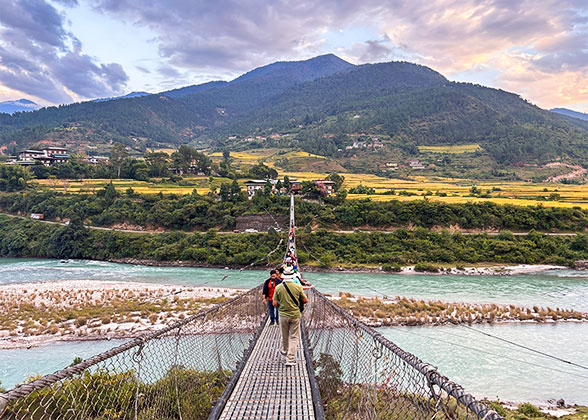
Continue driving for 1.5 hours until we reach Punakha, where your guide will lead you around the Punakha Dzong. Built in 1637 at the river confluence, it boasts Bhutanese architecture. Its soaring white walls are coated in lime plaster, which resists moisture and insects and symbolizes pure devotion. Steep wooden stairs lead us inside; their design is not just for defense but also offers a spiritual gateway from the chaos outside to a sacred site. Appreciate exquisite Buddhist murals and then cross the nearby suspension bridge, where growing rice, vegetables, and fruits showcase the vitality of this subtropical valley. A little sway will add an extra thrill to your experience! Finally, your guide and driver will escort you to your hotel.
Meals: Breakfast, Lunch, Dinner
Accommodation: Hotel Zangto Pelri, Punakha (3 stars) or similar
Stupas in Honor of 108 Bhutanese Soldiers, Dochula Pass
Punakha Dzong
Day 4: Punakha - Chimi Lhakhang - Phobjikha Valley
After breakfast, your guide and driver will escort you on a 30-minute drive to Chimi Lhakhang, commonly known as the ‘Fertility Temple’. It’s said that childless couples who visit are significantly more likely to conceive. Since cars cannot access the site directly, your guide will accompany you on a 30-to 40-minute hike from the parking lot. Along the way, giant phallus patterns decorate the houses - some wrapped in ribbons, some entwined with dragons, and some with eyes - all depicted in strong, upright forms. This is because, in local folklore, their patron saint—Drukpa Kunley, who built the temple—subdued a demon that had prevented locals from reproducing with his phallus. Stepping inside the temple, you will find an album filled with baby photos and thank-you letters from couples who successfully conceived after visiting.
Then, we’ll make our way to Phobjikha Valley via Wangdue Phodrang and Pelela Pass (3400m/11,155ft.). After 2.5 hours, check into your hotel and rest for the following journey.
Meals: Breakfast, Lunch, Dinner
Accommodation: Gakiling Resort, Phobjikha (3 stars) or similar
Surroundings of Punakha Suspension Bridge
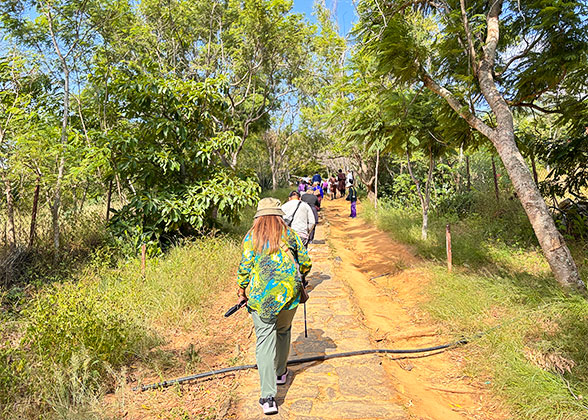
Our Guests Hiking to Chimi Lhakhang
Day 5: Phobjikha Valley: Nature Trail Hike, Black-necked Crane Center, Gangtey School & Monastery
You’ll have a full day to explore Phobjikha Valley with your guide and driver. In this bowl-shaped canyon carved by glaciers, meandering streams slice through vast grasslands and bamboo groves, forming natural wetlands that shelter rare wildlife like black-necked cranes, muntjac deer, and Himalayan black bears.
Let’s kick off with a 45-minute gentle hike along the Gangtey Nature Trail! Make the best of this goldmine for photos and maybe spot grazing cattle along the way. Afterwards, we’ll visit the Black-necked Crane Information Center. In Bhutanese culture, these graceful birds are considered ‘divine’ and believed to bring blessings of happiness and peace, making them highly cherished by locals. If visiting between October and March, you can use the center’s high-powered monocular telescopes to watch these silvery-gray birds forage and dance in the wetlands. Visiting outside migration season? Informative documentaries will offer insights into their behaviors and migration routes.
Later, enjoy leisure time with the kids at Gangtey Primary School. They study both academic subjects like English, Geography, and Math, along with Buddhist courses. Each morning begins with prayers to the Bodhisattva of Wisdom and tranquil meditation.
Then, we’ll visit Gangtey Monastery. Local lore says that black-necked cranes circle the monastery three times upon arrival and departure from the valley as a sign of reverence. To strengthen this religious bond, villagers depict the cranes in Buddhist murals and celebrate the Black-necked Crane Festival on November 11th. During the festival, children dress as birds and dance alongside monks performing cham masked dances.
After exploring local villages and farmhouses to experience authentic Bhutanese life for the rest of the day, your guide and driver will escort you back to your hotel.
Meals: Breakfast, Lunch, Dinner
Accommodation: Gakiling Resort, Phobjikha (3 stars) or similar
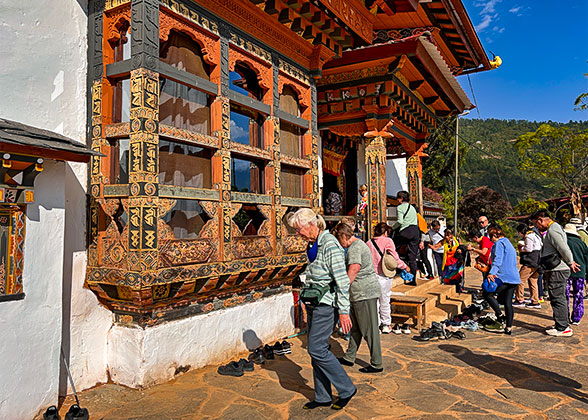
Serene Chimi Lhakhang Nestled in Valley
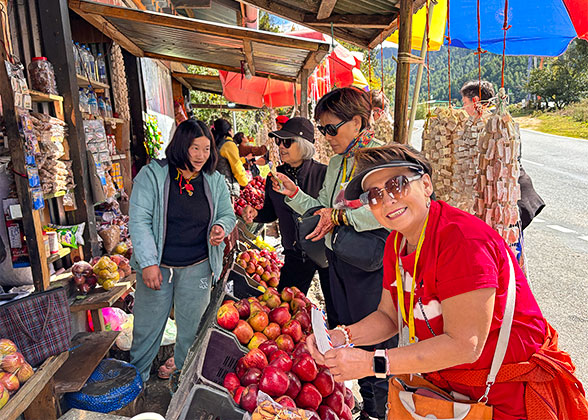
Punakha Local Market
Day 6: Phobjikha Valley - Dochula Pass - Paro: Visit Rinpung Dzong & Ta Dzong (National Museum)
In the morning, your guide and driver will greet you at your hotel for a 5-hour drive back to Paro via Dochula Pass.
Once there, let’s visit Rinpung Dzong. Cross the traditional wooden cantilever bridge and explore clay statues, stupa models, and a ceiling painted with nine mandalas that unveil the cosmic order of Tibetan Buddhism in the central tower’s main hall. While photography isn’t allowed inside the hall, you’ll still be satisfied whether shooting the dzong’s panoramic views from afar or capturing the Paro Valley from the outer corridors.
Next, we’ll ascend the hill to Ta Dzong, the National Museum of Bhutan. Uncover the country’s multi-layered history through over 3,000 artifacts spanning a millennium—ranging from religious scriptures and production tools to vintage stamps. Your guide’s detailed explanations won’t make it a cursory look. As the day concludes, your guide and driver will escort you back to your hotel.
Meals: Breakfast, Lunch, Dinner
Accommodation: Hotel Olathang, Paro (3 stars) or similar
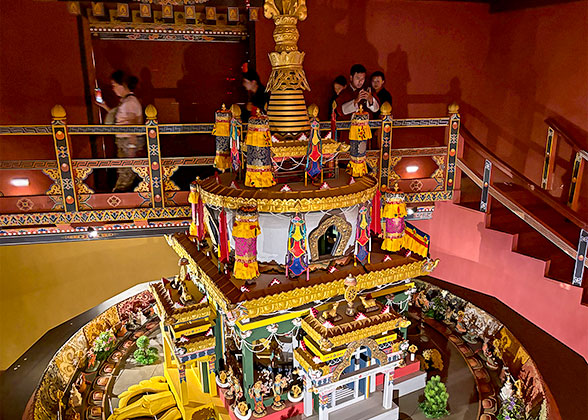
Religious Items in Ta Dzong, Paro
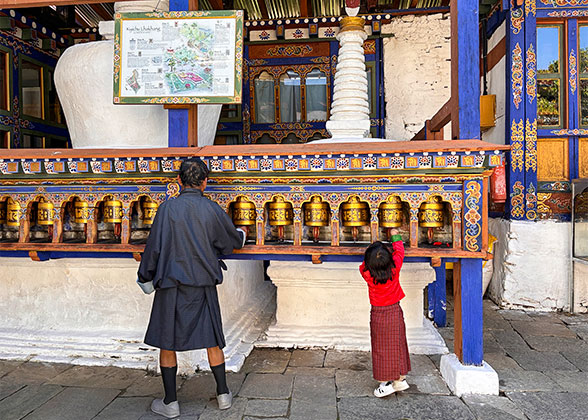
Prayer Wheels in Kyichu Lhakhang Temple
Day 7: Paro Tour: Hike to Tiger’s Nest Monastery, Visit Kyichu Lhakhang & Old Town
★ Tiger’s Nest Monastery: An Ultimate Sacred Site for Photographers’ Dream
After breakfast, gear up for the hike to Tiger’s Nest Monastery accompanied by your guide! Perched precariously on a cliff at 3,120m (10,236 ft.), this national icon resembles a ferocious tiger in its nest, offering multiple photo opportunities on the 7-8 km (4-5 mi) round-trip trail. Hike about 1 hour to the midway café, where you can refuel and enjoy an eye-level view from the observation deck. Seeing how it attaches to the cliff promises a pumping heart! Once reaching the stone-walled vantage point after another 45-to 60-minute climb, you’ll be rewarded with the temple’s best flank silhouette. In the final stretch, the waterfall offers a perfect spot to frame the rushing waters, jagged cliffs, and sanctuary in the clouds from a low angle. When we’re done, your guide will unlock the secrets of Buddhist murals inside the monastery, and then lead you along a lesser-known trail to the opposite ridge for a bird’s-eye view with fewer visitors. Pro Tips: 1.Wear your high-traction hiking shoes to handle heavy morning dew on steep paths, and strap on a brace if you have sensitive knees. 2.To prevent altitude sickness, please inhale through your nose and blast it out through your mouth. Resting after every 50 to 100 steps and drinking cola will also be helpful. 3.Want to save energy for the second half of the climb? Perhaps rent a guided horse at the base to carry you halfway up and complete the final summit by yourself. For reference, the 1-hour ride costs USD 40, payable on-site at your own expense if interested.
In the afternoon, we’ll visit Kyichu Lhakhang Temple to enjoy the peaceful ambiance under its renowned orange trees, believed to bloom and bear fruit year-round. Then, stroll around Paro Old Town to cap off the day. You may unveil the contemporary aspect of this peace-reputed kingdom, with young locals socializing at cozy cafes and hanging out in pubs.
Finally, your guide and driver will whisk you back to your hotel.
Meals: Breakfast, Lunch, Dinner
Accommodation: Hotel Olathang, Paro (3 stars) or similar
Day 8: Paro Airport See-off
Your trip will end with a private hotel-to-airport escort service by your guide and driver. Enjoy your homeward flight!
If you have a longer vacation, consider extending your trip to the adjacent countries like Nepal, Bangladesh, or China. Feel free to contact our travel consultants for a customized itinerary!
Meals: Breakfast
Expand All
This trip can be tailored to match your dates and interests!
Tour Prices
Christmas & 2027 Specials: 12% off - Book before Oct 31, 2026