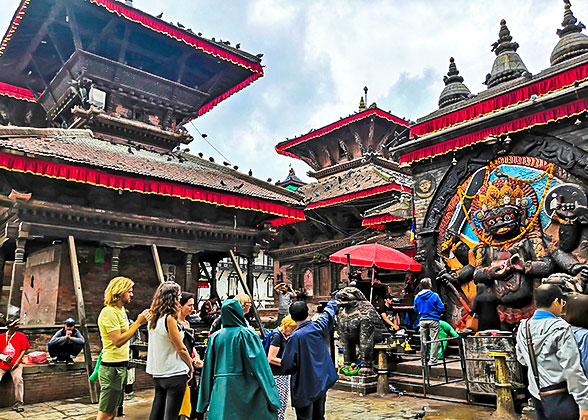
Day 1: Arrival in Kathmandu of Nepal, Airport Pick-up
Welcome to Nepal’s capital, Kathmandu! When you arrive at the airport, your private guide and driver will be waiting for you at the exit, and escort you to your hotel in about 20 minutes. The rest of the day is free for you. If you wish to experience the local atmosphere, you may hail a ride to Thamel Street via InDrive app by yourself. There are a variety of shopping and dining options, as well as money exchangers. Please pay attention to your safety if you are alone.
► Notes about Your China Visa & Tibet Travel Permit
1. After your arrival in Kathmandu, we’ll assist you in applying for your China Visa. Please be aware that the local Chinese Embassy opens only from 9-12 a.m. on Monday, Wednesday and Friday. Therefore, we suggest you arrive at least two days earlier or stay longer to have enough time for the application.
2. Please provide us with a copy of your valid passport in advance so that we can apply for your China Visa Invitation Letter and Tibet Travel Permit as early as possible.
3. Before we go to the Nepalese border, your guide will remind you to take your passport, visa and the copy of your Travel Permit. After entering, you’ll get the original of your permit, which should be kept with you during your whole stay in Tibet.
Accommodation: Hotel Himalaya Kathmandu (4 stars) or similar
|
Day 2: Visit Patan & Kathmandu Durbar Squares, Watch a Cultural Dinner Show
In the morning, your guide and driver will meet you at your hotel to start your Kathmandu exploration! The first stop is the Patan Durbar Square. On this rectangular palace square, we’ll see some of the iconic ancient buildings. Standing before the sandstone-built Krishna Temple, you can admire its 21 gilded pinnacles and 21 stone steps, and feel the color contrast between its dark gray facade and the surrounding reddish-brown wooden structures. Walk to the Golden Temple, marvel at its golden eaves, lintels and walls, and understand the religious inclusiveness in Nepal. Then, let’s continue to the bustling Kathmandu Durbar Square. Follow your guide to visit the grandest building on the square, the Taleju Temple. Taleju is a highly-respected Hindu goddess in Nepal. People built the Kumari Temple to enshrine her avatar in the secular world, known as the “living goddess”. If it’s during late September and October, when the whole country is celebrating the Dashain Festival, you may not only witness local sacrificial ceremonies, but also see the parading living goddess on the street. After admiring the white Swayambhunath Stupa and the panorama of Kathmandu, let’s go to a featured restaurant for a Nepalese Dinner with authentic Momo dumplings and Dhal Bhat, and watch a culture dance show while dining. After that, your guide and driver will escort you back. Meals: Breakfast, Dinner Accommodation: Hotel Himalaya Kathmandu (4 stars) or similar Kathmandu Durbar Square Patan Durbar Square
|
Day 3: Fly to Pokhara, Phewa Lake Boat Tour with Barahi Temple
This morning, your guide and driver will pick you up and accompany you to the airport for your short flight to Pokhara, the second largest city in Nepal. Upon arrival, enjoy a private car transfer to your hotel. Take a short break, and then let’s head to Phewa Lake. The vast and peaceful lake is like a natural mirror, reflecting the surrounding mountains and buildings on its surface. If the weather is clear, you may see the peak of Mt. Fishtail piercing into the clouds. We’ll take a boat on the lake, and make a stop on a small island, where there is the Barahi Temple dedicated to the Hindu goddess of power. Your lunch is arranged at a nice lakeside restaurant. Then, if time permits, your guide will accompany you to stroll around Pokhara Town and visit Buddhist monasteries and Hindu temples. After that, your guide will escort you back to your hotel. Meals: Breakfast, Lunch, Dinner Accommodation: Soaltee Westend Lakeside, Pokhara (4 stars) or similar
|
Day 4: Pokhara: Sarangkot Sunrise, World Peace Pagoda, Devi’s Fall & Mountain Museum
Today, our Pokhara adventure will start from a spectacular Sarangkot sunrise! Your guide and driver will accompany you to the viewing platform, where you can witness the Annapurna mountains of the Himalayas lightened by the golden sun. Then, go to the nearby hilltop Bindhyabasini Temple, one of Pokhara’s oldest temples, take a stroll around its peaceful garden and overlook the city. Then, we’ll escort you back to your hotel for breakfast.
Later, let’s continue to the World Peace Pagoda constructed by four countries, and head to Devi’s Fall to see the rushing water and listen to the love story about the fall. We’ll go down a spiral staircase, and explore the sacred Gupteswor Mahadev Cave under the fall with devout Hindus. Then, at the International Mountain Museum, you can learn about the ancient life of the mountain people and legends of the mysterious Yeti snowman, get to know the development of international mountaineering, and see alpine plant specimens. Around noon, we’ll have lunch at a notable restaurant in Pokhara.
In the afternoon, let’s relax by the Begnas Lake, the third largest lake in Nepal. Compared with the downtown area, it’s less touristy and more serene. Indulge yourself in the beautiful views of the snow-capped mountains and the calm lake under the blue sky. If interested, you can experience paddling or boating at your own expense. We’ll also visit the Tibetan Refuge Camp if time permits. Afterward, your guide and driver will escort you back to your hotel. Dinner is arranged at your hotel, followed by a brilliant cultural show.
Meals: Breakfast, Lunch, Dinner
Accommodation: Soaltee Westend Lakeside, Pokhara (4 stars) or similar
|
Day 5: Pokhara Visit to Mahendra Cave & Chamero Cave, Fly back to Kathmandu
This morning, your guide and driver will accompany you on a tour of the Mahendra Cave and Chamero Cave before you fly back to Kathmandu. Wear your water shoes and turn on the flashlight, and let’s explore this dark, damp underworld. Walking through the narrow spaces between the limestone formations, you may see bats hanging on the cave ceiling.
Then, after visiting the temples and monasteries nearby and having lunch, your guide and driver will escort you to Pokhara Airport for your flight back to Kathmandu. Upon arrival, enjoy a private car transfer to your hotel.
Meals: Breakfast, Lunch
Accommodation: Hotel Himalaya Kathmandu (4 stars) or similar
|
Day 6: Kathmandu: Bouddhanath Stupa, Pashupatinath Temple & Bhaktapur Durbar Square
After breakfast, your guide and driver will meet you at your hotel and accompany you to delve into the religious and cultural heritage of Kathmandu Valley. First, let’s visit the majestic Bouddhanath Stupa, the world’s largest round stupa built in the 5th century AD. However, it’s said that the giant structure was actually constructed by a poultry keeper! She begged the king for land for the stupa, but only got a buffalo hide and was asked to build the stupa on the land covered by it. Cleverly, the woman cut the buffalo hide into stripes and enclosed a large piece of land, and that’s how the stupa we see was built. Then, we’ll head to Pashupatinath Temple, next to the sacred “Ganges” of Nepal, the Bagmati River. Every day, cremation ceremonies are held here in public. Hindus believe that, death is a prelude to rebirth. When it comes to death, they have the similar optimistic, philosophical attitudes to Mexicans. Our last stop is the Bhaktapur Durbar Square. We’ll admire the buildings that were well-preserved even after earthquakes, including the Nyatapola Temple, the famous 55 Window Palace and the Golden Gate. Most of them were built with the local Dhumsi wood, whose lifespan can reach up to 3,000 years! Afterward, your guide and driver will escort you back to your hotel. Meals: Breakfast, Lunch Accommodation: Hotel Himalaya Kathmandu (4 stars) or similar Bouddhanath Stupa Bhaktapur Durbar Square
|
Day 7: Drive from Kathmandu to Gyirong Border, Enter Tibet
Today, let’s say goodbye to Nepal. Your guide and driver will pick you up from your hotel and escort you to the Rasuwagadhi - Gyirong Border. Due to the rough mountain road conditions, it generally takes 6 to 8 hours to get there. However, the picturesque landscape of the valleys, forests and rivers can ease your fatigue a bit.
After going through the immigration, you’ll enter Tibet, and meet your local guide and driver. Then, enjoy a private car transfer to your hotel in Gyirong. For the rest of the day, you may get a good rest from the long ride at your hotel, or take a leisurely walk along the nearby streets to explore the local life.
► Warm Tips:
1. Gyirong is at around 2,800 meters (9,186 ft.) above sea level, and in the following days, we’ll need to get used to much higher altitudes. So, we suggest you take precautions to prevent altitude sickness, for example, avoiding vigorous exercise, showers and alcohol, and having sufficient sleep.
2. Payment: Alipay and WeChat pay are widely used in Tibet. You can download the apps and bind your bank card beforehand. Also, you can exchange some CNY at the border.
Meals: Breakfast
Accommodation: Gyirong Hotel or similar
|
Day 8: Private Car Transfer from Gyirong to Dingri
After breakfast, your guide and driver will meet you at your hotel for your 10-hour private car transfer to Dingri, a county situated at the foot of Mt. Everest. Upon arrival, your guide will assist you with hotel check-in, and you can get relaxed for the remainder of the day.
► High Altitude Tips: The altitude of Dingri is over 4,300 meters (14,107 ft.), and please take altitude sickness medication according to your physical condition. The sunlight is strong and the temperature difference is large, so it’s recommended to use sun protection and keep warm to cope with the weather. Remember to bring your outdoor jacket and windproof down jacket even if it’s in summer.
Meals: Buffet breakfast, Lunch
Accommodation: Everest Hotel, Dingri or similar
|
Day 9: Dingri: Visit Everest Base Camp & Rongbuk Monastery
Get ready for the highlight of this itinerary, the Mt. Everest! Early in the morning, your guide and driver will pick you up from your hotel, and escort you to the Everest Base Camp in 4 hours. Since we’ll drive along bumpy gravel roads, you can take motion sickness pills just in case. The camp, located at an altitude of 5,200 meters (17,060 ft.), is the closest to the world’s highest peak that tourists can reach. From here, you can be obsessed by the unparalleled grandeur of Mt. Everest and the excitement of getting close to it, which is sure to be a once-in-a-lifetime experience. ► When Is It Most Likely to See Mt. Everest? Generally, April to May and September to October are the best time. Since the weather of this area is unpredictable, the peak of Mt. Everest is hidden in the clouds and mist for most of the year. Avoid the rainy months from July to August for better comfort and higher probability of seeing the peak. Later, we’ll visit the Rongbuk Monastery. “Rongbuk” refers to high mountains in the local language. It’s said that Padma Sambhava, the founder of Tibetan Buddhism, made spiritual practices in the cave here for 9 years, and the relics of his handprint and footprint are kept in the monastery. Standing in front of the monastery, you may see the glistening snow peak of Mt. Everest under the sun and the swaying prayer flags. Afterward, we’ll drive another 4 hours back to your hotel in Dingri. Meals: Buffet breakfast, Lunch Accommodation: Everest Hotel, Dingri or similar Everest Base Camp Local People in Tibet
|
Day 10: Dingri - Lhatse County - Sakya Monastery - Shigatse
This morning, your guide and driver will pick you up from your hotel and escort you to Shigatse, about 250 kilometers (155 mi.) away. En route, we’ll stop and visit Lhatse County and Sakya Monastery. Lhatse is praised as the “Hometown of Tibetan Knives”. In the past, each Tibetan man would carry a knife with him, and the handmade skills have a history of over a thousand years.
When we get to Sakya Monastery, you can be deeply attracted by its bright red, white and grey walls. Constructed from the 11th to 13th century AD, it’s the head monastery of the Sakya Sect of Tibetan Buddhism, with 150 branch monasteries in China, Nepal, and Bhutan. As one of the largest and oldest monasteries in Tibet, it houses over 80,000 scriptures, some of which are even written with ink with gold powder and silver powder. Discover the magnificent murals inside, and admire the main hall supported by towering old pillars.
Upon arrival in Shigatse, your guide will help you check in at your hotel.
Meals: Buffet breakfast, Lunch
Accommodation: Gasar Hotel - VIP Building, Shigatse (4 stars) or similar
|
Day 11: Visit Tashilhunpo Monastery, Private Car Transfer to Gyantse
After breakfast, your guide and driver will meet you at your hotel and accompany you on a tour of Shigatse, the second largest city in Tibet.
First, let’s go to Tashilhunpo Monastery. It was the religious and administrative center of the Rear Tibet in ancient times, equivalent to the Potala Palace in the Front Tibet. Entering the monastery, you can see the old buildings with bright colors and touch the rough texture of rock. The windows are decorated with white cloth like the hems of dresses, adding an exquisite sense of beauty. See the monks in distinctive yellow robes? They are monks of Gelug sect, also known as the “Yellow Hats”. We won’t miss the tomb stupa and the gigantic statue of the Maitreya Buddha in the monastery.
Then, let’s head south to the New Palace of Panchen, surrounded by old trees and built in 1954 AD. It serves as the summer palace of Panchen Lamas, the religious leaders highly respected in Tibet. Besides admiring the fine murals that cover the palace walls, you can see a dog specimen - the 10th Panchen Lama’s lovely dog who passed away shortly after his owner’s death.
After lunch, enjoy a private car transfer to Gyantse in 3 hours. Your guide will assist you with hotel check-in.
Meals: Buffet breakfast, Lunch
Accommodation: Gyantse Hotel (3 stars) or similar
|
Day 12: Gyantse Palkhor Monastery - Yamdrok Yumtso Lake - Karola Glacier - Lhasa
After breakfast, your guide and driver will meet you at your hotel and escort you to visit Palkhor Monastery. Generally, there are different monasteries for different Tibetan Buddhism sects in Tibet, but in this monastery, you can see monks from three sects! Also, in its history of over 600 years, there was not a single dispute or conflict, and various medieval murals are well-kept here. Let’s admire the 9-tiered “Ten Thousand Buddha Pagoda”, which blends with the Nepali style. ► Tip: Please ask for permissions before taking photos. Avoid using flash which may accelerate the ageing of murals. Then, after taking a stroll along Gyantse Old Street, let’s proceed to Lhasa by a comfortable private vehicle for about 6 hours. On the way, we’ll stop at Yamdrok Yumtso Lake, one of Tibet’s four holy lakes, as well as Karola Glacier. The azure lake stretches from the verdant grasslands to the mountains in the distance, frequently visited by black-headed gulls and flocks of sheep. Let the beautiful view relieve your fatigue. And in front of the chilly glacier, marvel at the surreal scenery and the creativity of the nature. Upon arrival in Lhasa, your guide will help you check into your hotel. Meals: Buffet breakfast, Lunch Accommodation: Tashipozhang Hotel, Lhasa (4 stars) or similar
|
Day 13: Lhasa: Tibet Museum, Sera Monastery & Norbulingka Park
In the morning, your guide and driver will greet you at your hotel and accompany you on a tour of Lhasa, the holy land of Tibetan Buddhism.
Let’s start from the Tibet Museum. Here, you can find the ethnic costumes and tools from different regions in Tibet, and get to know the past and present of this snow-covered plateau with your guide’s explanation. See the two-body pottery jar from 4,000 years ago, and the 15-kilogram (33 lb.) armor made from yak hide. At the special Memorial Hall for Emancipation of One Million Serfs, you can unveil the dark history of Tibet’s old times through the cruel dharma instruments and the historical photos.
In the afternoon, we’ll visit Sera Monastery, one of Tibet’s three main Gelug monasteries. It’s said that in 1419 AD when it was constructed, wild roses were in full bloom everywhere. That’s why the monastery was named “sera”, meaning “wild roses”. Walking among the mazy alleys under the high walls, you may encounter monks in red robes and Tibetans with their kids. If time permits, your guide will accompany you to watch a passionate debate in the courtyard. Each Gelug monk has to master the ability of debating Buddhist scriptures, and those who know the scriptures very well and have good critical thinking skills can gain recognition from the monastery and society.
Our last stop is the Norbulingka Park, a Tibetan-style fine garden. It used to be the summer palace of the Dalai Lamas, and is now a part of the local life. Besides strolling around the old trees, you can admire the murals depicting Tibet’s history. After that, your guide and driver will escort you back to your hotel.
Meals: Buffet breakfast, Lunch
Accommodation: Tashipozhang Hotel, Lhasa (4 stars) or similar
|
Day 14: Lhasa: Potala Palace, Jokhang Temple, Barkhor Street with Tea Tasting
After breakfast, your guide and driver will pick you up from your hotel and start today’s Lhasa exploration. We’ll first go on a pilgrimage tour to the world-renowned Potala Palace, a UNESCO World Heritage Site. No matter where you are in Lhasa, you can see this grand palace complex on the top of the Red Hill. As we get close to it, prepare to be awestruck by the thick stone walls and steep steps, which bear witness to the 1,300 years of Potala Palace’s history. Follow your guide to explore the luxurious palaces, and appreciate the tomb stupas of the Dalai Lamas, especially the one of the Fifth Dalai Lama, where there are tons of gold and tens of thousands of precious stones including a pearl produced inside an elephant’s body. Later, let’s proceed to visit the Jokhang Temple located in the center of the Barkhor Street. You may find the architectural style familiar. According to records, the Newari craftsmen from Nepal also participated in the construction of the temple. Upon entering, you may notice the pilgrims crawling and kowtowing, which is because of the life-size statue of 12-year-old Shakyamuni enshrined here. When you see the holy statue for yourself, you may think it’s a bit “chubby”. This is due to Tibet’s special maintenance method of the Buddha statue - plating gold on the statue regularly. Next, enjoy your time on the bustling Barkhor Street, experiencing the local atmosphere and discovering Tibetan handicrafts. At last, we’ll head to a Tibetan teahouse to savor authentic sweet tea and Tibetan noodles. After that, your guide and driver will escort you back to your hotel. Meals: Buffet breakfast, Lunch Accommodation: Tashipozhang Hotel, Lhasa (4 stars) or similar
|
Day 15: Departure from Lhasa, Airport See-off
This is the last day of your tour. Your guide and driver will escort you to the airport according to your departure flight schedule and see you off there.
► Friendly Tips:
1. Since there are few international flights from Lhasa, you can choose other cities in China, such as Beijing, Xi’an, Chengdu, or Shanghai, as transit points.
2. The sequence of this itinerary can be reversed based on your needs, and you can take an overland journey or take a direct flight from Lhasa to Kathmandu.
Meals: Breakfast
|