Trip Planning FAQs
What are Zimbabwe’s best safari parks?
The must-see is sure the Victoria Falls National Park featuring the world’s three great waterfalls, while other parks worth visiting include Hwange, Matobo, Mana Pools, Matusadona Mountain, Nyanga, and Gonarezhou.
Hwange National Park is the largest, owning one of the world’s largest elephant herds, other four of the ‘Big Five’ animals of lions, leopards, rhinos, and buffaloes, as well as rare animals like African Wild Dogs, thus regarded as the most suitable one to make a regular safari.
Matobo National Park is a good place to spot endangered white rhinos that seldomly seen in other parks. At the same time, it offers a unique cultural experience of appreciating ancient rock paintings and distinctive landforms of balancing rocks.
Mana Pools National Park is known for walking safaris and canoeing experiences, thereby closer observation and interaction are allowed. In the primitive wetlands and by the side of Zambezi River, you can see flocks of birds and Nile crocodiles besides those frequently seen African animals.
What’s the best time to visit Zimbabwe?
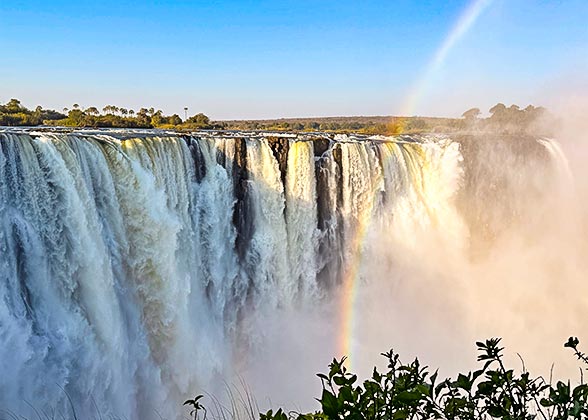
Dry season during May to October is widely recognized as the best time since the weather is favorable for Victoria Falls and exciting safaris. Low rainfall and abundant sunshine make the waterfalls largely visible and rainbows frequent. Moreover, wild animals tend to gather around the water sources during this period, so it’s easier to find them.
Meanwhile, belonging to the subtropical climate zone, Zimbabwe actually has a pleasant weather for sightseeing in the whole year. Taking its capital Harare as an example, even in the hottest October, the daily highs fluctuate around 32°C (90°F) and lows around 15°C (59°F), while in the coldest July, the high temperatures still hover around 25°C (77°F) and low ones around 10°C (50°F).
Is Zimbabwe safe to travel?
In most tourist areas like Victoria Falls as well as large cities like Harare and Bulawayo, you don’t need to worry much about personal safety. Terrible affairs such as gun robbery and house breaking rarely happen. You can rest assured when taking our private Zimbabwe tours. However, certain caution is still needed to prevent stealing in crowded situations. Besides, it is not suggested to visit suburbs and slum areas like Mbare alone or hang out alone at night.
In terms of infectious diseases, the risk is relatively low overall, but it remains necessary to take preventive measures especially if your travel schedule encounters rainy season from November to April when mosquitoes thrive or involves rural and low-altitude areas like Zambezi Valley. You can wear long-sleeved clothes and use mosquito repellent to further reduce the risk. Vaccinations for malaria, typhoid, and rabies are advised for safari visitors based on their own immune conditions.
Is better to visit Victoria Falls from Zimbabwe or Zambia?
Frankly, Zimbabwe is a better choice to admire Victoria Falls since you can see more waterfalls in higher water flow. About 70% of Victoria Falls are visible on the Zimbabwean side including the magnificent Main Falls and appealing Horseshoe Falls. Even in the dry season, most falls still have considerable water flow and prevailing mist, let alone frequent rainbows. While Zambia owns the Eastern Cataract only, it charges only USD 20 for entrance fee, less than half of the Zimbabwean side. The only advantage is that it provides an exclusive and thrilling activity in dry season when the Devil’s Pool is open. If you have enough time, it is suggested to visit Victoria Falls first from Zimbabwe and then enter Zambia through the Victoria Falls Railway Bridge to enjoy a full experience.
How is Zimbabwe’s electricity supply?
In general, the electricity supply in Zimbabwe is not that stable, but it is of regional variations. In urban areas like Harare, Bulawayo, and Victoria Falls, power failures might take place occasionally and last for several hours each time. But in rural and mountainous areas like Nyanga, the situation could be worse, with higher frequency and longer duration. The power may fail to be supplied for the whole night. Therefore, it matters a lot to charge your phone whenever it’s possible and prepare a power bank just in case.
How is Zimbabwe’s Internet?
Internet in cities could support common services like phone calls, texting and posting provided that you have a local SIM card; from time to time, internet lags occur when watching videos. However, when coming to wildlife reserves like Hwange National Park, the internet might lose connection frequently or even have no signal at all, so you’d better download maps and other useful materials in advance.
For your information, Econet is the largest mobile operators in Zimbabwe and covers most well-known attractions. It costs about USD 10 to get data of 5GB valid for 30 days, a little expensive but suitable for independent travelers who need to use car-hailing apps and online maps frequently. While for visitors in guided tours, the cheaper Netone is a good choice too, which costs about USD 8 to get the same data bundles. You can buy SIM cards at the airport or urban retail stores and the latter usually provides more various packages.
Is tipping customary in Zimbabwe?
Influenced by colonization, tipping is common here, but it is by no means mandatory. Just tip when you receive satisfying services and want to express your appreciation: usually 10-15% in a restaurant, USD 5-10 for your safari guide per game drive, and USD 1-5 for lodge staff. You might be asked to give unnecessary tips at the customs and it’s ok to refuse if you feel offended or find it unreasonable. The same is true for other situations.



 4-5 Days
 Zimbabwe